Trump launching campaign to end HIV epidemic in US by 2030

Advertisement

Advertise with us

WASHINGTON - President Donald Trump is launching a campaign to end the HIV epidemic in the United States by 2030, targeting areas where new infections happen and getting highly effective drugs to people at risk.

Read this article for free:


or

Already have an account? Log in here »

To continue reading, please subscribe:

Subscribe and receive a limited-edition Free Press branded hat or tote.

Digital Subscription

One year of digital access for only $205*

  • Enjoy unlimited reading on winnipegfreepress.com
  • Read the E-Edition, our digital replica newspaper
  • Access News Break, our award-winning app
  • Play interactive puzzles

*First annual payment billed as $205.00 + GST for one year. This annual subscription will automatically renew at $233.00 + GST every 52 weeks (10% off the regular annual price of $259.35). Offer available to new and qualified returning subscribers only. Cancel any time.

To continue reading, please subscribe:

Add Free Press access to your Brandon Sun subscription for only an additional

$1 for the first 4 weeks*

  • Enjoy unlimited reading on winnipegfreepress.com
  • Read the E-Edition, our digital replica newspaper
  • Access News Break, our award-winning app
  • Play interactive puzzles
Start now

*Your next Brandon Sun subscription payment will increase by $1.00 and you will be charged $17.95 plus GST for four weeks. After four weeks, your payment will increase to $24.95 plus GST every four weeks.

Hey there, time traveller!
This article was published 06/02/2019 (2748 days ago), so information in it may no longer be current.

WASHINGTON – President Donald Trump is launching a campaign to end the HIV epidemic in the United States by 2030, targeting areas where new infections happen and getting highly effective drugs to people at risk.

His move is being greeted with a mix of skepticism and cautious optimism by anti-AIDS activists. State and local health officials are warning the administration not to take money from other programs to finance the initiative, whose budget has not been revealed.

Briefing reporters ahead of Trump’s State of the Union speech , Health and Human Services Secretary Alex Azar and senior public health officials said the campaign relies on fresh insights into where about half of new HIV cases occur — 48 out of some 3,000 U.S. counties, and Washington, D.C., Puerto Rico and seven states with at-risk rural residents.

President Donald Trump talks to Supreme Court Chief Justice John Roberts while leaving the House chamber after giving his State of the Union address to a joint session of Congress, Tuesday, Feb. 5, 2019 at the Capitol in Washington. (Doug Mills/The New York Times via AP, Pool)

“We’ve never had that kind of ‘This is the target,'” said Dr. Anthony Fauci, the government’s pre-eminent AIDS warrior and head of the National Institute of Allergy and Infectious Diseases. The government has “been trying to address HIV, but never in such a focused way,” he said.

HIV is the virus that causes AIDS.

“Together, we will defeat AIDS in America and beyond,” Trump said in his speech. While he pledged funding in his upcoming budget, he did not say how much.

That raised a flag for state officials.

“This effort cannot move existing resources from one public health program and repurpose them to end HIV without serious consequences to our public health system,” Michael Fraser, CEO of the Association of State and Territorial Health Officials, said in a statement.

Anti-AIDS activists said they’re ready to work with the White House, but wary because of Trump’s previous efforts to slash Medicaid health care for low-income people, and his administration’s ongoing drive to roll back newly won acceptance for LGBTQ people.

“To date, this administration’s actions speak louder than words and have moved us in the wrong direction,” said AIDS United, which funds and advocates policies to combat AIDS.

The ONE Campaign, the global anti-poverty group co-founded by rock singer Bono, called Trump’s pledge a “welcome sign,” but pointed out that the administration has also proposed deep cuts in U.S. funding for efforts to battle HIV in Africa.

“While we might have policy differences with the president and his administration, this initiative, if properly implemented and resourced, can go down in history as one of the most significant achievements of his presidency,” Michael Ruppal, executive director of the AIDS Institute, said in a statement.

While Azar said significant new funding would be included in the president’s budget, he also emphasized that the campaign is about making more efficient use of existing programs like the Ryan White HIV/AIDS Program, which provides medical care and support services.

“The tools are there,” Azar said. “This is about execution.”

Today’s HIV treatments work so well they not only can give people with the AIDS virus a near-normal life expectancy, they offer a double whammy — making those patients less likely to infect other people.

At the same time, a longtime HIV medication named Truvada can prevent infection if taken daily by healthy people who are at risk from their infected sexual partners, a strategy known as “pre-exposure prophylaxis” or PreP.

The people most at risk include men who have sex with men, minorities, particularly African-Americans, and American Indians/Alaska Natives. Azar said the administration’s campaign would rely on public health workers to identify people at risk for HIV/AIDS, get them tested, and on medication.

The 48 counties HHS is focusing on are mainly metro areas. The states are Alabama, Arkansas, Kentucky, Mississippi, Missouri, Oklahoma and South Carolina.

Researchers noted that will require working with groups that often shun health services, including injectable drug users.

“Trust is a crucial weapon in our fight to eradicate HIV and it’s necessary to encourage people from marginalized groups to get tested,” said Dr. Albert Wu, an HIV researcher at Johns Hopkins University.

The initial goal is to reduce new HIV infections by 75 per cent in five years.

There are about 40,000 new cases of HIV infections a year in the U.S. That’s a dramatic reduction from the crisis years of the AIDS epidemic, but progress has stalled. More than 1 million Americans live with the disease.

William McColl of AIDS United said the Trump administration’s goal is “very doable,” based on currently available technology and trends.

“I think the HIV community would work with the administration on this issue if they’re serious, but it’s also going to take real action, including possibly regulatory and legislative changes to achieve the goal,” said McColl.

Azar said the idea for the new push came from within the ranks of HHS, building on progress made over the last 30 years under administrations of both parties.

“There was a recognition that we were facing a unique and historic moment where all the strands were coming together,” said Azar. They took the idea to Trump, who “is personally invested in this,” said Azar.

In recent years a number of health organizations, including the United Nations, have called for co-ordinated steps to end the HIV epidemic by 2030.

Trump’s CDC director, Dr. Robert Redfield, told agency employees last March that it would possible to end the AIDS epidemic in less than seven years.

___

Associated Press writers Matthew Perrone and Lauran Neergaard contributed to this report.

Report Error Submit a Tip

More Stories

Development turning long-vacant gas station in Selkirk into commercial hub

By Tiago Resko 2 minute read Preview

Development turning long-vacant gas station in Selkirk into commercial hub

By Tiago Resko 2 minute read Thursday, Aug. 13, 2026

A plot of land that has sat vacant in Selkirk for 30 years is being redeveloped to host new businesses in the heart of the city.

The former gas station site on Main Street — between Rosser and Pacific avenues — will be turned into a commercial hub that will be home to six local businesses, and will be a big stepping stone for economic growth in Selkirk, Mayor Larry Johannson said Thursday.

“For decades this site has been a reminder of what once was. Today, it represents what is possible when investors see the potential of our community and choose to be a part of its future,” he said in a news release announcing the project and Thursday’s groundbreaking.

“This development reflects confidence in Selkirk, our economy and the direction we are heading.”

Read
Thursday, Aug. 13, 2026

Men’s recovery home dedicated to ‘homeless hero’ Faron Hall’s memory

Scott Billeck 14 minute read Preview

Men’s recovery home dedicated to ‘homeless hero’ Faron Hall’s memory

Scott Billeck 14 minute read Yesterday at 12:30 PM CDT

Faron Hall never got the chance to begin recovery. Once heralded as Winnipeg’s “homeless hero” after twice plunging into the Red River to save strangers from drowning, Hall told St. Boniface Street Links executive director Marion Willis shortly before his death in 2014 that he wanted help for his alcoholism.

Read
Yesterday at 12:30 PM CDT

‘Disrespectful’: residents frustrated after Wyatt arrives hour late to committee meeting

Joyanne Pursaga 3 minute read Preview

‘Disrespectful’: residents frustrated after Wyatt arrives hour late to committee meeting

Joyanne Pursaga 3 minute read Updated: Yesterday at 1:00 PM CDT

Several Winnipeggers attending a city development hearing on Thursday expressed frustration that one councillor arrived about an hour late, delaying the matter from being heard.

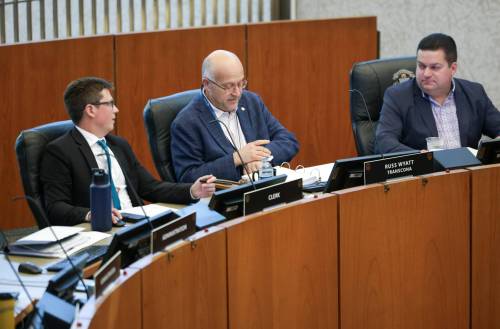
Coun. Russ Wyatt, who continues to attend city hall while facing criminal charges, began participating in the 9:30 a.m. East Kildonan-Transcona community committee meeting at 10:35 a.m.

A resident who hoped to speak at the meeting about a development plan in south Transcona noted the tardiness led the committee to bump the topic down on its agenda, while dozens waited to speak on it.

Christina Pyra eventually opted to leave city hall instead of waiting for her turn to make a presentation, to avoid missing a work commitment.

Read
Updated: Yesterday at 1:00 PM CDT

A Life's Story: Woman fought for better outcomes for others amid cancer fight

Janine LeGal 7 minute read Preview

A Life's Story: Woman fought for better outcomes for others amid cancer fight

Janine LeGal 7 minute read 3:00 AM CDT

Catherine Mary Burke was strong and motivated in ways many of us could never imagine.

She was known for fighting the good fight, and she fought as hard as she could for as long as she could. But something set her apart. Even when it was too late for her, she insisted cancer survival rates had to be better for other women. And they are today because of her fierce determination.

Burke died on Nov. 29, 2025, at age 67 after courageously facing breast cancer for more than a decade.

“Cathy was born happy,” said her husband, Patrick Burke. “She was a glass-half-full person. What a gift this attitude was to me and the boys. She never once said ‘Why me?’ or complained. She was just so happy to be alive.

Read
3:00 AM CDT

Big Loser’s latest a winning mix of country, folk

Ben Waldman 5 minute read Preview

Big Loser’s latest a winning mix of country, folk

Ben Waldman 5 minute read 6:00 AM CDT

The yellow trucker hat for sale on Facebook Marketplace said “Selkirk Lumber,” so Adam Wayne Brown knew he had to hammer home a deal.

Like the other millennial members of Winnipeg folk-country band Big Loser, the bassist has an affinity for the nostalgic, taking every opportunity — through music, through lyrics and through wardrobe — to recall the unique circumstances of growing up in a changing Interlake.

“I remember the matte yellow trucks driving around — the lumber trucks — and so I’ve had this strange memory of something disappearing from my youth and then persisting,” says Brown, who, like the band’s frontman Alex Paradoski, moved to Winnipeg more than a decade ago.

“I have a photo of the Lockport Bridge in my dining room,” chimes in Paradoski, whose first job as a teenager was bunning wieners and chopping fries at Skinner’s, a drive-in mainstay since 1929 along Highway 44.

Read
6:00 AM CDT

August in the kitchen garden

Colleen Zacharias 7 minute read Preview

August in the kitchen garden

Colleen Zacharias 7 minute read 3:00 AM CDT

Lynne Hermiston is passionate about growing her own food. Her backyard food garden in south Winnipeg is an amazing example of the abundance and diversity of food that can be grown in a relatively small space. But it’s also a prime example of how a zest for learning innovative methods can make food gardening more fun.

Hermiston’s backyard is approximately 10 metres wide and 15 metres deep. The growing area consisting of raised beds and a couple of in-ground beds between her deck and back fence is about nine metres deep. There is not a single blade of turf grass in sight. The design for this attractive and productive space was created by Classic Landscaping four years ago. A series of raised wooden beds mulched with straw are neatly arranged on a light grey, slate-like surface. An inviting centre arbor acts as a focal point and supports climbing plants. The square-shaped raised-bed area receives eight to nine hours of sun daily. It is flanked on one side by a long, linear-shaped bed, planted with flowering perennials that attract and support pollinators.

The food plants Hermiston is growing this summer include tomatoes, cucumbers, squash, beets, chickpeas, beans, onions, sweet potatoes, horseradish, garlic, peppers, carrots, pumpkin and cauliflower. She is growing Chinese Pink celery, an heirloom variety with bubblegum-pink stems, for the first time, as well as eggplant.

She also grows salad greens and herbs, which have made delicious additions to her summer recipes this year. Only a few harvests remain of the spinach she planted. But, compared to last year’s growing season, some food plants are taking their time, Hermiston says.

Read
3:00 AM CDT