US begins organ transplants from living donors who have HIV

Advertisement

Advertise with us

WASHINGTON - Surgeons in Baltimore have performed what's thought to be the world's first kidney transplant from a living donor with HIV, a milestone for people with the AIDS virus — and one that could free up space on the transplant waiting list for everyone.

Read this article for free:


or

Already have an account? Log in here »

To continue reading, please subscribe:

Subscribe and receive a limited-edition Free Press branded hat or tote.

Digital Subscription

One year of digital access for only $205*

  • Enjoy unlimited reading on winnipegfreepress.com
  • Read the E-Edition, our digital replica newspaper
  • Access News Break, our award-winning app
  • Play interactive puzzles

*First annual payment billed as $205.00 + GST for one year. This annual subscription will automatically renew at $233.00 + GST every 52 weeks (10% off the regular annual price of $259.35). Offer available to new and qualified returning subscribers only. Cancel any time.

To continue reading, please subscribe:

Add Free Press access to your Brandon Sun subscription for only an additional

$1 for the first 4 weeks*

  • Enjoy unlimited reading on winnipegfreepress.com
  • Read the E-Edition, our digital replica newspaper
  • Access News Break, our award-winning app
  • Play interactive puzzles
Start now

*Your next Brandon Sun subscription payment will increase by $1.00 and you will be charged $17.95 plus GST for four weeks. After four weeks, your payment will increase to $24.95 plus GST every four weeks.

Hey there, time traveller!
This article was published 28/03/2019 (2711 days ago), so information in it may no longer be current.

WASHINGTON – Surgeons in Baltimore have performed what’s thought to be the world’s first kidney transplant from a living donor with HIV, a milestone for people with the AIDS virus — and one that could free up space on the transplant waiting list for everyone.

Nina Martinez of Atlanta travelled to Johns Hopkins University to donate a kidney to an HIV-positive stranger, saying she “wanted to make a difference in somebody else’s life” and counter the stigma that too often still surrounds HIV infection.

Many people think “somebody with HIV is supposed to look sick,” Martinez, 35, told The Associated Press before the operation. “It’s a powerful statement to show somebody like myself who’s healthy enough to be a living organ donor.”
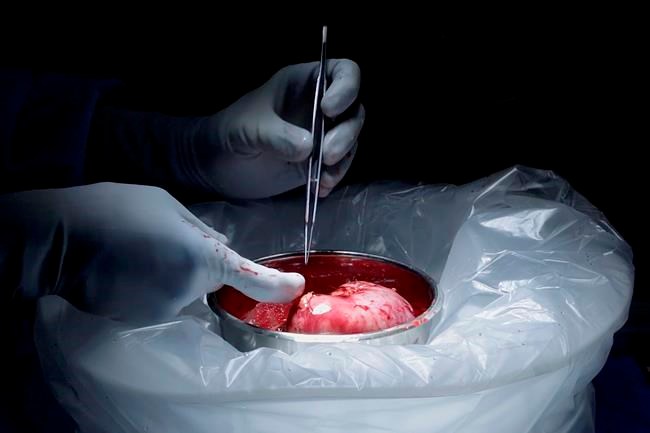
This image made from video provided by Johns Hopkins Medicine in Baltimore shows a kidney from Nina Martinez of Atlanta, who is thought to be the world’s first kidney transplant living donor with HIV, on Monday, March 25, 2019. Doctors transplanted one of her kidneys into an HIV-positive recipient who chose to remain anonymous. (Johns Hopkins Medicine via AP)

At a news conference Thursday, Martinez said she was “feeling good” and hopes she’s opened doors for other would-be donors.

“To be able to leave this kind of medical legacy for me was quite important,” she said.

The recipient of Martinez’s kidney, who chose to remain anonymous, also is recovering well, Hopkins said.

“Here’s a disease that in the past was a death sentence and now has been so well controlled that it offers people with that disease an opportunity to save somebody else,” said Dr. Dorry Segev, a Hopkins surgeon who pushed for the HIV Organ Policy Equity, or HOPE, Act that lifted a 25-year U.S. ban on transplants between people with HIV.

There’s no count of how many HIV-positive patients are among the 113,000 people on the nation’s waiting list for an organ transplant. HIV-positive patients can receive transplants from HIV-negative donors just like anyone else.

Only in the last few years, spurred by some pioneering operations in South Africa, have doctors begun transplanting organs from deceased donors with HIV into patients who also have the virus, organs that once would have been thrown away.

Since 2016, 116 such kidney and liver transplants have been performed in the U.S. as part of a research study, according to the United Network for Organ Sharing, or UNOS, which oversees the transplant system. One question is whether receiving an organ from someone with a different strain of HIV than their own poses any risks, but so far there have been no safety problems, said UNOS chief medical officer Dr. David Klassen.
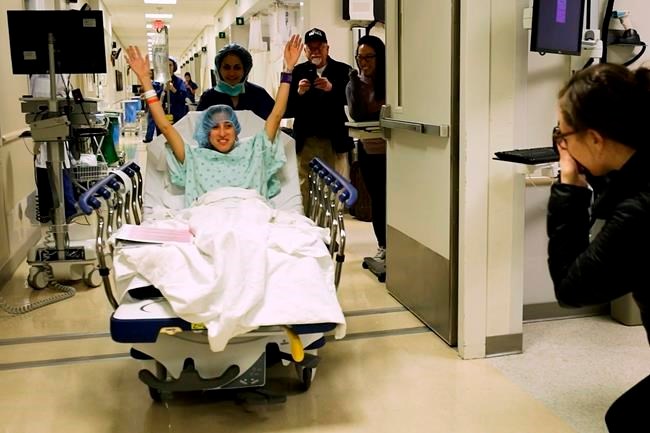
In this image made from video provided by Johns Hopkins Medicine, Nina Martinez of Atlanta is wheeled into a Baltimore operating room to become who is thought to be the world’s first kidney transplant living donor with HIV, on Monday, March 25, 2019. Martinez, 35, donated a kidney to an HIV-positive stranger, saying she
In this image made from video provided by Johns Hopkins Medicine, Nina Martinez of Atlanta is wheeled into a Baltimore operating room to become who is thought to be the world’s first kidney transplant living donor with HIV, on Monday, March 25, 2019. Martinez, 35, donated a kidney to an HIV-positive stranger, saying she "wanted to make a difference in somebody else's life" and counter the stigma that too often still surrounds HIV infection. (Johns Hopkins Medicine via AP)

Hopkins’ Segev said Monday’s kidney transplant was a world first. Doctors had hesitated to allow people still living with HIV to donate because of concern that their remaining kidney would be at risk of damage from the virus or older medications used to treat it.

But newer anti-HIV medications are safer and more effective, Segev said. His team recently studied the kidney health of 40,000 HIV-positive people and concluded that those with well-controlled HIV and no other kidney-harming ailments like high blood pressure should face the same risks from living donation as someone without HIV.

“There are potentially tens of thousands of people living with HIV right now who could be living kidney donors,” said Segev, who has advised some other hospitals considering the approach.

Generally, kidneys from living donors last longer, added Dr. Niraj Desai, the Hopkins surgeon caring for the recipient. And if more people living with HIV wind up donating, it helps more than HIV-positive patients who need a kidney.

“That’s one less person waiting for a limited resource,” Desai said. “That helps everybody on the list.”

Martinez, a public health consultant, became interested in living donation even before HIV-to-HIV transplants began. Then last summer she learned that an HIV-positive friend needed a transplant, and tracked down Segev to ask if she could donate.

Her friend died before Martinez finished the required health tests but she decided to honour him by donating to someone she didn’t know.
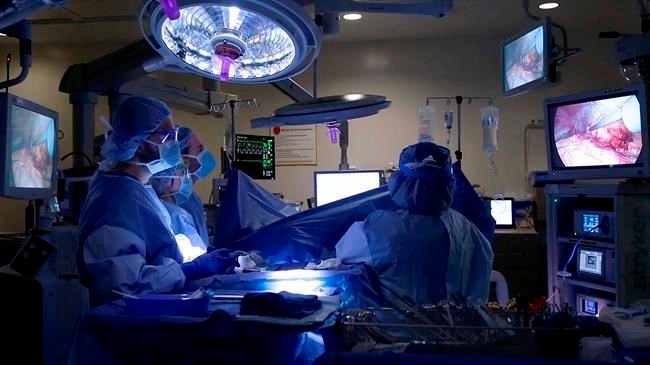
In this image made from video provided by Johns Hopkins Medicine, surgeons operate on Nina Martinez of Atlanta, who’s thought to be the world’s first kidney transplant living donor with HIV, in Baltimore on Monday, March 25, 2019. Doctors transplanted one of Martinez’s kidneys into an HIV-positive recipient who chose to remain anonymous. (Johns Hopkins Medicine via AP)

A runner who plans on making this fall’s Marine Corps Marathon, “I knew I was probably just as healthy as someone not living with HIV who was being evaluated as a kidney donor,” Martinez said. “I’ve never been surer of anything.”

___

The Associated Press Health & Science Department receives support from the Howard Hughes Medical Institute’s Department of Science Education. The AP is solely responsible for all content.

Report Error Submit a Tip

More Stories

Mayoral candidate Vogiatzakis promises new express-lane permitting process

Malak Abas 4 minute read Preview

Mayoral candidate Vogiatzakis promises new express-lane permitting process

Malak Abas 4 minute read 4:55 PM CDT

A mayoral candidate is promising a complete overhaul of the city’s permit processes, if elected.

Mike Vogiatzakis held his second of what he said would be weekly campaign pledges leading up to the Oct. 28 mayoral election. He pitched what he described as a “one-day green lane” model for approving small-scale permits: complete applications for “simple, low-risk projects” would be approved in one business day. Other residential permits would be guaranteed to be approved within five days and simple commercial permits would have a 10-day approval. Larger jobs, he said, would have a “written timeline.”

Vogiatzakis promised to open a permit hub dedicated solely to applications filed by small businesses.

“Business owners, of course, can spend months (paying) rent while waiting for permits,” he said Friday. “Homeowners and contractors can be left without clear decisions for a long time. Winnipeg has gone online with applications, but an online application is not an approval. A target is not a guarantee. My plan adds the missing link.”

Read
4:55 PM CDT

Province announces phys-ed curriculum overhaul

Maggie Macintosh 6 minute read Preview

Province announces phys-ed curriculum overhaul

Maggie Macintosh 6 minute read Updated: Yesterday at 6:55 PM CDT

Manitoba is overhauling phys-ed class and requiring all high school students to regularly work up a sweat on school grounds to graduate.

Premier Wab Kinew announced on Thursday that a new curriculum is being piloted across the kindergarten to Grade 12 system this fall.

Changes to phys-ed and health education — which apply to all grades, but Grade 11 and 12 students, in particular — will ensure these mandatory subjects are delivered entirely in-person, starting in the 2028-29 school year.

The policy is called “Every Body, Every Day.”

Read
Updated: Yesterday at 6:55 PM CDT

‘Last chance’ clearance U.S. booze punted from Liquor Marts

Carol Sanders 5 minute read Preview

‘Last chance’ clearance U.S. booze punted from Liquor Marts

Carol Sanders 5 minute read Updated: Yesterday at 7:51 PM CDT

American alcohol that returned to Manitoba Liquor Mart shelves in May as part of a “last chance” sale is headed back to storage or will be destroyed.

“We are removing U.S. liquor products from Liquor Mart shelves,” a spokesperson for Manitoba Liquor and Lotteries said Thursday. The Crown corporation had been pushing to off-load its stockpile of U.S. booze.

Premier Wab Kinew launched a provincewide boycott of American alcohol in March 2025 to fight back against tariffs imposed by U.S. President Donald Trump. Manitoba Liquor and Lotteries has not placed new orders since the boycott began, but it still had inventory.

As of early May, the U.S. inventory had a value of roughly $3.4 million, which is roughly one-third of what was removed from shelves and placed in storage, Manitoba Liquor and Lotteries has said. It was unable to provide an inventory update on Thursday.

Read
Updated: Yesterday at 7:51 PM CDT

Hydro announces CEO out after two years

Chris Kitching 7 minute read Preview

Hydro announces CEO out after two years

Chris Kitching 7 minute read Updated: 5:18 PM CDT

Allan Danroth is out as Manitoba Hydro’s president and CEO — a departure that came as a surprise to some observers — just two years after he was hired.

Danroth left for personal reasons, the Crown corporation’s board chair, Jamie Wilson, said Friday, while announcing chief operating officer Hal Turner as interim president and CEO ahead of a national and international search for a replacement.

“Today’s one of those days where you have a lot of mixed emotions,” Turner told reporters at Hydro’s downtown Winnipeg headquarters. “I just want to say on behalf of all the employees in Manitoba Hydro, we very much appreciate Allan’s leadership over the last two years.”

Turner wouldn’t say whether he will apply to be the next permanent CEO.

Read
Updated: 5:18 PM CDT

Puzzles Palace

1 minute read Monday, Jul. 27, 2026

To solve our puzzles, please subscribe with this special offer: |

Carney’s defence of Lake Ontario carries enormous weight

Niigaan Sinclair 5 minute read Preview

Carney’s defence of Lake Ontario carries enormous weight

Niigaan Sinclair 5 minute read 4:28 PM CDT

For centuries on Turtle Island (North America), explorers, map makers, and political leaders have erased Indigenous place names and substituted them — more often than not — with political, ethnocentric, and self-aggrandizing names.

In recent years, a few places on the continent have had Indigenous names re-established, but as of today, few of the original names are “official.”

So, it was no surprise when U.S. President Donald Trump on Thursday signed an executive order directing the U.S. Department of the Interior and Board on Geographic Names to take steps within 30 days to officially rename Lake Ontario as “Lake America.”

The move may have been a result of the Canada-U.S. trade war and Trump’s pettiness and ego, but it also fits in perfectly with his career.

Read
4:28 PM CDT