Younger school entry could set stage for ADHD diagnosis

Advertisement

Advertise with us

The youngest children in kindergarten are more likely to be diagnosed with attention deficit hyperactivity disorder in early grades, a study shows, an intriguing finding for parents on the fence about when to start their child in school.

Read this article for free:

or

Already have an account? Log in here »

To continue reading, please subscribe:

Subscribe and receive a limited-edition Free Press branded hat or tote.

Digital Subscription

One year of digital access for only $205*

  • Enjoy unlimited reading on winnipegfreepress.com
  • Read the E-Edition, our digital replica newspaper
  • Access News Break, our award-winning app
  • Play interactive puzzles

*First annual payment billed as $205.00 + GST for one year. This annual subscription will automatically renew at $233.00 + GST every 52 weeks (10% off the regular annual price of $259.35). Offer available to new and qualified returning subscribers only. Cancel any time.

To continue reading, please subscribe:

Add Free Press access to your Brandon Sun subscription for only an additional

$1 for the first 4 weeks*

  • Enjoy unlimited reading on winnipegfreepress.com
  • Read the E-Edition, our digital replica newspaper
  • Access News Break, our award-winning app
  • Play interactive puzzles
Start now

*Your next Brandon Sun subscription payment will increase by $1.00 and you will be charged $17.95 plus GST for four weeks. After four weeks, your payment will increase to $24.95 plus GST every four weeks.

Hey there, time traveller!
This article was published 28/11/2018 (2793 days ago), so information in it may no longer be current.

The youngest children in kindergarten are more likely to be diagnosed with attention deficit hyperactivity disorder in early grades, a study shows, an intriguing finding for parents on the fence about when to start their child in school.

The study found younger students, especially boys, are also more likely to be started on medications for ADHD and kept on the drugs longer than the oldest children. The medications are generally safe, but can have harmful side effects.

“Doctors and therapists need to factor that into their decision-making,” said study co-author Dr. Anupam Jena of Harvard Medical School. They should ask, “Does he really have ADHD, or is it because he needs six more months to mature? That extra year makes a big difference.”
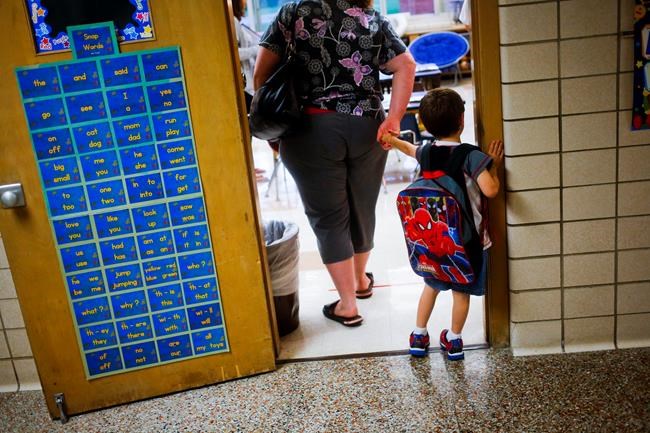
FILE - In this Sept. 8, 2015 file photo, a reluctant student is pulled into the first day of kindergarten at an elementary School in Clio, Mich. A study shows the youngest children in a classroom are more likely to be diagnosed with attention deficit hyperactivity disorder. It’s an intriguing finding for parents considering what’s called “kindergarten redshirting,” or delaying school entry. Researchers say doctors should be aware of how classroom comparisons shape diagnosis. The paper was published Wednesday, Nov. 28, 2018, by the New England Journal of Medicine. (Christian Randolph/The Flint Journal via AP, File)

About 6 million U.S. children and teenagers have been diagnosed with ADHD, which causes inattention, hyperactivity and impulsivity. The rate of diagnosis is climbing.

The study, published Wednesday by the New England Journal of Medicine, stemmed from a lunchroom conversation about “kindergarten redshirting” for a co-author’s son. The term is borrowed from athletics and means waiting a year to give a child time to mature.

“The parents were thinking about whether or not to hold their child back an additional year,” Jena recalled. That led the researchers to ask, “What happens to kids who are in the same class who are perceived to be different?”

They used insurance claims to compare more than 71,000 students with August and September birthdays in 18 states with Sept. 1 cutoffs. A child who turns 5 before Sept. 1 can start kindergarten. If not, the child waits until the next year. An August birthday can mean a child is the youngest in class while those born in September are the oldest.

Overall, from birth to the first few years of school, the number of children diagnosed with ADHD was low. The researchers calculated that the rate of ADHD diagnosis was a third higher in August-born kids than in September-born kids, based on 309 cases among about 36,300 with August birthdays and 225 cases among about 35,300 born in September.

There was no group difference before age 4; it showed up after school enrolment.

The researchers also looked at asthma, diabetes and obesity rates and found they were the same for the August and September babies. And no other month-to-month comparison showed a sharp difference in ADHD.

Finally, using insurance data for more than 400,000 children in all 50 states, the researchers looked at states that don’t use a Sept. 1 cutoff and the effect disappeared.

“They did so many careful (checks) to make sure of their findings. It was really striking it was so consistent,” said Dr. William Cooper, a pediatrics and health policy professor at Vanderbilt University in Nashville, who wasn’t involved in the research.

Cooper said younger children can have more trouble paying attention, sitting still and controlling their impulses. Compared to other kids, they may look like they have ADHD.

The study didn’t evaluate whether the children were diagnosed appropriately. The August-September difference could be a reflection of spotting actual cases of ADHD earlier in the August-born kids because of their early start to school, said Dr. Jonathan Posner, an associate professor of psychiatry at Columbia University Medical Center in New York.

On the other hand, since there’s no lab test for ADHD, doctors rely on subjective observations from parents and teachers. A younger student may simply need time to catch up, but his immature behaviour looks like ADHD and raises a teacher’s concern, said Posner, who wasn’t involved in the study.

“The information we receive about a child has to be interpreted within a developmental context,” Posner said. “A 4-year-old isn’t going to respond as well to academic challenges as a 5-year-old.”

ADHD stimulant medications are generally considered safe, Posner said, but some children have side effects such as lowered appetite, sleep troubles and afternoon rebounds of hyperactivity.

The study didn’t include kids covered by Medicaid, the government insurance program that serves 35 million low-income children. Other research has shown children on Medicaid are more likely to be diagnosed with ADHD, which may account for the low rates of diagnosis in the new study, Jena said.

___

Follow AP Medical Writer Carla K. Johnson on Twitter: @CarlaKJohnson

___

The Associated Press Health & Science Department receives support from the Howard Hughes Medical Institute’s Department of Science Education. The AP is solely responsible for all content.


Report Error Submit a Tip

More Stories

Donald Trump and tariffs, ad nauseam

Editorial 4 minute read Preview

Donald Trump and tariffs, ad nauseam

Editorial 4 minute read 2:01 AM CDT

Are you tired of it all yet? You should be.

Once again, Canada’s biggest trading partner has launched punitive trade tariffs on Canadian goods: U.S. President Donald Trump has levied a 50 per cent tariff on a wide range of Canadian exports, a move that is expected to affect US$20 billion in Canadian exports. The reason? Because Canada had the temerity to actually respond to unilateral U.S. tariffs despite Canada’s trade deals with that country.

Long a fan of using ancient and esoteric law to push his tariff agenda, this time Trump has reached back to the Dirty Thirties to resurrect section 338 of the Smoot-Hawley Tariff Act, part of a piece of tariff legislation that economists say severely deepened the Depression.

Is this an attempt to use leverage in ongoing negotiations in the Canada-U.S.-Mexico trade agreement? Possibly, because the reason Trump says he’s imposing the tariffs mirrors the complaints he’s made publicly about CUSMA — dairy imports into Canada among them.

Read
2:01 AM CDT

Climate change? It’s already here

Scott Forbes 5 minute read Preview

Climate change? It’s already here

Scott Forbes 5 minute read 2:01 AM CDT

Winnipeg’s roads are buckling. Ontario forests are burning. Toronto chokes on wildfire smoke. The summer heat dome in Europe has already killed thousands. Climate change is not some future dystopian vision. It’s right here, right now. And the cause is crystal clear: burning fossil fuels.

One astute observer in 2020 noted that: “Climate change is an existential threat. We all recognize that, and there’s increasing urgency around it… Companies and those who invest in them and lend to them, and who are part of the solution will be rewarded. Those who are lagging behind and are still part of the problem will be punished.”

Who was that? None other than the United Nations Secretary-General’s special envoy on climate action and finance.

Mark Carney.

Read
2:01 AM CDT

Disciplinary hearing centres on teacher’s 15-second hug with student

Maggie Macintosh 4 minute read Yesterday at 10:08 PM CDT

School security camera footage of a nearly 15-second hug between a teacher and one of her students was repeatedly screened and scrutinized at a historic hearing.

“This isn’t a fleeting or a casual embrace. The two were comfortable with each other,” teacher commissioner lawyer Tristan Sandulak told a professional disciplinary panel on Tuesday.

Sandulak made a case for cancelling Janice Wen Ying Ma’s teaching certificate, citing the early career educator’s alleged conduct and “credibility issues.”

The lawyer presented on behalf of Noni Classen, the independent commissioner who oversees Manitoba’s new teacher registry, during a videoconference that took up much of the day.

City dermatologist penalized again for misconduct

Chris Kitching 4 minute read Preview

City dermatologist penalized again for misconduct

Chris Kitching 4 minute read Yesterday at 1:29 PM CDT

A longtime Winnipeg dermatologist was forced to reduce the scope of his practice after pursuing a relationship with a female patient and seeing another without a required chaperone while his office was normally closed.

Read
Yesterday at 1:29 PM CDT

Ukrainian influencer learning, sharing all he can about Manitoba home

Melissa Martin 7 minute read Preview

Ukrainian influencer learning, sharing all he can about Manitoba home

Melissa Martin 7 minute read Yesterday at 2:01 AM CDT

In Andrian Makhnachov’s first nine days as a Winnipegger, he immersed himself in the city’s most distinctive delights. He went to the Goldeyes’ Ukrainian Night, toured the Manitoba Museum and cheered the Sea Bears at Canada Life Centre.

He sampled boxes of treats from local institutions such as Baked Expectations and Oh Doughnuts. He tried pickerel for the first time, and even a Jeanne’s Cake. (His diplomatic verdict on the city’s most intensely debated dessert: “I think it’s a very interesting experience … maybe there’s some special way I should eat it and it’s going to be better.”)

Still, the rising social media star encountered a few challenges. When Makhnachov first planned his move here from Regina, he’d picked an apartment in the Exchange District, not realizing there were few grocery stores within walking distance. For now, he’s making do with Giant Tiger.

For all the ups and downs, there is no doubt in the Ukrainian-Canadian’s mind that he made the right decision to move his life, and his burgeoning influencer career, to Winnipeg.

Read
Yesterday at 2:01 AM CDT

Younger school entry could set stage for ADHD diagnosis

Carla K. Johnson, The Associated Press 5 minute read Preview

Younger school entry could set stage for ADHD diagnosis

Carla K. Johnson, The Associated Press 5 minute read Wednesday, Nov. 28, 2018

The youngest children in kindergarten are more likely to be diagnosed with attention deficit hyperactivity disorder in early grades, a study shows, an intriguing finding for parents on the fence about when to start their child in school.

The study found younger students, especially boys, are also more likely to be started on medications for ADHD and kept on the drugs longer than the oldest children. The medications are generally safe, but can have harmful side effects.

"Doctors and therapists need to factor that into their decision-making," said study co-author Dr. Anupam Jena of Harvard Medical School. They should ask, "Does he really have ADHD, or is it because he needs six more months to mature? That extra year makes a big difference."

About 6 million U.S. children and teenagers have been diagnosed with ADHD, which causes inattention, hyperactivity and impulsivity. The rate of diagnosis is climbing.

Read
Wednesday, Nov. 28, 2018