

Climate change? It’s already here
Advertisement
Read this article for free:
or
Already have an account? Log in here »
To continue reading, please subscribe:
Digital Subscription
One year of digital access for only $1.44 a week*
- Enjoy unlimited reading on winnipegfreepress.com
- Read the E-Edition, our digital replica newspaper
- Access News Break, our award-winning app
- Play interactive puzzles
*Billed as $5.77 plus GST every four weeks. After 52 weeks, price increases to the regular rate of $19.95 plus GST every four weeks. Offer available to new and qualified returning subscribers only. Cancel any time.
To continue reading, please subscribe:
Add Free Press access to your Brandon Sun subscription for only an additional
$1 for the first 4 weeks*
- Enjoy unlimited reading on winnipegfreepress.com
- Read the E-Edition, our digital replica newspaper
- Access News Break, our award-winning app
- Play interactive puzzles
*Your next Brandon Sun subscription payment will increase by $1.00 and you will be charged $17.95 plus GST for four weeks. After four weeks, your payment will increase to $24.95 plus GST every four weeks.
Read unlimited articles for free today:
or
Already have an account? Log in here »
Winnipeg’s roads are buckling. Ontario forests are burning. Toronto chokes on wildfire smoke. The summer heat dome in Europe has already killed thousands. Climate change is not some future dystopian vision. It’s right here, right now. And the cause is crystal clear: burning fossil fuels.
One astute observer in 2020 noted that: “Climate change is an existential threat. We all recognize that, and there’s increasing urgency around it… Companies and those who invest in them and lend to them, and who are part of the solution will be rewarded. Those who are lagging behind and are still part of the problem will be punished.”
Who was that? None other than the United Nations Secretary-General’s special envoy on climate action and finance: Mark Carney.
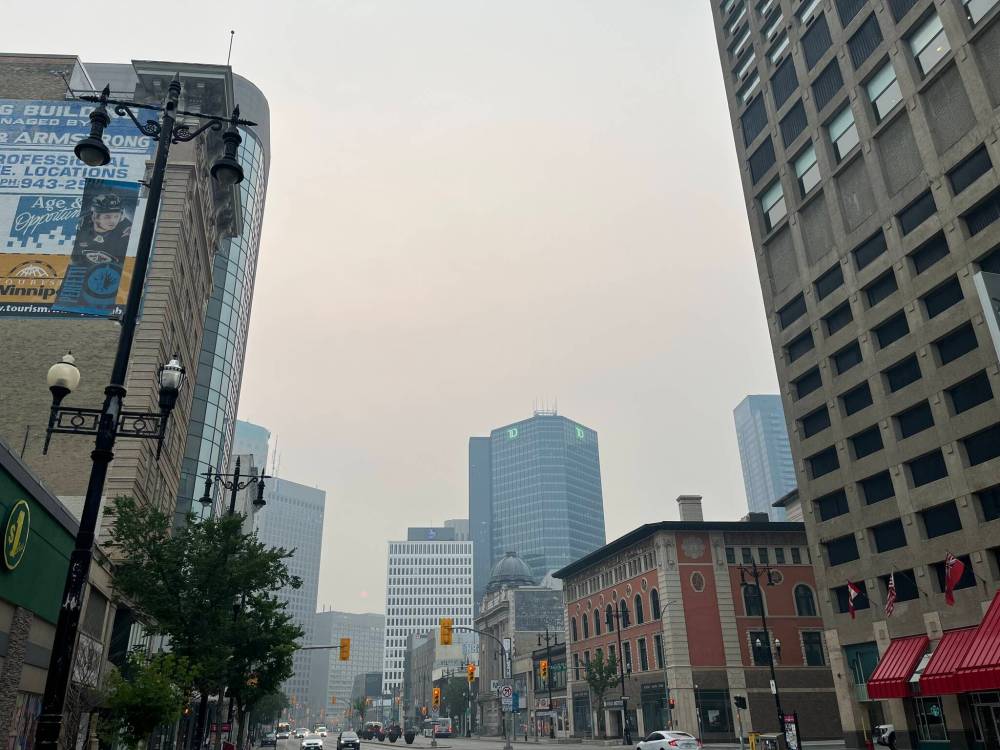
Russell Wangersky / Free Press File
Forest fire smoke clouds the skies over downtown Winnipeg in July, 2025.
How times have changed. Like the pro wrestler turned heel, Carney has joined the side of the NTO (New Trump Order) — the oil barons who profit from burning the planet.
Since 2005 Canada has made only modest gains on cutting carbon emissions. They’ve fallen by about 10 per cent, currently sitting at approximately 700 megatonnes. Two provinces, Alberta and Saskatchewan, with one-seventh of Canada’s population, account for half of that. Their increased emissions since 2005 have undone most of the carbon reductions of the rest of the country.
Like the pro wrestler turned heel, Carney has joined the side of the NTO (New Trump Order): the oil barons who profit from burning the planet.
Now Alberta wants no limits on planet-cooking emissions. And Mark Carney has said: “Fine. How can I help with that?”
Industrial carbon pricing too high? We’ll cut that to trivial levels.
Consumer carbon pricing and EV mandates? We’ll get rid of those.
Worried about pesky emissions caps? Consider those scrapped.
Unhappy with clean electricity regulations? Gone.
Want to jack up tar sands production? How about if we build you a pipeline and Canadian taxpayers pay for it? That might entice a hesitant private sector which sees no business case, fearful of falling future global oil demand.
And the extra 20 megatonnes of planet-burning emissions from tar sands expansion? We’ll ask the oil companies to offset a bit of that with carbon capture. Sure, we’ll say it’s 22 megatonnes by 2030 at first (68 megatonnes by 2050), but then we’ll cut that to just six megatonnes by 2035. Instead of Big Oil picking up the tab, taxpayers will pay for three-quarters of the cost through tax breaks and direct subsidies.
Never mind that carbon capture has never worked at scale. We’ll capture some carbon and use it to squeeze more oil from tired oil fields! We’ll pretend we’re part of the solution while making the problem of planet heating much worse. What great PR value! We’ll call it “decarbonized oil” even though there is no such thing. Oil is mostly carbon.
And that extra 20 megatonnes of carbon emissions from expanding tar sands oil production? That’s the price of progress. It’s also the equivalent of all of Manitoba’s emissions.
Our strategy will be to embrace Trump’s energy policy. Decarbonization is for sissies. We’ll be loud and proud that we’re an “energy superpower” with per capita carbon emissions already among the very highest on the planet. But we’re still behind Saudi Arabia, Qatar and Kuwait, so Alberta can help us close that emissions gap.
We’ll tell voters it’s too expensive to cut emissions, even though the rest of the world (outside the petrostates) manages to do so.
And just for good measure, we’ll greenlight gigantic data centres for American companies. How will they be powered? With methane, of course! The proposed Meta data centre in Alberta will belch a staggering four megatonnes of carbon dioxide annually.
Little known fact: Canada’s biggest pipeline doesn’t carry oil or gas. It ships profits to foreign, mostly American shareholders.
If we build more of those, we’ll be able to clear all that pesky Arctic ice with ever-faster climate heating. Premiers Smith, Moe, Ford and Kinew will be delighted as we turn Churchill into a year-round port to ship oil and gas past rotting carcasses of expired polar bears and beluga whales. Maybe the profits will cover some of the cost of housing all the displaced rural, mainly Indigenous, communities who no longer have homes as the permafrost thaws and forests burn.

Oh, forget that. Taxpayers can pay for that, too. Profits from tar sands and methane production should go straight to the bottom line of the Big Four oil companies: Cenovus, Imperial Oil (Exxon), Canadian Natural Resources and Suncor.
Little known fact: Canada’s biggest pipeline doesn’t carry oil or gas. It ships profits to foreign, mostly American shareholders.
Canadian taxpayers pay for the infrastructure, subsidize the operating costs of pipelines and carbon capture, pay for cleaning up the mess left behind ($260 billion-plus), take all the risks, and Americans collect a steady stream of cash — $60 billion annually, at last count. What a deal!
Fire up the AC and pass the suntan lotion. It’s gonna be a hot one.
Scott Forbes is an ecologist at the University of Winnipeg.
Related Articles
Aerial photos show devastation of Ontario First Nation as wildfires burn across north

Advertisement Advertise With Us
Advertisement Advertise With Us