

Ticket refunds? Maybe
Driver starts class action against city
Advertisement
Read this article for free:
or
Already have an account? Log in here »
To continue reading, please subscribe:

Digital Subscription
One year of digital access for only $205*
- Enjoy unlimited reading on winnipegfreepress.com
- Read the E-Edition, our digital replica newspaper
- Access News Break, our award-winning app
- Play interactive puzzles
*First annual payment billed as $205.00 + GST for one year. This annual subscription will automatically renew at $233.00 + GST every 52 weeks (10% off the regular annual price of $259.35). Offer available to new and qualified returning subscribers only. Cancel any time.
To continue reading, please subscribe:
Add Free Press access to your Brandon Sun subscription for only an additional
$1 for the first 4 weeks*
- Enjoy unlimited reading on winnipegfreepress.com
- Read the E-Edition, our digital replica newspaper
- Access News Break, our award-winning app
- Play interactive puzzles
*Your next Brandon Sun subscription payment will increase by $1.00 and you will be charged $17.95 plus GST for four weeks. After four weeks, your payment will increase to $24.95 plus GST every four weeks.
Read unlimited articles for free today:
or
Already have an account? Log in here »
Hey there, time traveller!
This article was published 09/05/2009 (6318 days ago), so information in it may no longer be current.
The chances of speeders caught in the act by photo radar actually getting a ticket refund appear to be growing slimmer.
While Attorney General Dave Chomiak raised hopes earlier this week of a possible fine rebate for drivers ticketed in construction zones, he and his advisers were less than encouraging Friday.
At the same time, the province set down in law how police can use photo radar in construction zones.
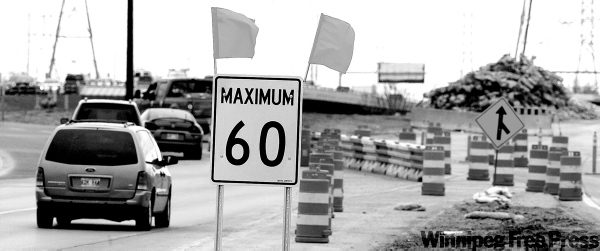
The new rules essentially give photo-radar vans the green light to do what they were doing before this week’s political ruckus over speeding tickets in unmanned construction zones — but this time tickets and accompanying fines will stick.
The new regulations say city-run speed-enforcement cameras can only be used in construction zones when workers are present. If no workers are present, there must be a specific safety risk for police to enforce reduced speeds on weekends. There also must be a proper sign in place advising drivers they are entering a construction zone with a reduced speed and a second sign at the end of the construction zone advising drivers they can resume travelling the posted speed limit.
By giving police clear guidelines where and when the photo-radar vans can be used, the Doer government also hopes to put behind it the bitter finger-pointing between it and the city over who’s to blame for the fiasco.
"We’re at where we’re at," a frustrated Mayor Sam Katz said after speaking with Chomiak and Winnipeg police Chief Keith McCaskill on the matter. "The idea now is to make sure everyone understands what photo radar is and how it applies.
"When you’re doing something, you always want to make sure you’re making it very clear to the public what you’re doing."
Meanwhile, Winnipeg resident Tyler Weaver has initiated a class-action lawsuit against the City of Winnipeg, alleging the city improperly collected the photo-radar fines.
The legal action must still be accepted by the courts as a class-action suit on behalf of all motorists.
Weaver alleges in the statement of claim that the City of Winnipeg, "unjustly enriched itself at the expense of the plaintiffs."
Weaver states that all fines, fees and other penalties imposed through the photo-radar tickets, "were without colour of right and thus should not have been levied, imposed, sought or collected."
Late last week, the city was caught completely off guard when the province announced it was abandoning its appeal of a traffic-court case that saw a magistrate toss out nine speeding offences because the tickets were issued when workers weren’t on the job. Magistrate Norman Sundstrom said workers must be working for police to enforce reduced speed limits in construction zones.
What made it worse for the city and the police traffic division is that the Crown also said the public works department had not properly installed signs at the end of photo-enforced construction zones to tell drivers they could increase their speed to the posted limit. Because of that, the Crown also stayed 875 speeding offences still before the courts on the basis it could not prosecute because of the lack of signage.
The decision stunned police and later outraged the public when Chomiak said tickets issued last year would not be refunded because the fines had already been paid. A day later, Chomiak softened his stance when he said 60,000 tickets had been issued last year — a huge jump from 3,000 the year before — making it look like a cash grab, and that officials in the Justice department would examine the possibility of fine repayments.
Chomiak said Friday a final decision on refunds — not expected for several weeks — will be based on the law, not politics.
bruce.owen@freepress.mb.ca
The new rules
New rules for photo radar in construction zones (Image Capturing Enforcement Regulation amendment under Highway Traffic Act):
9(3) A municipality or police service must not use a photo radar system to detect a speed limit violation that occurs within a construction zone, unless:
(a) one or more construction workers are present in the zone; or

(b) the municipality:
(i) has, in accordance with the Act, imposed a speed limit in the zone that is lower than the maximum speed normally permitted for the portion of highway containing the zone,
(ii) has placed an approved traffic control device at the beginning of the zone stating the lower speed limit and at the end of the zone indicating that traffic may proceed at the maximum speed normally permitted, and
(iii) has, if the municipality considers it advisable to do so, placed approved traffic control devices at intervals within the zone stating the lower speed limit.
Related Articles
No hope for refunds on construction-zone speeding tickets: Chomiak
Advertisement Advertise With Us
Advertisement Advertise With Us