

Flood of bad news for us all
Higher-than-average runoff could spell big trouble
Advertisement
Read this article for free:
or
Already have an account? Log in here »
To continue reading, please subscribe:

Digital Subscription
One year of digital access for only $205*
- Enjoy unlimited reading on winnipegfreepress.com
- Read the E-Edition, our digital replica newspaper
- Access News Break, our award-winning app
- Play interactive puzzles
*First annual payment billed as $205.00 + GST for one year. This annual subscription will automatically renew at $233.00 + GST every 52 weeks (10% off the regular annual price of $259.35). Offer available to new and qualified returning subscribers only. Cancel any time.
To continue reading, please subscribe:
Add Free Press access to your Brandon Sun subscription for only an additional
$1 for the first 4 weeks*
- Enjoy unlimited reading on winnipegfreepress.com
- Read the E-Edition, our digital replica newspaper
- Access News Break, our award-winning app
- Play interactive puzzles
*Your next Brandon Sun subscription payment will increase by $1.00 and you will be charged $17.95 plus GST for four weeks. After four weeks, your payment will increase to $24.95 plus GST every four weeks.
Read unlimited articles for free today:
or
Already have an account? Log in here »
Hey there, time traveller!
This article was published 25/01/2011 (5699 days ago), so information in it may no longer be current.
Brace yourself for spring, Manitoba.
The Red River could experience a flood not seen since 1997’s Flood of the Century, and the potential for flooding is rated as ‘high’ across much of the rest of the province.
In fact, higher-than-average spring runoff is projected for almost everywhere south of Gillam near the 56th parallel, the Manitoba government said Monday in its first flood outlook of the year.
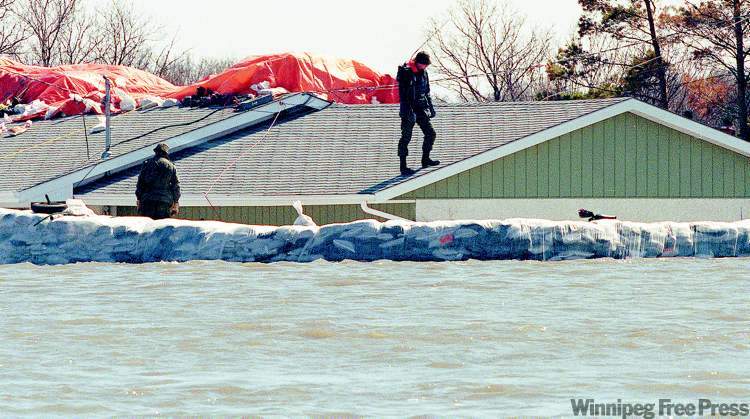
With average weather, communities along the Red River are likely to be hit by a flood similar to the major event in 2009, flood forecasters said. But there’s a one-in-10 chance unfavourable weather could push the Red as high or slightly higher than in 1997. Meanwhile, the potential for spring flooding is also high along the Assiniboine, Souris, Pembina, Winnipeg, Saskatchewan and Fisher rivers, as well as the Interlake region.
“This is the first time we’ve had it on so many fronts,” said Steve Topping, a senior Manitoba flood official, of his 15 years battling floods.
The likelihood of a province-wide struggle against flooding prompted the Selinger government Monday to boost its flood-fighting arsenal. As first reported by the Free Press, the government will spend $22 million on new equipment and other resources that can be deployed throughout the province.
Saturated soils and above-average precipitation since last fall in most of Manitoba, central and southern Saskatchewan, North Dakota and Minnesota have created conditions ripe for spring flooding. According to long-term weather forecasts, the region could also see a lot more snow this winter followed by a rainier-than-normal spring.
While the major rivers are higher and the soils are more saturated than they were at this point in 1997, it’s too early to panic, government officials said.
“It really will come down to the weather — favourable, average or unfavourable,” Steve Ashton, minister responsible for emergency measures, told reporters. In 1997, there was a major snowstorm late in the spring that contributed to that year’s high water mark. But Manitoba could get lucky and enjoy a month without precipitation as it did last spring, Ashton said.
Flooding is predicted this spring along the Assiniboine River, affecting mainly agricultural areas. The area hardest hit is expected to be from the Saskatchewan border to Brandon.
Along the Souris River, the flood potential is rated as ‘high.’ Even with average weather conditions, a flood nearly as severe as the 1974 benchmark is likely.
Closer to home, Steve Strang, mayor of the RM of St. Clements, said the municipality is already contacting homeowners whose properties are most vulnerable to flooding.


Strang warns the municipality lacks the resources to protect all properties by itself and homeowners will have to pitch in.
“Our goal is to empower people (with training and equipment). There’s no way the municipality can deal with this whole issue by itself,” he said Monday. South of the city along the Red, where ring dikes guard communities and most homeowners have taken advantage of government programs to protect their homes from flooding, the main issue is the cost of looming infrastructure damage.
Ralph Groening, reeve of the RM of Morris, said following the 2009 flood, one-third of the municipality’s gravel roads needed repairs.
And it looks like it will face similar damage this year, he said.
larry.kusch@freepress.mb.ca
A perfect storm for a rough spring
Wet winter
Snow, snow everywhere you go: Researchers flying over the Red, Assiniboine and Souris river watersheds found 10 per cent more snow hanging around southern Manitoba than usual, between 50 and 100 millimetres in most places.
Soggy spring
Epic melts are predicted everywhere south of Gillam. A swath of land from The Pas down to Brandon and the eastern Red River Basin are expected to bear the brunt of the runoff.
Who’ll stop the rain?
Atmospheric front La Niña is beaming up the Pacific and she could bring even heavier snowfall for the rest of the winter. That’s not the end of it: The weather pattern’s big brother, El Niño, is expected to show up in April and that could bring downpours.
Boggy soil
When the ground froze in late 2010, soil moisture levels were the second-highest since 1948: only 2009 had soil that was more saturated. The water-logged soil is also frozen deep, meaning spring meltwater may spread out instead of soaking in… especially if it melts too fast.
Wild weather
There is a one-in-10 chance of weather so wet, the Red River would swell to 1997 levels, cresting at almost 25 feet in Winnipeg. Best-case scenario would mean dry skies, a slow melt and flooding at only 2001 levels… also a one-in-10 chance. If the weather stays average? Manitoba might flood like it’s 2009.
Icy breakup
Ice jams are so unpredictable, they’re not included in flood forecasting. But it could trigger brief and local floods, even if the river flow is low. So what happens if the flow is high?
Related Articles
City readies for river levels higher than '97 Cancel those travel plans

Advertisement Advertise With Us
Advertisement Advertise With Us