

Housing refugees’ top challenge
Lack of address only makes settlement here more difficult

Advertisement
Read this article for free:
or
Already have an account? Log in here »
To continue reading, please subscribe:

Digital Subscription
One year of digital access for only $205*
- Enjoy unlimited reading on winnipegfreepress.com
- Read the E-Edition, our digital replica newspaper
- Access News Break, our award-winning app
- Play interactive puzzles
*First annual payment billed as $205.00 + GST for one year. This annual subscription will automatically renew at $233.00 + GST every 52 weeks (10% off the regular annual price of $259.35). Offer available to new and qualified returning subscribers only. Cancel any time.
To continue reading, please subscribe:
Add Free Press access to your Brandon Sun subscription for only an additional
$1 for the first 4 weeks*
- Enjoy unlimited reading on winnipegfreepress.com
- Read the E-Edition, our digital replica newspaper
- Access News Break, our award-winning app
- Play interactive puzzles
*Your next Brandon Sun subscription payment will increase by $1.00 and you will be charged $17.95 plus GST for four weeks. After four weeks, your payment will increase to $24.95 plus GST every four weeks.
Read unlimited articles for free today:
or
Already have an account? Log in here »
Hey there, time traveller!
This article was published 18/01/2012 (5325 days ago), so information in it may no longer be current.
Hundreds of refugees arrive in Manitoba each year, each one trying to carve out a home in a city where there are too few homes to go around.
And while social-service agencies push to find their clients safe places to stay, the housing gap leaves many refugees from Africa and elsewhere stuck in a catch-22 that can put their new life on pause for months.
According to a study by University of Winnipeg Prof. Tom Carter, 91 per cent of refugees lived below the poverty line in their first year in Winnipeg. By their third year, that figure dropped to 53 per cent. If that figure speaks to the hard work of new arrivals, it also tells a tale of housing need: For most refugees, transitional and social housing are the only options within reach.
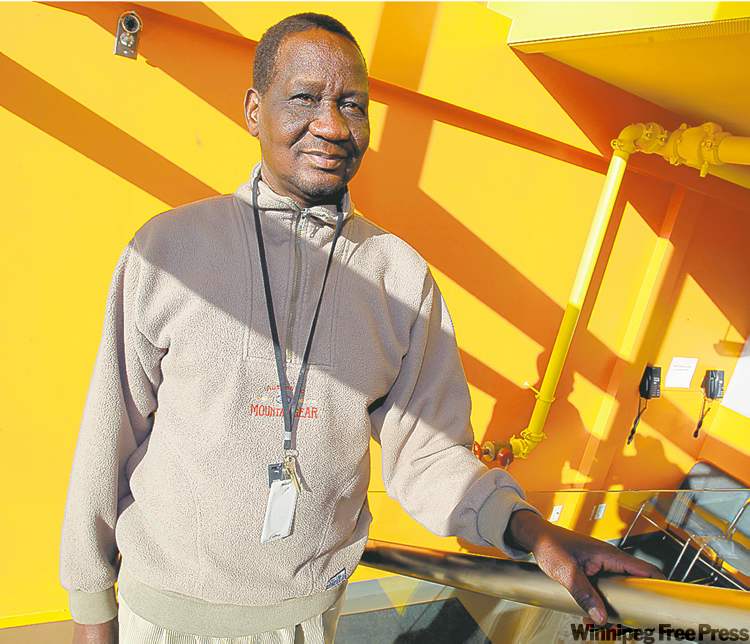
But there’s a waiting list for Manitoba Housing, and affordable apartments get snapped up quickly in a city with a vacancy rate that hovers near a paltry one per cent.
“The only thing which really frustrates me is the housing,” says Mubambe Didier, 44, who landed in Winnipeg with his wife and three children on Nov. 15. “It’s the only thing (missing). If housing would be upgraded to the reality on the ground, it would be much better. But the gap is too big.”
Even though the cold snap in the wind and the snow on the ground are foreign, the Didier family “felt at home right away,” Didier says, hands neatly folded on a table inside refugee agency Welcome Place’s brightly coloured boardroom.
The counsellors from Welcome Place who met them at the airport were “very gentle and kind,” he says; they helped the family learn everything from where to find a doctor to how to take the bus in Winnipeg. And yet, two months later, the family is still living in one of the 31 temporary apartments above Welcome Place’s Bannatyne Avenue offices. Counsellors at Welcome Place and other agencies work to find families like the Didiers a place to stay, but for new refugees on a razor-thin budget, including a social-housing allowance that can hover around $480 a month, there are few options.
That’s the catch-22, said Welcome Place settlement counsellor Aurelio Madut Danto: Until refugees find a permanent address, they cannot apply for a social insurance number, cannot start to work, cannot start to do all the things it takes to get established in a new land.
“The bottom line is affordable housing for newcomers,” Danto says. “The second is finding a job… but housing is the biggest issue for our clients.”
As the pressure mounts, it could become one of the biggest problems for government, too.
At a conference in Edmonton in November, Carter, the Canada research chair for Urban Change and Adaptation at the U of W, called on government to expand its mandate to help boost immigrant and refugee housing. Among the solutions he cited were property-tax forgiveness, reducing land costs and reducing fees to encourage the development of affordable housing.
But the challenges facing newcomers don’t stop there.
Manitoba MP and Liberal citizenship and immigration critic Kevin Lamoureux said the two biggest priorities for settlement services should be language training and help for young immigrants to ensure they don’t drop out of school and get sucked up by gangs.
Lamoureux has spent much of his political career helping immigrants and their families navigate the system and he said while Manitoba does relatively well overall with settlement services, the biggest gaps are for refugees and immigrants who arrive without built-in support systems of family, friends and co-workers.
While most of Manitoba’s immigrants are provincial nominees and often have friends and family on the ground, or jobs on arrival, refugees don’t usually have any of that and have the highest needs.
“Many refugees, including many from Africa, are a lot more reliant on umbrella organizations to provide support because they don’t have family and friends here,” he said. “If you don’t provide adequate supports it can be challenging.”
Ottawa is spending $32 million on settlement services in Manitoba this fiscal year and plans to increase that to $36.5 million next year. Nationally, settlement funding has tripled since 2006. The new formula for calculating settlement-service funding allocations includes a recognition that refugees require higher levels of services, and therefore provinces are allocated money in part on their share of refugees.
For refugees currently languishing over long-term periods in transitional housing, change — however it comes — can’t come fast enough.

Didier acknowledges in some ways, he arrived in Canada in a good situation: He is bilingual and educated; he worked as a logistics officer for humanitarian agencies in his native Congo until war and corruption forced him and his family to flee to Uganda and, finally, to Canada.
But this doesn’t make it easier or less anxious for Didier when his children worry about when they might be able to start school. When it comes to housing the waiting is, indeed, the hardest part.
— with files from Mia Rabson
melissa.martin@freepress.mb.ca
Melissa Martin
Reporter-at-large
Melissa Martin reports and opines for the Winnipeg Free Press.
Every piece of reporting Melissa produces is reviewed by an editing team before it is posted online or published in print — part of the Free Press‘s tradition, since 1872, of producing reliable independent journalism. Read more about Free Press’s history and mandate, and learn how our newsroom operates.
Our newsroom depends on a growing audience of readers to power our journalism. If you are not a paid reader, please consider becoming a subscriber.
Our newsroom depends on its audience of readers to power our journalism. Thank you for your support.
Melissa Martin
Reporter-at-large
Melissa Martin reports and opines for the Winnipeg Free Press.
Every piece of reporting Melissa produces is reviewed by an editing team before it is posted online or published in print — part of the Free Press‘s tradition, since 1872, of producing reliable independent journalism. Read more about Free Press’s history and mandate, and learn how our newsroom operates.
Our newsroom depends on a growing audience of readers to power our journalism. If you are not a paid reader, please consider becoming a subscriber.
Our newsroom depends on its audience of readers to power our journalism. Thank you for your support.
Advertisement Advertise With Us
Advertisement Advertise With Us