

Governments to blame: chiefs
Leaders level flood accusations, walk away from media questions

Advertisement
Read this article for free:
or
Already have an account? Log in here »
To continue reading, please subscribe:
Digital Subscription
One year of digital access for only $1.44 a week*
- Enjoy unlimited reading on winnipegfreepress.com
- Read the E-Edition, our digital replica newspaper
- Access News Break, our award-winning app
- Play interactive puzzles
*Billed as $5.77 plus GST every four weeks. After 52 weeks, price increases to the regular rate of $19.95 plus GST every four weeks. Offer available to new and qualified returning subscribers only. Cancel any time.
To continue reading, please subscribe:
Add Free Press access to your Brandon Sun subscription for only an additional
$1 for the first 4 weeks*
- Enjoy unlimited reading on winnipegfreepress.com
- Read the E-Edition, our digital replica newspaper
- Access News Break, our award-winning app
- Play interactive puzzles
*Your next Brandon Sun subscription payment will increase by $1.00 and you will be charged $17.95 plus GST for four weeks. After four weeks, your payment will increase to $24.95 plus GST every four weeks.
Read unlimited articles for free today:
or
Already have an account? Log in here »
Hey there, time traveller!
This article was published 02/05/2012 (5150 days ago), so information in it may no longer be current.
BROKENHEAD FIRST NATION — The province’s aboriginal leaders are going on the offensive after both the federal and provincial governments alleged financial abuses of compensation claims from last year’s flood.
Grand Chief Derek Nepinak of the Assembly of Manitoba Chiefs, Grand Chief Morris J. Shannacappo of the Southern Chiefs Organization, Bill Traverse, regional chief of the Assembly of First Nations, and Chief Glen Hudson of Peguis First Nation joined together to point the finger of blame for flooding and flood compensation back at the two levels of government.
The four said aboriginal people aren’t to blame for flooding of Interlake reserves, which they said was caused by the provincial government when it allowed the diversion of more water into Lake Manitoba to minimize flood damage in communities downstream on the Assiniboine River, including Winnipeg.
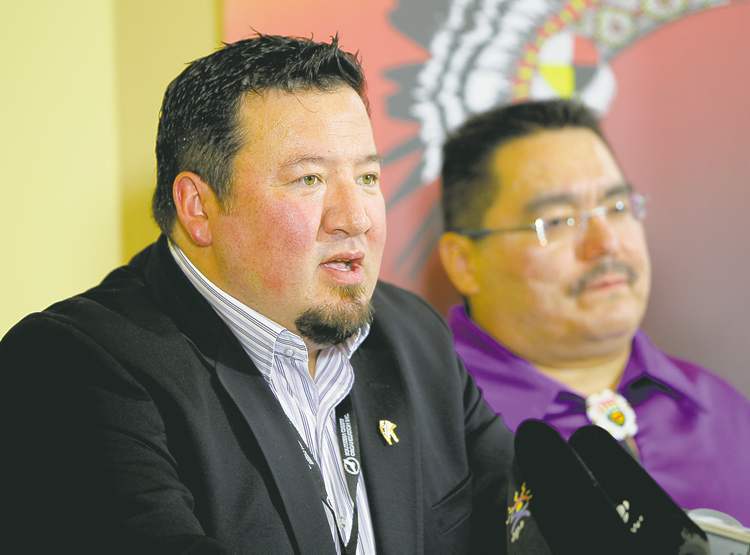
They said Peguis has endured annual floods, evacuations and property damages for the better part of three decades while Dauphin River’s main road is so bad it punctures tires.
“How can people get home when there is no road to go home on?” Nepinak said on Tuesday during a news conference at the South Beach Casino and Resort.
“How can people go home when there is black mould going up their walls?
“People have been forced to evacuate for years. Perhaps people have come forward and said they deserve flood entitlements (from past floods).”
The federal government is auditing Peguis First Nation, looking at alleged band mismanagement of millions of dollars in flood compensation.
Dauphin River First Nation and Lake St. Martin First Nation are two of four evacuated reserves that are accused of having inflated evacuee lists.
A federal review found more than 10 per cent of people receiving emergency assistance due to flooding at Lake St. Martin First Nation were not evacuees from the reserve.
Sid Dutchak, the government’s special representative overseeing flooding issues on Manitoba First Nations, told the Free Press last week, Aboriginal Affairs identified 170 people who were receiving evacuation benefits who weren’t eligible for them.
On Tuesday, Traverse accused Aboriginal Affairs of “victimizing the victims” and said he was glad a delegation from the United Nations would visit the reserves later this month to see the flood damage and the lack of progress on getting people back to their communities.
“Now they are blaming the leadership and the unqualified evacuees? Something is not right,” he said.
The news conference came to an abrupt end when reporters began more intense questioning based on interviews with individual reserve residents who demanded to know what’s going on and when can they go home.
Resort security officers helped Lake St. Martin Chief Adrian Sinclair escape into a meeting room as reporters tried to grill him about the increasing number of evacuees in the months after the flood. Evacuees have been living in hotels free of charge and receive daily living allowances.
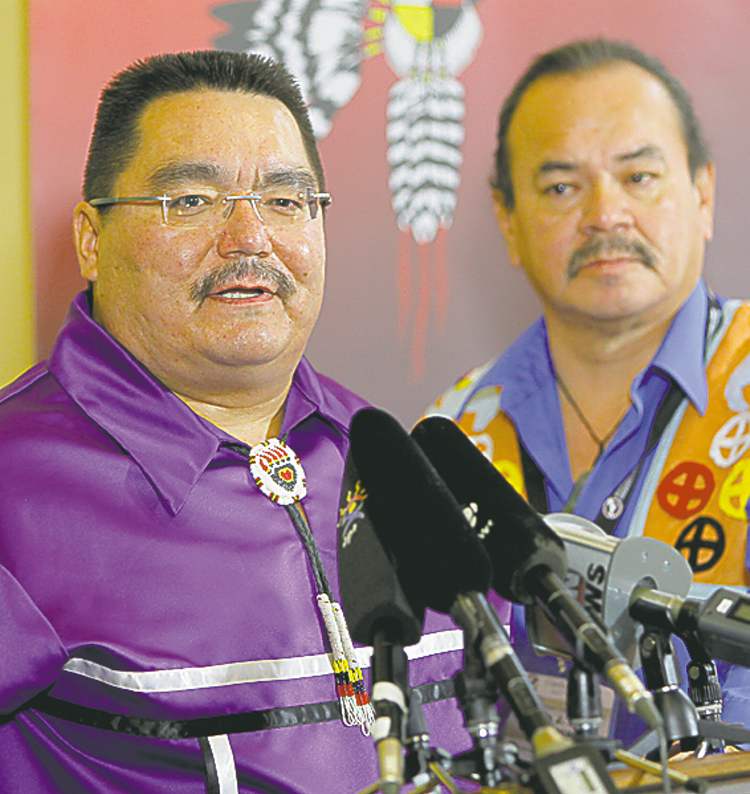
Hudson, whose band has been accused by the federal government of mismanaging millions of dollars in flood compensation, said Ottawa should be helping victims and working on long-term flood solutions rather than looking for problems he claimed don’t exist.
“I can guarantee you there is no fraud happening at Peguis First Nation,” he said.
Hudson said Peguis not only needs a floodway to divert the river around the community, it needs long-promised money to repair homes.

“There was a ministerial commitment back to July 2010 that homes would be repaired and only now are we getting that money.”
Hudson said Peguis residents are “sick and tired of the annual flooding.”
“We want to enjoy life in our home communities because if all you do is flood every year we become the victims. All we are asking is to be treated like any other Canadian.”
kevin.rollason@freepress.mb.ca
Kevin Rollason is a general assignment reporter at the Free Press. He graduated from Western University with a Masters of Journalism in 1985 and worked at the Winnipeg Sun until 1988, when he joined the Free Press. He has served as the Free Press’s city hall and law courts reporter and has won several awards, including a National Newspaper Award. Read more about Kevin.
Every piece of reporting Kevin produces is reviewed by an editing team before it is posted online or published in print — part of the Free Press‘s tradition, since 1872, of producing reliable independent journalism. Read more about Free Press’s history and mandate, and learn how our newsroom operates.
Our newsroom depends on a growing audience of readers to power our journalism. If you are not a paid reader, please consider becoming a subscriber.
Our newsroom depends on its audience of readers to power our journalism. Thank you for your support.
Kevin Rollason is a general assignment reporter at the Free Press. He graduated from Western University with a Masters of Journalism in 1985 and worked at the Winnipeg Sun until 1988, when he joined the Free Press. He has served as the Free Press’s city hall and law courts reporter and has won several awards, including a National Newspaper Award. Read more about Kevin.
Every piece of reporting Kevin produces is reviewed by an editing team before it is posted online or published in print — part of the Free Press‘s tradition, since 1872, of producing reliable independent journalism. Read more about Free Press’s history and mandate, and learn how our newsroom operates.
Our newsroom depends on a growing audience of readers to power our journalism. If you are not a paid reader, please consider becoming a subscriber.
Our newsroom depends on its audience of readers to power our journalism. Thank you for your support.
Advertisement Advertise With Us
Advertisement Advertise With Us