

Winnipegger was Canada’s first black Olympian

Advertisement
Read this article for free:
or
Already have an account? Log in here »
To continue reading, please subscribe:

Digital Subscription
One year of digital access for only $205*
- Enjoy unlimited reading on winnipegfreepress.com
- Read the E-Edition, our digital replica newspaper
- Access News Break, our award-winning app
- Play interactive puzzles
*First annual payment billed as $205.00 + GST for one year. This annual subscription will automatically renew at $233.00 + GST every 52 weeks (10% off the regular annual price of $259.35). Offer available to new and qualified returning subscribers only. Cancel any time.
To continue reading, please subscribe:
Add Free Press access to your Brandon Sun subscription for only an additional
$1 for the first 4 weeks*
- Enjoy unlimited reading on winnipegfreepress.com
- Read the E-Edition, our digital replica newspaper
- Access News Break, our award-winning app
- Play interactive puzzles
*Your next Brandon Sun subscription payment will increase by $1.00 and you will be charged $17.95 plus GST for four weeks. After four weeks, your payment will increase to $24.95 plus GST every four weeks.
Read unlimited articles for free today:
or
Already have an account? Log in here »
Hey there, time traveller!
This article was published 24/07/2012 (5170 days ago), so information in it may no longer be current.
They called him Army Howard, and he ran so awkwardly with his long-legged gait that newspaper writers of the time took note.
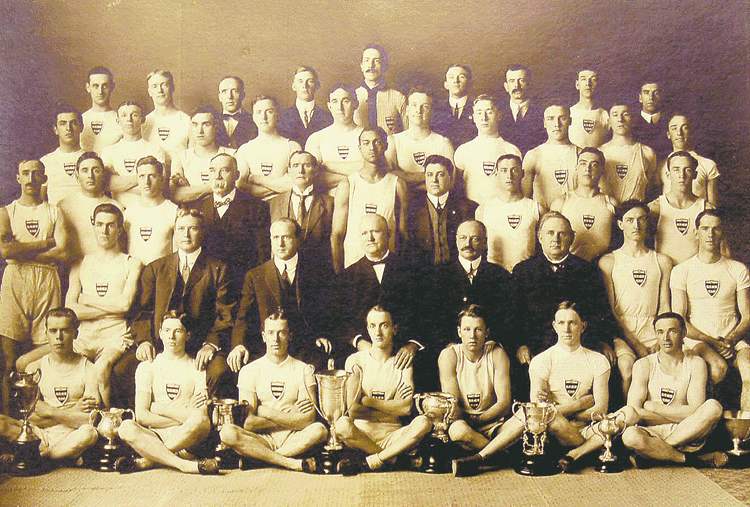
But by the time John Armstrong Howard’s running days were done, those lanky legs had carried the lightning-fast Winnipeg man straight from the North End Amateur Athletic Club and into the history books as Canada’s first black Olympian.
And yet, a full century since Howard blazed his way onto the national team at the 1912 Olympics in Stockholm, his name is rarely spoken. For most Canadian history buffs, his descendants come more quickly to mind: his grandson, Harry Jerome, smashed sprinting records on the track and competed in all three Olympic Games of the 1960s. Jerome’s legacy was highlighted in a documentary film. A bronze statue was erected on Vancouver’s Stanley Park seawall and he was induction into Canada’s Sports Hall of Fame.
Howard’s granddaughter, Valerie Jerome, also sprinted for Canada in the Olympic Games.
But first there was Army Howard. He had power in his lanky 6-3 frame, and showed grit when he faced down the racism that sometimes barred his way.
“Here he was running and doing phenomenally well,” says John Cooper, an Ontario author who penned a historical fiction book about Howard’s life. “He was young when he died, and largely he was forgotten. He tends to come up as a footnote.”
Still, Howard is remembered — beginning with his 2010 induction into the Manitoba Sports Hall of Fame. Howard was born in Winnipeg in 1889, the son of a barber. He became a mechanic and played catcher for the city’s Crescent Creamery Baseball Club. But running was his passion.
Cooper’s research uncovered patchy newspaper accounts that took notice of the sprinter. Writers dreamed up nicknames to attach to the man, most of them centred on the colour of his skin: Dusky Whirlwind, Long Coloured Drink of Water. “You had all these racist terms used to describe him,” Cooper says. “And yet, Canadian crowds loved him, they were just crazy about him. They loved the fact he burned up the track.”
Running officials weren’t always so enamoured. While Howard was training for the 1912 Olympics, the Manitoba Free Press reported he’d had a falling out with Canadian track coach Walter Knox.
Knox, the Free Press reported, accused Howard of “insubordination” — a common attack levelled at athletes of colour — and threatened to throw him off the team, though the circumstances are unclear. But the Amateur Athletic Association of Canada intervened and Howard joined the rest of the Canadian athletes in Stockholm.
He was not the only trailblazer on the team: Also making his Olympic debut in 1912 was Joe Keeper, from Norway House Cree Nation, who was Canada’s best middle-distance runner of the era.

Although Howard was a favourite to win a medal, the stress of Knox’s threats and a vicious stomach ailment derailed his run. Howard was eliminated in the semifinals of the 100- and 200-metre sprints. One year later, Howard dominated the Canadian outdoor championships, easily winning two gold sprinting medals.
Sadly, the 1912 Olympics were Howard’s one and only Games. the First World War halted any talk of an Olympics in 1916.
In 1917, with war raging in Europe, Howard made his way overseas to carry stretchers at army hospitals. He married an English woman, Edith Lipscomb, and the couple tried settling down outside Winnipeg in Ste. Rose du Lac. Soon, hostility to the interracial union would drive the couple away from Manitoba. Howard started working as a train porter for the Canadian National Railway, and ranched in the Riding Mountains. He died in 1937, when he was 48.
Though Howard never made it to the Olympic podium, his runs secured his place in history. “It wasn’t until 1928 when black athletes started to make big gains. And there’s Army Howard right in the front end, opening the door, opening possibilities. He opened the eyes of the people in terms of the potential for black athletes,” Cooper says.
melissa.martin@freepress.mb.ca
Melissa Martin
Reporter-at-large
Melissa Martin reports and opines for the Winnipeg Free Press.
Every piece of reporting Melissa produces is reviewed by an editing team before it is posted online or published in print — part of the Free Press‘s tradition, since 1872, of producing reliable independent journalism. Read more about Free Press’s history and mandate, and learn how our newsroom operates.
Our newsroom depends on a growing audience of readers to power our journalism. If you are not a paid reader, please consider becoming a subscriber.
Our newsroom depends on its audience of readers to power our journalism. Thank you for your support.
Melissa Martin
Reporter-at-large
Melissa Martin reports and opines for the Winnipeg Free Press.
Every piece of reporting Melissa produces is reviewed by an editing team before it is posted online or published in print — part of the Free Press‘s tradition, since 1872, of producing reliable independent journalism. Read more about Free Press’s history and mandate, and learn how our newsroom operates.
Our newsroom depends on a growing audience of readers to power our journalism. If you are not a paid reader, please consider becoming a subscriber.
Our newsroom depends on its audience of readers to power our journalism. Thank you for your support.
Related Articles
EYES ON LONDON: Elevated queen, giving up Twitter, remembering Munich in 1972

Advertisement Advertise With Us
Advertisement Advertise With Us