

Dad had brain disease
MacIver family finds comfort in ex-Bomber's CTE diagnosis
Advertisement
Read this article for free:
or
Already have an account? Log in here »
To continue reading, please subscribe:

Digital Subscription
One year of digital access for only $205*
- Enjoy unlimited reading on winnipegfreepress.com
- Read the E-Edition, our digital replica newspaper
- Access News Break, our award-winning app
- Play interactive puzzles
*First annual payment billed as $205.00 + GST for one year. This annual subscription will automatically renew at $233.00 + GST every 52 weeks (10% off the regular annual price of $259.35). Offer available to new and qualified returning subscribers only. Cancel any time.
To continue reading, please subscribe:
Add Free Press access to your Brandon Sun subscription for only an additional
$1 for the first 4 weeks*
- Enjoy unlimited reading on winnipegfreepress.com
- Read the E-Edition, our digital replica newspaper
- Access News Break, our award-winning app
- Play interactive puzzles
*Your next Brandon Sun subscription payment will increase by $1.00 and you will be charged $17.95 plus GST for four weeks. After four weeks, your payment will increase to $24.95 plus GST every four weeks.
Read unlimited articles for free today:
or
Already have an account? Log in here »
Hey there, time traveller!
This article was published 19/09/2012 (5126 days ago), so information in it may no longer be current.
The worry was real, even frightening to some extent, about what researchers and medical experts would find in the brain of Manitoba Sports Hall of Famer Doug MacIver after he died of natural causes in late January.
The family of the former nose guard and Grey Cup champion with the Winnipeg Blue Bombers learned last week MacIver had “moderately advanced” chronic traumatic encephalopathy, a degenerative brain condition.
“Hearing the news, there was probably a little fear going into it, thinking he might not have (CTE) because we had heard that the CFL game is nowhere near as violent and they don’t start with the full, heavy contact as early as they do down south,” MacIver’s son, Doug MacIver Jr., said Tuesday. “We worried that maybe it was that my dad was just crazy. We ended up finding out he did (have CTE), so it adds a little bit of comfort and puts some instances into perspective. There’s definitely a little more understanding and compassion for him.”
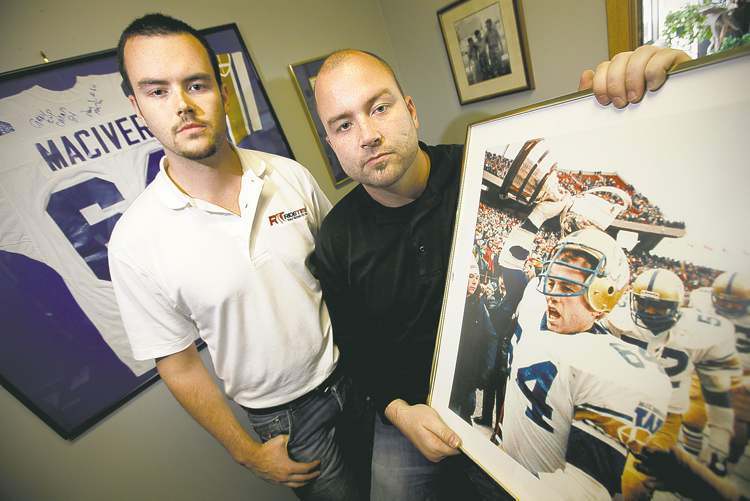
The compilation of football injuries — in particular the three concussions he believed he suffered plus all the head-smashing that’s normal during the course of a game — had caused MacIver to be concerned over the years since he left the gridiron.
“My dad had thought there was something going on,” MacIver said. “He had mentioned to me a few times about Derek Boogaard.”
It turns out that MacIver Jr., an aspiring young hockey player in 2002, dropped the gloves with the former Minnesota Wild and New York Rangers tough guy at a rookie tournament.
“My dad and I came back to that a few times just because how much bigger Derek was than I was,” MacIver said. “When Derek passed away, his family had decided to make the donations to Boston University and I sat in my dad’s office, we talked for a good while about how Derek’s family had made that donation and my dad figured he probably had it and that it would be a neat thing to do.
“That was the first time we talked in depth about it, but that’s what sparked a conversation about it.”
His father did donate his brain for research to the Boston University’s Center for the Study of Traumatic Encephalopathy.
Doug Jr. said his father was as sharp as they come, and that’s why, when he returned to Winnipeg after his playing days, some things didn’t add up.
“My dad was interested in everything… He was very successful in business. He spent a lot of time reading and was always up on current events. He definitely had talked about this, had conversations with my brother about it, too, about thinking there may be something wrong.
“I’d been gone so long — left to play junior hockey about 15 years earlier — so when when my wife and I came back two years ago, my dealings with my dad on a day-to-day basis were a little different.
“When I got back and we talked, for me, his thought process seemed to bounce around. Months before his death, I was just sitting there and I yelled at him, ‘I have no idea what you’re talking about.’ I felt I was going crazy. It was just one idea after another and they weren’t connecting. And he broke down and started crying.
“It’s probably less than five times in my life I’d seen my dad cry. It was small stuff like that.”
The MacIver family will not be walking away from the issue of how much the human brain is at risk in contact sport.

“My dad was all about giving back, research, education,” MacIver said. “He was a brilliant guy and it’s tough, having said it a few times, but if my dad was here, I firmly believe he’d do it all over again.
“The sacrifices you make in trying to achieve a dream, it’s tough to measure what they’ll be like down the road. I went through this myself. I never made it to the NHL for regular-season games but I know I would have done anything for that. The same thing for him.
“At some point, somebody will have to make the decisions for people who can’t make decisions with a clear mind. I don’t know where it leads, but people are getting bigger and bigger.
“There are tons of big guys moving fast. There’s only so much a human body can take.”
tim.campbell@freepress.mb.ca
Related Articles
Ticats to shake Pierce's hand, wish him worst of luck in Friday's game


Advertisement Advertise With Us
Advertisement Advertise With Us