

How to solve homelessness? Help them find a home
It may seem simplistic, but 'housing first' approach saves social service, policing costs
Advertisement
Read this article for free:
or
Already have an account? Log in here »
To continue reading, please subscribe:
Digital Subscription
One year of digital access for only $75*
- Enjoy unlimited reading on winnipegfreepress.com
- Read the E-Edition, our digital replica newspaper
- Access News Break, our award-winning app
- Play interactive puzzles
*Billed as $5.77 plus GST every four weeks. After 52 weeks, price increases to the regular rate of $19.95 plus GST every four weeks. Offer available to new and qualified returning subscribers only. Cancel any time.
Monthly Digital Subscription
$4.99/week*
- Enjoy unlimited reading on winnipegfreepress.com
- Read the E-Edition, our digital replica newspaper
- Access News Break, our award-winning app
- Play interactive puzzles
*Billed as $19.95 plus GST every four weeks. Cancel any time.
To continue reading, please subscribe:
Add Free Press access to your Brandon Sun subscription for only an additional
$1 for the first 4 weeks*
- Enjoy unlimited reading on winnipegfreepress.com
- Read the E-Edition, our digital replica newspaper
- Access News Break, our award-winning app
- Play interactive puzzles
*Your next Brandon Sun subscription payment will increase by $1.00 and you will be charged $17.95 plus GST for four weeks. After four weeks, your payment will increase to $24.95 plus GST every four weeks.
Read unlimited articles for free today:
or
Already have an account? Log in here »
Hey there, time traveller!
This article was published 25/09/2012 (4987 days ago), so information in it may no longer be current.
Every night for five years, Lyle Tobacco had no idea where he was going to sleep.
The 47-year-old residential-school survivor said drinking and drugs were his coping mechanism for a painful family split that caused him to lose touch with his former partner and three children.
The downward spiral landed him on Winnipeg streets, where he said he barely survived, floating from stairwells and bus shacks to core-area shelters and riverbanks.
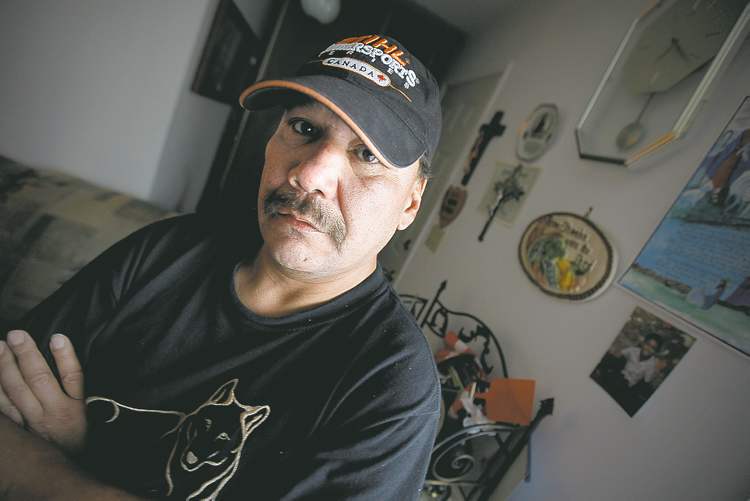
“Life had no meaning. Drinking was a career,” he said. “I wanted to give up.”
A new national study has found getting rid of homelessness on Winnipeg streets may be as simple as helping people such as Tobacco find a home.
The Mental Health Commission of Canada launched its At Home program in Winnipeg and four other Canadian cities in the fall of 2009 to test whether the “housing first” approach can help improve the lives of homeless individuals who live with at least one serious mental illness.
Preliminary findings, released last week, found spending money to help the homeless find affordable housing works, and saves hospitals, police, and other social service agencies as much as $10,000 per person.
The study investigated whether people who were moved into affordable homes and given a chance to link with other social services fared any better than homeless individuals who continued to use a hodgepodge of existing shelters, social programs and emergency services.
A total of 511 homeless individuals in Winnipeg were involved in the study, and 70 per cent were of aboriginal descent. Slightly more than half — 278 people — were placed in their choice of housing and given access to a range of other supports, including addiction treatment and mental health services.
After one year, researchers found 160 people — about 68 per cent of the “housing first” individuals — were living in stable housing, compared with only 30 per cent of the group who was not.
“When they’re having to spend so much time contemplating and thinking of where they’re going to sleep that night, there’s not much energy left to pursue health care, to pursue wellness, to pursue eating properly and employment,” said Cameron Keller, vice-president of mental health and homeless for the Mental Health Commission of Canada.
“Once people have a home and stable base they can call their own they can quit worrying about that and start focusing on a whole range of personal goals.”
For Tobacco, the program was a chance to get clean and piece his life back together. He gets counselling to deal with his alcohol and drug issues and his transition from a foster home to a northern aboriginal community as a child. Tobacco lives with a supportive roommate, and said he has started to contact his children with the hopes of reconciling.
“I’m really starting to see the light here,” he said. “It’s overwhelming, and I wish I could’ve done this years ago.”
Keller said the program has seen similar success across Canada and overall, 87 per cent of 2,255 “housing first” participants were in their first or second housing unit.

While it often took one or more attempts to get an individual into stable housing, he called the results “remarkable.”
Keller said the findings show for every $1 spent on the “housing first” approach, 76 cents is saved by reducing the burden on other health and social services, including police detention and ER visits. For a smaller group of frequent users, the savings are even greater. Keller said for every $1 spent on “housing first,” $1.68 is saved.
The federal government spent $110 million to support the five-year project in 2008, but funding is set to expire next spring. Keller said officials are expected to find out in the next week whether the government plans to continue to support the long-term research.
Lucille Bruce, At Home’s Winnipeg co-ordinator, said there’s a significant number of aboriginal residents who are homeless and are not reached by mainstream social services.
jen.skerritt@freepress.mb.ca
Who they are
THE Mental Health Commission of Canada said its “housing first” program in Winnipeg has been a success. A total of 511 homeless people are involved. Here’s a further glimpse:
- 70 per cent are of aboriginal descent
- Most are middle-aged, though one in four is under the age of 30 and one in six is over the age of 50
- 63 per cent are men and 36 per cent are women
- 40 per cent are parents of children under 18, though none is currently caring for children
- 40 per cent had parents who attended residential schools
- 12 per cent attended residential schools
- Nearly 50 per cent were involved in the foster system as children and youth
— source: Mental Health Commission of Canada
Related Articles
Housing First a good start
Advertisement Advertise With Us
Advertisement Advertise With Us
History
Updated on Tuesday, September 25, 2012 2:01 PM CDT: corrects typo