

‘Tiny asteroid’ a warning shot
Russians eye steps to protect population
Advertisement
Read this article for free:
or
Already have an account? Log in here »
To continue reading, please subscribe:
Digital Subscription
One year of digital access for only $75*
- Enjoy unlimited reading on winnipegfreepress.com
- Read the E-Edition, our digital replica newspaper
- Access News Break, our award-winning app
- Play interactive puzzles
*Billed as $5.77 plus GST every four weeks. After 52 weeks, price increases to the regular rate of $19.95 plus GST every four weeks. Offer available to new and qualified returning subscribers only. Cancel any time.
Monthly Digital Subscription
$4.99/week*
- Enjoy unlimited reading on winnipegfreepress.com
- Read the E-Edition, our digital replica newspaper
- Access News Break, our award-winning app
- Play interactive puzzles
*Billed as $19.95 plus GST every four weeks. Cancel any time.
To continue reading, please subscribe:
Add Free Press access to your Brandon Sun subscription for only an additional
$1 for the first 4 weeks*
- Enjoy unlimited reading on winnipegfreepress.com
- Read the E-Edition, our digital replica newspaper
- Access News Break, our award-winning app
- Play interactive puzzles
*Your next Brandon Sun subscription payment will increase by $1.00 and you will be charged $17.95 plus GST for four weeks. After four weeks, your payment will increase to $24.95 plus GST every four weeks.
Read unlimited articles for free today:
or
Already have an account? Log in here »
Hey there, time traveller!
This article was published 17/02/2013 (4842 days ago), so information in it may no longer be current.
MOSCOW — As Russian authorities searched Saturday for remnants of the space object that startled residents of the southern Ural Mountain region a day earlier, scientists called its shock wave a loud warning that they hoped would inspire action to prevent potential catastrophes.
“When a small piece of rock would fall on the Earth 100 years ago, it could have caused minimal damage and would have stayed largely undetected, but Friday’s accident fully demonstrated how vulnerable the technological civilization of today has become,” Vladimir Lipunov, head of the Space Monitoring Laboratory with Moscow State University, said in an interview.
“It is high time Russia should start heavily investing in building an advanced space danger monitoring and warning system, and above that, a system capable of destroying such super bombs falling on us from the skies,” he added.
The scientist’s remarks echoed concern displayed by government officials. “Today neither Russia nor the United States is capable of shooting down objects from outer space,” tweeted Dmitry Rogozin, vice-premier in charge of the nation’s defence industry.
What NASA described as a “tiny asteroid” wreaked havoc in the densely populated and highly industrialized Chelyabinsk region early Friday. Its shock wave resulted in injuries to more than 1,100 people, costing millions of dollars in damage to buildings and disrupting phone and Internet communications.
The massive sonic boom damaged 3,000 houses, 34 hospitals and clinics, and 360 schools, as well as several businesses, officials said. At least three hockey games were cancelled because of damage to the local rink.
Regional Gov. Mikhail Yurevich told reporters Saturday that damage exceeded $33 million but that 30 per cent of the windows broken by the shock wave had already been replaced. About 20,000 municipal employees, emergency workers and volunteers worked round the clock to fix the windows in a region where the overnight temperature fell to -20 C.
Police have collected several small pieces of a black rock-like substance believed to be from the space object that broke apart as it exploded over the area, Interfax reported. Divers finished their initial inspection of Chebarkul Lake, about 65 kilometres west of Chelyabinsk, but found no traces of the object, a big chunk of which was believed to have fallen into the lake, breaking the thick ice.
The Chelyabinsk region has long been one of the most important military industrial regions of Russia, where you “can’t drive a mile without passing a defence or a nuclear industry installation,” Lipunov said.
“We should be thankful to fate that this meteor, in fact, was a blessing in disguise, and instead of destroying a significant part of Russia with quite dire consequences to the rest of the world, it sent us a clear warning signal by simply blowing up a bunch of windows and lightly injuring over 1,000 people,” he said.
Rogozin said he would provide Prime Minister Dmitry Medvedev on Monday with “proposals on possibilities to register the danger of the Earth’s coming close to ‘aliens’ ” and to prevent such events in the future.
— Los Angeles Times
Related Articles
Taking aim at space threats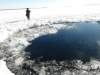
Advertisement Advertise With Us