

Nature’s rebar: Lake Winnipeg pilot projects using willows to battle shoreline erosion

Advertisement
Read this article for free:
or
Already have an account? Log in here »
To continue reading, please subscribe:
Monthly Digital Subscription
$1 per week for 24 weeks*
- Enjoy unlimited reading on winnipegfreepress.com
- Read the E-Edition, our digital replica newspaper
- Access News Break, our award-winning app
- Play interactive puzzles
*Billed as $4.00 plus GST every four weeks. After 24 weeks, price increases to the regular rate of $19.95 plus GST every four weeks. Offer available to new and qualified returning subscribers only. Cancel any time.
Monthly Digital Subscription
$4.99/week*
- Enjoy unlimited reading on winnipegfreepress.com
- Read the E-Edition, our digital replica newspaper
- Access News Break, our award-winning app
- Play interactive puzzles
*Billed as $19.95 plus GST every four weeks. Cancel any time.
To continue reading, please subscribe:
Add Free Press access to your Brandon Sun subscription for only an additional
$1 for the first 4 weeks*
- Enjoy unlimited reading on winnipegfreepress.com
- Read the E-Edition, our digital replica newspaper
- Access News Break, our award-winning app
- Play interactive puzzles
*Your next Brandon Sun subscription payment will increase by $1.00 and you will be charged $17.95 plus GST for four weeks. After four weeks, your payment will increase to $24.95 plus GST every four weeks.
Read unlimited articles for free today:
or
Already have an account? Log in here »
Hey there, time traveller!
This article was published 08/06/2013 (4720 days ago), so information in it may no longer be current.
At times, it seems Lake Winnipeg is determined to become Lake Agassiz again. The ice-age lake that formed 13,000 years ago included present-day Lake Winnipeg, Lake Manitoba, Lake Winnipegosis and Lake of the Woods. It spread all the way west to the Manitoba escarpment, south to Fargo, N.D. and covered a vast amount of northwestern Ontario.
Even though it is a mere remnant of that great lake, Lake Winnipeg is still the 13th largest in the world and drains a basin that covers a million square kilometres across several provinces and states.
And the lake is growing. Cottagers and residents around the lake have seen the shoreline literally disappear into the water.
There’s no line in the sand. It is a constantly moving line of scrimmage, albeit, in one direction.
Much of this losing battle can be blamed on high water. It’s one thing for Manitoba Hydro to keep the lake at a maximum level of 217 metres above sea level, but when the wind comes from the north and water rushes from the lake’s massive north basin into the smaller south basin, whatever level it is at can quickly jump a couple metres higher, especially when there are strong waves.
But you can also blame cottagers and residents who tear out the native plants and trees that help stabilize the shoreline and replace them with grass so they can have an unhindered waterfront view.
What works on the front lawn of a Winnipeg residence isn’t exactly the best strategy beside an inland ocean.
It’s part of the reason the East Interlake Conservation District is working on several pilot projects on the west side of Lake Winnipeg to show people what they can do to slow the relentless onslaught.
And — full disclosure — the lakeshore right in front of my family’s cottage was selected as one of those project sites.
Armand Belanger, the EICD’s manager, said willows are the perfect plant to use to protect a shoreline. After all, that’s where they’re found naturally, with roots growing as deep as five metres.
He said the pilot projects have already seen success at Hnausa Provincial Park and near the Icelandic River south of Riverton.
“People are used to rip-rap and hard edging,” he said. “But even the U.S. Corps of Engineers calls willows nature’s rebar because of their roots.”
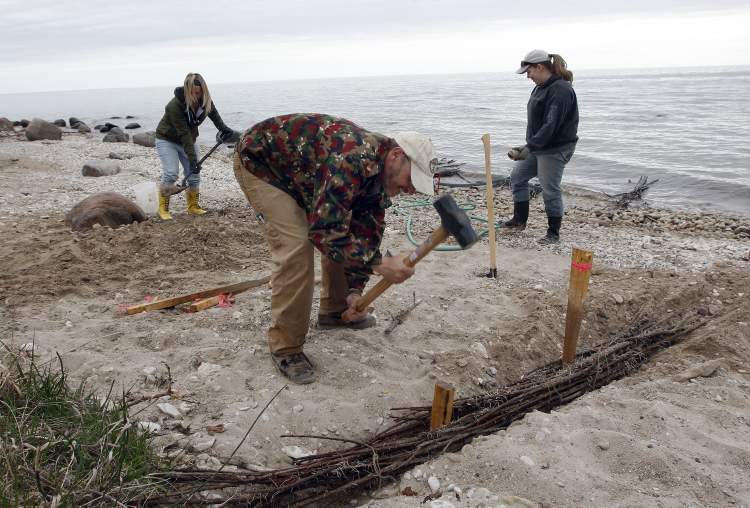
Last fall, after participating in a shoreline workshop, a group of volunteers went north of Gimli to Hnausa and took shovels to the sand to bury several bundles of sandbar willow branches in the sand.
In the past seven years, almost 20 metres of shoreline had eroded. Even more troubling, the lake had pushed the shoreline back to stands of mature trees on either side of a grassy open area. If those trees were to drop in the water, there would be nothing stopping the erosion process from accelerating.
Other areas around the lake have employed shoreline-protection projects using tons of jagged boulders, steel plates or metal cages filled with rock.
But those techniques are not only costly, they change the nature of the shoreline forever, as well as its accessibility.
Our family wanted to try something more natural to see if that would work — something close to what was probably there before the grass.
As the parents of a child who uses a wheelchair full-time, we also wanted the beach to continue to be accessible for our daughter.
And in the end — like other cottagers — we also wanted to protect our investment.
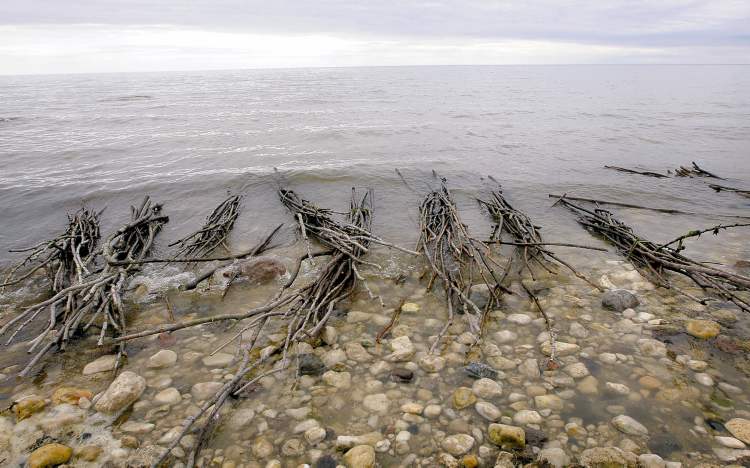
Belanger said once the willows and their roots are established, they will not only help protect the shoreline by holding the soil and sand together, they will also serve to help filter out some of the nutrients and sediment from run-off before they get out into the lake.
Belanger said the roots will also serve as airbags, redistributing the energy inflicted by pounding waves of water, to help decrease erosion.
There’s also an unexpected bonus: Once they start growing, the willows will also provide shelter for birds.
When we dug up one of the bundles planted last fall we could see success already — they were covered with short white roots springing out from the branches. That bundle was quickly replanted.
Nearby, green willow shoots are already popping out of the sand.
“This is fantastic,” said Chris Randall, who is currently doing his master’s degree at the University of Manitoba on willows being used to bolster shorelines.
“With my study, I don’t usually want to open it up again, but this one… I can see how the roots are growing. They’re growing along the whole length. It’s working.”
Unfortunately, the few willows that were planted like stakes on the shore itself never rooted — a couple of them also appeared to have been run over by snowmobiles. A few more willows were inserted into the soil, only deeper than before.
As for final advice, Belanger said the main point is, “don’t let anybody walk on the willows.
“And hope the water levels don’t come up this year.”
We’ll continue monitoring the pilot project on a sporadic basis and report on how it is doing, whether any changes need to be made, or if it has to be scrapped to try something new.
We know you can’t stop Mother Nature and an inland ocean, but we’re hoping the willows will at least serve as a natural speed bump to slow the erosion.
kevin.rollason@freepress.mb.ca
Kevin Rollason is a general assignment reporter at the Free Press. He graduated from Western University with a Masters of Journalism in 1985 and worked at the Winnipeg Sun until 1988, when he joined the Free Press. He has served as the Free Press’s city hall and law courts reporter and has won several awards, including a National Newspaper Award. Read more about Kevin.
Every piece of reporting Kevin produces is reviewed by an editing team before it is posted online or published in print — part of the Free Press‘s tradition, since 1872, of producing reliable independent journalism. Read more about Free Press’s history and mandate, and learn how our newsroom operates.
Our newsroom depends on a growing audience of readers to power our journalism. If you are not a paid reader, please consider becoming a subscriber.
Our newsroom depends on its audience of readers to power our journalism. Thank you for your support.
Kevin Rollason is a general assignment reporter at the Free Press. He graduated from Western University with a Masters of Journalism in 1985 and worked at the Winnipeg Sun until 1988, when he joined the Free Press. He has served as the Free Press’s city hall and law courts reporter and has won several awards, including a National Newspaper Award. Read more about Kevin.
Every piece of reporting Kevin produces is reviewed by an editing team before it is posted online or published in print — part of the Free Press‘s tradition, since 1872, of producing reliable independent journalism. Read more about Free Press’s history and mandate, and learn how our newsroom operates.
Our newsroom depends on a growing audience of readers to power our journalism. If you are not a paid reader, please consider becoming a subscriber.
Our newsroom depends on its audience of readers to power our journalism. Thank you for your support.
Advertisement Advertise With Us
Advertisement Advertise With Us