

‘The system failed Mr. Sinclair’: health minister
Inquest report includes 63 recommendations

Advertisement
Read this article for free:
or
Already have an account? Log in here »
To continue reading, please subscribe:

Digital Subscription
One year of digital access for only $205*
- Enjoy unlimited reading on winnipegfreepress.com
- Read the E-Edition, our digital replica newspaper
- Access News Break, our award-winning app
- Play interactive puzzles
*First annual payment billed as $205.00 + GST for one year. This annual subscription will automatically renew at $233.00 + GST every 52 weeks (10% off the regular annual price of $259.35). Offer available to new and qualified returning subscribers only. Cancel any time.
To continue reading, please subscribe:
Add Free Press access to your Brandon Sun subscription for only an additional
$1 for the first 4 weeks*
- Enjoy unlimited reading on winnipegfreepress.com
- Read the E-Edition, our digital replica newspaper
- Access News Break, our award-winning app
- Play interactive puzzles
*Your next Brandon Sun subscription payment will increase by $1.00 and you will be charged $17.95 plus GST for four weeks. After four weeks, your payment will increase to $24.95 plus GST every four weeks.
Read unlimited articles for free today:
or
Already have an account? Log in here »
Hey there, time traveller!
This article was published 12/12/2014 (4315 days ago), so information in it may no longer be current.
The province’s health minister apologized to the family of Brian Sinclair today for systematic failures that led to the man’s death after he waited 34 hours in an emergency room without receiving care in 2008.
Health Minister Sharon Blady said this morning in a statement, “the death of Mr. Brian Sinclair was a preventable tragedy.
“The system failed Mr. Sinclair and for that I humbly apologize to his family, friends and loved ones.”
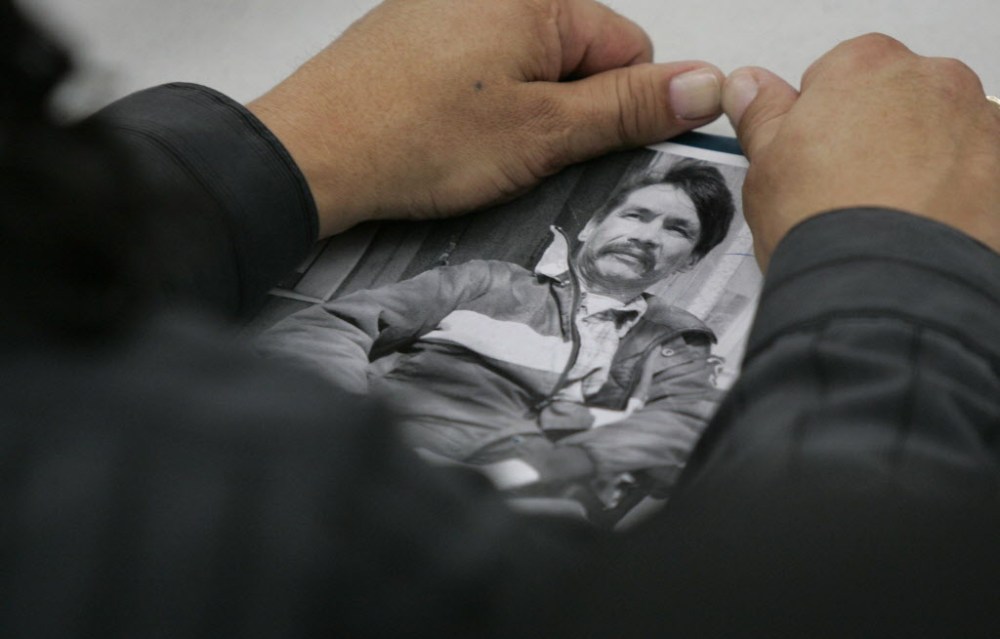
Blady was responding to the release today of the judicial inquest report into the 45-year-old man’s death.
The double-amputee, confined to a wheelchair, sat in the Health Sciences Centre ER for 34 hours waiting for care that never came. An autopsy determined by the time Sinclair was discovered and rushed into the emergency department’s treatment area, rigor mortis was setting in and he may have been dead as long as seven hours.
The inquest, which heard from 82 witnesses over 10 months last year, was told Sinclair died of a treatable bladder infection. His blocked urinary catheter tube needed changing.
The WRHA says there were few recommendations contained in the report that were new to staff. Work is nearly finished on a handful and well underway on about half of the 63.
At a press conference, Blady would not acknowledge that racism played a role in Sinclair’s death, a question the inquest sidestepped but that underpinned much of the public outcry about the tragedy.
But, both Blady and Winnipeg Regional Health Authority president and CEO Arlene Wilgosh said racism exists in the wider health system as is does in the public at large, though staff are committed to giving every patient the same high-quality care regardless of race.
As they have before, Blady and Wilgosh again apologized to the Sinclair family for the man’s treatment and for his death.
“None of what we can do will make up for your loss,” said Blady.
Wilgosh said the death was a turning point for many in the health care system, that it would be putting it mildly to suggest the Sinclair tragedy had an impact on staff.
Sinclair’s family was given a copy of the inquest report late Wednesday. Robert Sinclair, Brian’s cousin, said hospital staff made racial stereotypes of the man as drunk or homeless rather than a person in need of medical care.
“These stereotypes were at the root of why Brian Sinclair was ignored for 34 hours,” he said.
“Those stereotypes have not gone away. Aboriginal people frequently experience the same kinds of stereotypes when we try to access the health care system today. Unfortunately, this inquest report does not probe into those issues, and that will not make things any better.”
ER physician disappointed
Dr. Alan Drummond, an emergency room physician in Perth, Ont., and a past president of the Canadian Association of Emergency Physicians, said he is disappointed by the report.
Drummond said emergency physicians across the nation have been waiting for the report, but he sees little in it addressing problems with crowding in the emergency room, flow and bed capacity.
“I’m looking for evidence that the inquest understood the root cause of the problem — I see very little,” he said.
“I’m frankly disappointed.”
Death not in vain: judge
A judge said his death didn’t have to happen.
Provincial court Judge Tim Preston said, in a 195-page report released today looking at the death on Sept. 21, 2008, that while he “was a man with a number of serious health challenges… the acute peritonitis which caused his death was avoidable.
“Brian Sinclair died because he did not receive the initial treatment he required.”
But Preston said while Sinclair’s death was tragic and avoidable, he didn’t die “in vain.

“His death prompted a complete overhaul of the ‘Front End’ of HSC ED and a systematic streamlining of the registration and triage process in that facility.”
“Hopefully, the recommendations that I make, as a result of hearing from those people who cared for Brian Sinclair during his later years and experts in areas of Emergency Medicine, will help prevent anything like this from ever recurring.”
Rejects call to find death a homicide
Vilko Zbogar, one of the lawyers acting for Sinclair’s family said Sinclair died because of “fatal neglect by medical professionals charged with a vulnerable person’s care. In law, that is called homicide, even if the result is unintended.”
Zbogar said while the family called Sinclair’s death a homicide, the judge decided it was “natural”, but didn’t add any reasons why he made that finding.
“To reject that human factors substantially contributed to Brian Sinclair’s death, without explaining in detail why, feels like an injustice to the Sinclair family,” Zbogar said.
Zbogar, on the final day of the inquest, told the judge he wanted him to determine in the inquest report that Sinclair’s death was a homicide and the family again requested the provincial government call a public inquiry into his death.
In his report, Preston said that the province’s chief medical examiner, Thambirajah Balachandra, classified Sinclair’s death as “death by natural causes,” not meaning “inevitable” or “preventable”.
Preston chided and called it “somewhat surprising” that Zbogar urged him to rule Sinclair’s death was a homicide when “no questions were put to the CME by counsel for the family on the issue of Mr. Sinclair’s manner of death.
“I am not persuaded that Mr. Sinclair’s manner of death was a homicide, nor would I consider altering the CME’s expert conclusion.”
Health dept. to report back within 90 days
Blady said the province has assigned deputy minister of health Karen Herd to head an implementation team. She said regional health authority boards will appoint senior members to the team.
Blady said the team will review all 63 recommendations by the judge and report back within 90 days with short-, medium- and long-term implementation strategies.
“We are committed to ensure other families will not face the same tragic and preventable loss that has been faced by Mr. Sinclair’s family.”
The recommendations include:
- provincial regional health authorities (RHAs) review the floor plan of all emergency departments to ensure that no persons in the waiting room requiring medical care face away from the triage desk;
- RHAs review their policies and procedures to ensure that persons in ER waiting rooms are awakened at regular intervals; and
- that RHAs look at the feasibility of recruiting and retaining an indigenous elder for ERs, where deemed appropriate.
Racism not addressed in report: critics
Lawyer Emily Hill, of Aboriginal Legal Services of Toronto, which participated in the inquest until February, when Preston limited its scope to what happened in the emergency waiting room and not issues of racism, said in a statement the organization is still looking for answers to questions raised by Sinclair’s death.

Hill said the inquest report doesn’t “go far enough in addressing the root causes of Brian Sinclair’s death.
“The report spends 61 paragraphs outlining the incorrect assumptions that were made by nurses and security guards about Brian Sinclair’s presence in the HSC Emergency Department waiting room, yet does not address the reason these assumptions were made.”
Christa Big Canoe, legal advocacy director of ALST, said aboriginal people still face negative stereotypes in both Canadian society and the health care system.
“Brian Sinclair was a victim of those stereotypes because staff assumed he was homeless or intoxicated, instead of treating him as someone who needed medical care. Aboriginal patients continue to face these stereotypes every day when they access health care services and this issue was largely ignored in the report.”
kevin.rollason@freepress.mb.ca
Kevin Rollason
Reporter
Kevin Rollason was a general assignment reporter at the Free Press.
Our newsroom depends on a growing audience of readers to power our journalism. If you are not a paid reader, please consider becoming a subscriber.
Our newsroom depends on its audience of readers to power our journalism. Thank you for your support.
Kevin Rollason
Reporter
Kevin Rollason was a general assignment reporter at the Free Press.
Our newsroom depends on a growing audience of readers to power our journalism. If you are not a paid reader, please consider becoming a subscriber.
Our newsroom depends on its audience of readers to power our journalism. Thank you for your support.
Related Articles
Implementing Sinclair inquest recommendations could take years: province
Advertisement Advertise With Us
Advertisement Advertise With Us
History
Updated on Friday, December 12, 2014 9:08 AM CST: Report released.
Updated on Friday, December 12, 2014 9:18 AM CST: Updated with recommendations.
Updated on Friday, December 12, 2014 9:58 AM CST: Updates with judge's comments from report.
Updated on Friday, December 12, 2014 10:02 AM CST: Updated with reaction from ALST.
Updated on Friday, December 12, 2014 10:13 AM CST: Updated with health minister statement.
Updated on Friday, December 12, 2014 10:50 AM CST: Adds comment on homicide.
Updated on Friday, December 12, 2014 11:52 AM CST: Adds more comments from Blady.
Updated on Friday, December 12, 2014 1:06 PM CST: Adds comment from Dr. Alan Drummond.