

City awaits test results to see whether drinking water is safe
Advertisement
Read this article for free:
or
Already have an account? Log in here »
To continue reading, please subscribe:

Digital Subscription
One year of digital access for only $205*
- Enjoy unlimited reading on winnipegfreepress.com
- Read the E-Edition, our digital replica newspaper
- Access News Break, our award-winning app
- Play interactive puzzles
*First annual payment billed as $205.00 + GST for one year. This annual subscription will automatically renew at $233.00 + GST every 52 weeks (10% off the regular annual price of $259.35). Offer available to new and qualified returning subscribers only. Cancel any time.
To continue reading, please subscribe:
Add Free Press access to your Brandon Sun subscription for only an additional
$1 for the first 4 weeks*
- Enjoy unlimited reading on winnipegfreepress.com
- Read the E-Edition, our digital replica newspaper
- Access News Break, our award-winning app
- Play interactive puzzles
*Your next Brandon Sun subscription payment will increase by $1.00 and you will be charged $17.95 plus GST for four weeks. After four weeks, your payment will increase to $24.95 plus GST every four weeks.
Read unlimited articles for free today:
or
Already have an account? Log in here »
Hey there, time traveller!
This article was published 27/01/2015 (4241 days ago), so information in it may no longer be current.
The precautionary boil-water advisory for Winnipeg remains in effect, with an update on the situation scheduled for early this afternoon.
The city has re-sampled the locations that came back positive for low-level bacteria and should have results from those later today, Geoff Patton, acting director in the water and waste department told reporters this morning.
“The expectation for us is that there was a problem with the sampling and that these samples would come back clear and OK,” Patton said. “But we are doing several ‘what-if’ scenarios should the results be different.”
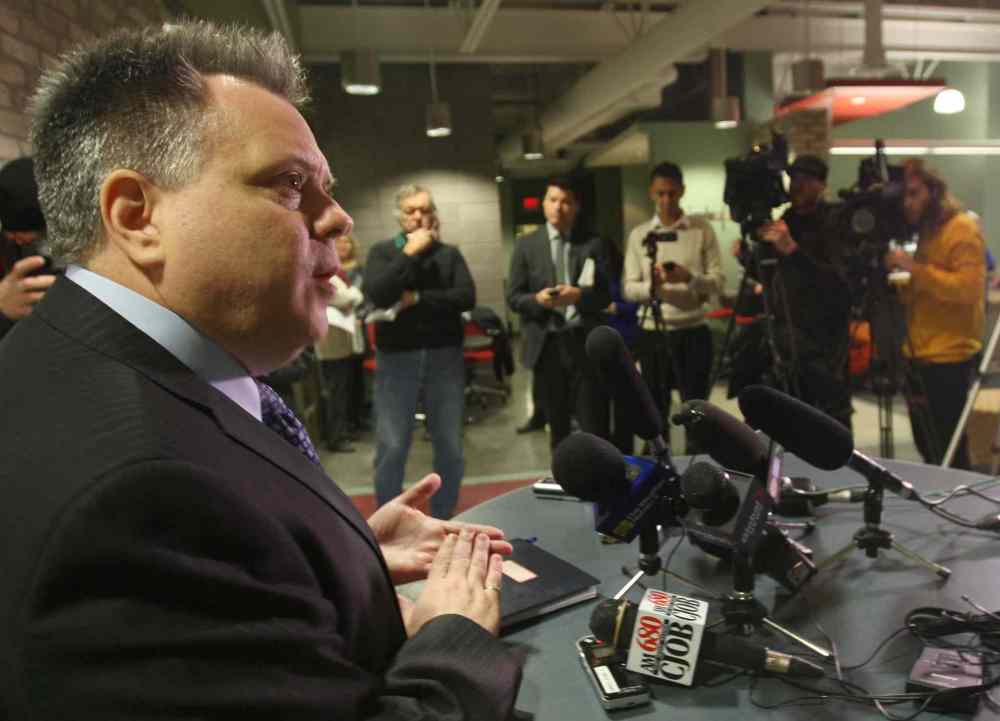
Further updates on the samples will come from City Hall later this afternoon. If the samples come back clean, Patton saidhe expects the boil-water advisory to be lifted quickly.
This is the first city-wide boil-water advisory for Winnipeg, Patton said.
Low counts of coliform bacteria — including E. coli — were found in six out of 39 water samples collected Monday. Testing of the water, which usually takes 16 to 24 hours, yielded coliform counts ranging from one to nine units per 100 millilitres of water.
The acceptable coliform count for drinking water is zero.
Five out of six positive samples were collected east of the Red River. A sixth was collected in southwest Winnipeg.
Patton said the results of the re-sampling are being processed as fast as they can, adding that the procedures cannot be rushed to ensure an accurate test reading.
Among the ‘what-if’ scenarios the city is preparing for include a wide range of possibilities from a single contaminated sample in one specific area of the city to a broader range of possible contamination, as was the case Monday evening.
“Everything we do around (these scenarios) will be around public health,” Patton said, adding that the city should not be treating this as a ‘no-water’ event and there is still water available for residents; precautions need to be taken before consuming it.
Patton called the situation “rare” and adds there are no signs the positive samples came from an issue with the water infrastructure in the city.
“All the operational items all show there are no issues. The pressure has been held constant, there has been multiple sampling at our supply location – that’s been clear. We (have) sample results upstream and downstream, they were clear,” said Patton, who was not willing to say or give a percentage possibility that this was a false positive – despite the conflicting information the city has regarding Monday’s samples.
As of 7:30 a.m. today, there have been no reports of any water-related illnesses, the WRHA said.
Helen Clark, chief operating officer, emergency response and patient transport, with the Winnipeg Regional Health Authority, confirmed there is no risk to patients in Winnipeg hospitals and that the WRHA has no knowledge of any water-related illness since the precautionary advisory was given Monday evening.
No surgeries have been cancelled, Clark said.

“In the emergency medical services system, they have a ‘first-watch’ system that flags any clusters of reports of specific illnesses. We haven’t seen any water-related clusters at this point,” Clark said.
The WRHA is providing long-term care patients with bottle water for drinking. The health authority reminds people that there is no risk when bathing, though extra care should be taken when bathing young children and infants.
The WRHA says it has already activated a number of water contingency plans, including food care (the washing of vegetables, etc.) and the extra stocking of bottled water in facilities around the city.
Clark said “tens of thousands, if not more” of bottled water would be ordered should the boil-water advisory continue through this afternoon.
On Tuesday, the province’s medical officer of health and the drinking-water office of Manitoba Conservation and Water Stewardship issued a precautionary boil-water advisory for areas of Winnipeg east of the Red on Tuesday at 5:30 p.m.
At about 5:45 p.m., Mayor Brian Bowman extended the advisory to the entire city due to what he described as “an abundance of caution.”
Although Winnipeg’s water and waste department was confident late Tuesday the coliform bacteria counts are the result of a sampling error, Bowman said city engineers could not provide him with assurances water west of the Red River is safe to drink in the event the initial test results are borne out by a second round of drinking-water samples collected Tuesday.
“We couldn’t be given a 100-per-cent assurance,” Bowman said at city hall early Tuesday evening. “This is a connected water system. The water flows between west and east.”
The city is expediting the testing of additional water samples and hopes to see the results by Wednesday afternoon, said Geoff Patton, acting director of Winnipeg’s water and waste department.
“We’re confident in the safety of our water and we’re resampling to prove this out. But what we have in front of us is testing samples that show this low level of bacteria,” Patton said. “We decided to issue this precautionary boil-water order to the whole City of Winnipeg until further sampling can prove the bacteria is not an issue and it was more than likely a sampling error in our procedures.”
Winnipeg is served by a five-year-old, $300-million water-treatment plant located at Deacon Reservoir, east of the Red River Floodway. It uses a series of treatment processes – coagulation, flocculation, ozonation, filtration, chlorine disinfection and ultraviolet radiation – to eliminate viruses, bacteria and protozoa from the city’s drinking water, which is supposed to be more pristine than bottled water.
Patton said he believes the presence of coliform bacteria in six water samples is a result of sampling errors.
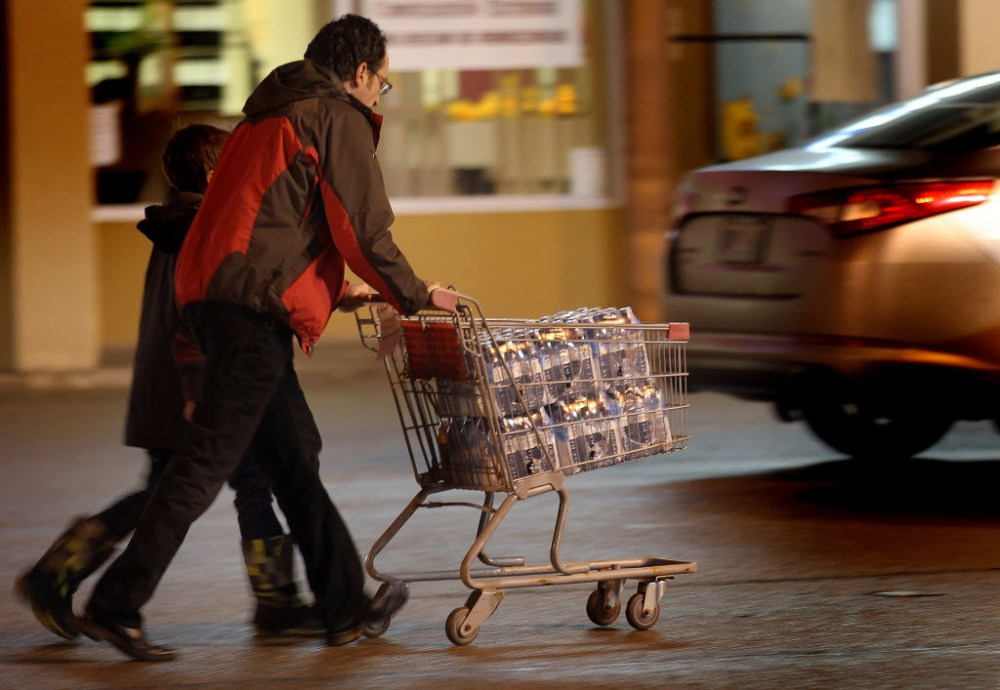
“There is an abundance of chlorine at these locations. Chlorine and the presence of bacteria do not go together,” he said. “We see clean results upstream and downstream of these locations and then we see these unusual samples. So what has happened?”
He said a number of things can go wrong with sampling to yield what lab technicians call “false positives,” or erroneous reports of biological contamination.
Tuesday’s city-wide boil-water advisory is the first in Winnipeg in recent memory. Water-borne illnesses such as typhoid were common in the city prior to the 1919 completion of the Winnipeg Aqueduct, which carries water from Indian Bay on Shoal Lake, near the Manitoba-Ontario border, to Deacon Reservoir.
In 2013, approximately 1.3 million Montrealers were told to boil water after the city adjusted levels on a reservoir, causing sediment to flood part of that city’s drinking-water system.

That incident pales in comparison to the 1993 cryptosporidiosis outbreak in Milwaukee, when protozoan contamination killed 104 people and made 403,000 ill over a two-week period that demanded a boil-water advisory.
Issuing a precautionary boil-water advisory for an entire city is a tough call, said Tom Pearson, a retired city water engineer.
“On one hand, the risk is fairly low; but the risk to the young, the old and the immune-compromised could be serious,” he said. “The economic fall-out for businesses, hospitals and on and on is significant. And the very act of boiling water can result in scald risks for the elderly and others in weakened/marginalized situations.”
bartley.kives@freepress.mb.ca
adam.wazny@freepress.mb.ca
wfpvideo:4017378958001:wfpvideoFact sheets
What to do when you are advised to boil your water
How to operate commercial/public facility under a boil water advisory
For additional information on water use go to the Province of Manitoba’s Drinking Water site.
Schools will be open
Brian O’Leary, chairman of the Metro Winnipeg Superintendents, said all Winnipeg schools will open tomorrow but schools are asking parents to send bottled or boiled water with their children.
Related Articles
New tests clean, but boil-water advisory still in effect for Winnipeg.jpg?w=100)


Advertisement Advertise With Us
Advertisement Advertise With Us
History
Updated on Tuesday, January 27, 2015 6:02 PM CST: Updates boil-water advisory
Updated on Tuesday, January 27, 2015 6:28 PM CST: Updates with Bowman comment.
Updated on Tuesday, January 27, 2015 6:36 PM CST: Write-thru
Updated on Tuesday, January 27, 2015 7:31 PM CST: Adds video.
Updated on Tuesday, January 27, 2015 7:44 PM CST: Adds World of Water quotes
Updated on Tuesday, January 27, 2015 9:32 PM CST: Adds school information.
Updated on Tuesday, January 27, 2015 10:11 PM CST: Writethru
Updated on Wednesday, January 28, 2015 8:16 AM CST: Updates with information from morning press conference.
Updated on Wednesday, January 28, 2015 8:35 AM CST: Adds comments this morning from WRHA spokeswoman.
Updated on Wednesday, January 28, 2015 8:50 AM CST: Adds video from January 28