

All aboard a not-yet broken bus

Advertisement
Read this article for free:
or
Already have an account? Log in here »
To continue reading, please subscribe:
Digital Subscription
One year of digital access for only $75*
- Enjoy unlimited reading on winnipegfreepress.com
- Read the E-Edition, our digital replica newspaper
- Access News Break, our award-winning app
- Play interactive puzzles
*Billed as $5.77 plus GST every four weeks. After 52 weeks, price increases to the regular rate of $19.95 plus GST every four weeks. Offer available to new and qualified returning subscribers only. Cancel any time.
Monthly Digital Subscription
$4.99/week*
- Enjoy unlimited reading on winnipegfreepress.com
- Read the E-Edition, our digital replica newspaper
- Access News Break, our award-winning app
- Play interactive puzzles
*Billed as $19.95 plus GST every four weeks. Cancel any time.
To continue reading, please subscribe:
Add Free Press access to your Brandon Sun subscription for only an additional
$1 for the first 4 weeks*
- Enjoy unlimited reading on winnipegfreepress.com
- Read the E-Edition, our digital replica newspaper
- Access News Break, our award-winning app
- Play interactive puzzles
*Your next Brandon Sun subscription payment will increase by $1.00 and you will be charged $17.95 plus GST for four weeks. After four weeks, your payment will increase to $24.95 plus GST every four weeks.
Read unlimited articles for free today:
or
Already have an account? Log in here »
Hey there, time traveller!
This article was published 18/09/2015 (3898 days ago), so information in it may no longer be current.
Ninety-four minutes on a Winnipeg Transit bus allows a lot of time to think, at least until the numbness born in your buttocks begins creeping down your legs.
That part, the inevitable result of shiftless, jolting minutes on a perfunctorily padded seat, kicked in at about the 35th minute for me. Otherwise, my long and looping ride on the No. 18, cutting the city half-lengthwise from Osborne Village down Main Street and back again, was fine.
Confession: because it is Winnipeg transit, I rode half-expecting something to go wrong. Two weeks ago, my partner was on a bus home from Polo Park, which started belching smoke from somewhere in its guts. The driver cut the engine. Riders sat on a dead bus for 15 minutes until a replacement showed up.
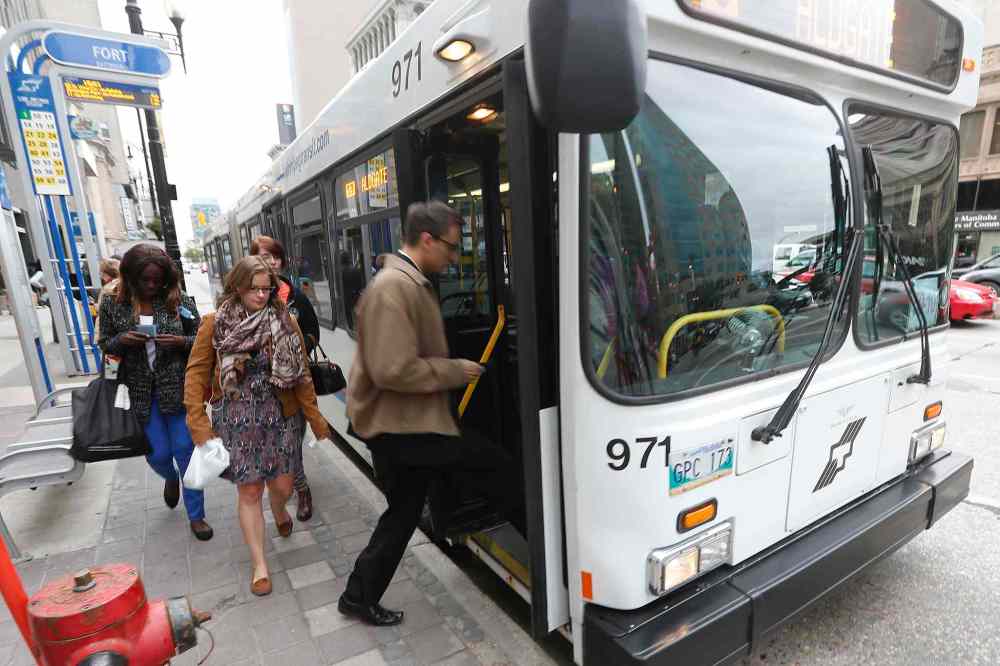
So a week later, when Winnipeg Transit announced rush-hour service on three dozen routes would be cut, we weren’t surprised. Groaning bus maintenance backlog, right. In the statement that was rushed onto the Internet just before 9 p.m. that night, Winnipeg chief administrative officer Doug McNeil apologized.
Words do not get Winnipeggers to and from work. They won’t carry seniors from the grocery store to home. An apology cannot sew the frayed ends of a family’s stretched-out day together. To see those parts, to understand the role transit plays in people’s lives, you can’t say it. You have to ride.
That is why I hopped on the No. 18 at River and Osborne at 2:04 p.m. one day: to watch, and think. On a busy route, the bus arrived when it was due, though I know enough about the strained services in this city to know that’s far from guaranteed. Just consider the sterling Twitter reviews.
“Winnipeg transit makes me sick with anxiety every single day,” one local bus rider Tweeted this week. “Will my bus show up? How late will it be if it does?”
But my bus showed up, on time and already heavy. Most of the seats were taken, save some lonely aisle spots near the back. An overhead ad promised me I can take control of my debt. A car dealership wanted me to know I can build my credit, if I work out a financing deal with it on a new car.
The subtext, clearly: you, too, can escape this bus when there’s someone else’s money to be made.
The bus rocked down the streets, turning onto Graham from Vaughan. Passengers cleared out there, replaced in an instant by a whole new load. A young mother with her two young children in tow squeezed them close to her legs, in a single seat. She coaxed the eldest, a boy of about four, to sit next to me.
He tried it, hesitantly, then flung his tiny body back into her arms. “He’s so shy,” she laughed, and in 30 seconds the empty seat was gone.
After the rush-hour cuts were announced, transit union president John Callahan said, “I hate to say I told you so,” pointing to long-standing warnings about the state of the city’s fleet. Mayor Brian Bowman promised the “oversight” would never happen again. He also said: the “expectation needs to be more realistic.”
As if real cities don’t really build better transit. As if real cities couldn’t have seen this coming, taken action on the warnings that had been percolating for at least three months. As if evidence of this fact isn’t clear whenever you travel to other cities, ones that have valued transit long and hard enough.
We lurched down Main. At 2:38 p.m., a car almost slammed into the bus, as it nosed into the middle lane to avoid construction. A gaggle of kids holding Slurpees loudly decided the driver was trying to kill them, before launching into a questionable discussion about the riches to be made if a car hits your bike.
“Give yourself bruises, give yourself cuts, and they’ve got to pay you,” a boy, about 11, says confidently.
There’s a hope I have for those kids, which is not that they strike it rich via a catastrophic accident. It is that by the time they’re old enough to hunger for the city, wander its nights, spill out young and full of energy into a bustling Winnipeg night, they’ll have better transit to move them between.
Strong transit liberates people, and places. Not just seniors and students and people living in poverty, but a city entire. It ensures the city is open to all, and releases from it some of the environmental weight of our movements. It knits neighbourhoods together, that are otherwise far out of reach.
Flashback to riding the old 62 as a car-less teen, the one bungee cord yanking me from the city outskirts to the theatres, the art, the music and the heart…
On those 94 minutes on the No. 18, I kept thinking to ask my fellow passengers about this, about what they think. But then I’d be that weirdo on the bus — we all have a story, the one that wiggled down next to you and launched into a soliloquy about woes you can’t quite comprehend. Smile patiently, wait for the end.
Besides, they’re all wearing headphones, tapping on screens, while the sidewalks and store windows slide by. Trying to drown out the noise of conversations they don’t belong to, and people they don’t know. Maybe they’re thinking about whether or not they can really get that car loan.

Then they could get out of this mess, this whittled-down chain of less- and not-yet-broken buses. This is all we’ve really come to know: low expectations.
Besides, maybe I didn’t need to hear someone else say it. Maybe I already know. Maybe I believe effective cities understand that if roads are the arteries of the city, then transit is the thickest part of the blood. Moving the vital parts — even shy toddlers — from where they fill up, to where they need to go.
By 3:30 p.m., the No. 18 was leaving downtown for Osborne Village, now half-empty. Fewer people were riding that way, at that time of day, than moving towards the more blue-collar neighbourhoods north. In the back of the bus, a man with a crisp white shirt and a black moustache was plastered against the window, vocally trying to figure out how long it’ll be before he can get off in Tuxedo.
“You never know,” he says finally, to no-one in particular. “With the bus you just never know.”
melissa.martin@freepress.mb.ca
Melissa Martin
Reporter-at-large
Melissa Martin reports and opines for the Winnipeg Free Press.
Every piece of reporting Melissa produces is reviewed by an editing team before it is posted online or published in print — part of the Free Press‘s tradition, since 1872, of producing reliable independent journalism. Read more about Free Press’s history and mandate, and learn how our newsroom operates.
Our newsroom depends on a growing audience of readers to power our journalism. If you are not a paid reader, please consider becoming a subscriber.
Our newsroom depends on its audience of readers to power our journalism. Thank you for your support.
Melissa Martin
Reporter-at-large
Melissa Martin reports and opines for the Winnipeg Free Press.
Every piece of reporting Melissa produces is reviewed by an editing team before it is posted online or published in print — part of the Free Press‘s tradition, since 1872, of producing reliable independent journalism. Read more about Free Press’s history and mandate, and learn how our newsroom operates.
Our newsroom depends on a growing audience of readers to power our journalism. If you are not a paid reader, please consider becoming a subscriber.
Our newsroom depends on its audience of readers to power our journalism. Thank you for your support.
Advertisement Advertise With Us
Advertisement Advertise With Us