

The power of threes
No quick fix to building chemistry up and down lineup
Advertisement
Read this article for free:
or
Already have an account? Log in here »
To continue reading, please subscribe:

Digital Subscription
One year of digital access for only $205*
- Enjoy unlimited reading on winnipegfreepress.com
- Read the E-Edition, our digital replica newspaper
- Access News Break, our award-winning app
- Play interactive puzzles
*First annual payment billed as $205.00 + GST for one year. This annual subscription will automatically renew at $233.00 + GST every 52 weeks (10% off the regular annual price of $259.35). Offer available to new and qualified returning subscribers only. Cancel any time.
To continue reading, please subscribe:
Add Free Press access to your Brandon Sun subscription for only an additional
$1 for the first 4 weeks*
- Enjoy unlimited reading on winnipegfreepress.com
- Read the E-Edition, our digital replica newspaper
- Access News Break, our award-winning app
- Play interactive puzzles
*Your next Brandon Sun subscription payment will increase by $1.00 and you will be charged $17.95 plus GST for four weeks. After four weeks, your payment will increase to $24.95 plus GST every four weeks.
Read unlimited articles for free today:
or
Already have an account? Log in here »
Hey there, time traveller!
This article was published 10/10/2015 (3987 days ago), so information in it may no longer be current.
NEW YORK — There’s a way to over-think this, of course. There always is. Analytics departments will be asked to study it and churn out pie charts, graphs and every possible metric imaginable.
But when it comes to the science behind line chemistry in hockey — which three forwards work well together and why some trios don’t — the bottom line on lines is it need not be all that complicated.
What makes a line work? Over to you, Blake Wheeler…
“When the puck goes in the net,” said the Jets winger with a wide-ass grin this week. “Nah, it’s more than that. It’s just that you have a good feeling for where each other is going to be. The reality of it is it’s probably a split-second here or there when you are on the ice.
“When you have confidence in the guys you are out there with and know where they are going to be, it allows you to be a little bit quicker with the puck. It allows you to get to a spot on the ice.”
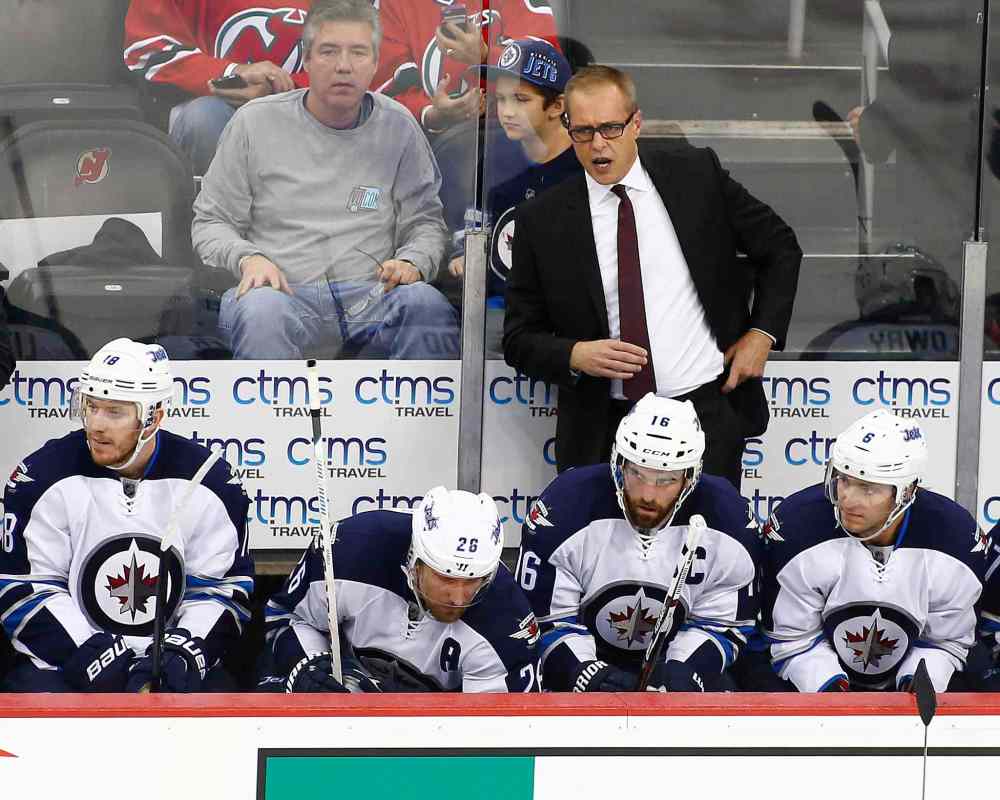
Line chemistry and the machinations behind different combinations are always a topic in hockey, and especially so when the curtain lifts on a new season. Jets coach Paul Maurice has experimented with all sorts of different trios through training camp and into the new campaign, flipping natural centres to the wing, moving right wingers to the left and vice versa.
But the one unit that has opened the season intact is a familiar one, with Bryan Little centering Wheeler and Andrew Ladd. The three have played together before and while Wheeler was also productive on the right flank with Mark Scheifele over the last little while, the transition to being reunited with two old compadres has been seamless. That trio has combined for three of the Jets nine goals through two games and six points in total — Little hasn’t picked up a point yet, but was on the ice for all three markers — and has given the club some offensive stability while everyone, Maurice included, gets a read on what works with the other threesomes.
“Chemistry? It’s huge. I think it’s the most-important thing,” said Wheeler. “You can write as many line combinations on paper as you want, but sometimes it just doesn’t work. Sometimes you just don’t connect the dots with certain people. I don’t have the answer as to why that happens sometimes or why it doesn’t, it either works or doesn’t and there’s no formula to it.
“You either get it done or you don’t and Laddy, Litts and I, for whatever reason, it just clicks.”
Added Little: “When you’re with a certain line combination that doesn’t have chemistry it’s pretty obvious. It’s nice to know where guys are on the ice and to have a good feel for what they want to do with the puck. With those two guys, especially with me with Ladd — I’ve played with him the last five years or so — when you play with someone that long you know what they’re going to do and where they’re going to be on the ice and how they play. It’s definitely easier operating with that.”

Maurice touched this week on the process of why the lines are put together the way they were to start the season. With four new forwards in his lineup — rookies Nikolaj Ehlers, Nic Petan, Andrew Copp and the return of Alex Burmistrov from the KHL — the coaching staff spent the first 10 days or so of training camp trying to get a read on different skill sets.
Oh sure, they knew that Ehlers and Petan lit up the CHL ranks with their junior clubs, but could they play defensively responsible? Could Copp handle increased minutes on the penalty kill? Would Burmistrov be more comfortable at the left or right wing or should he move to centre?
And now that the real games have started, it’s not just about who works well with others, but all about matching lines with whoever jumps over the boards in enemy colours, too.
“The first thing I ask myself is, ‘Who am I going to play these guys against? Is there an advantage to be had?’,” said Maurice. “There’s a bunch of different games within the game going on on the ice. Who you play against, an awareness of who you play against is really important.

“We’re looking for players who understand their role. In the past when you say that it’s, ‘OK, you three-four guys get to do whatever you want offensively and the rest of you don’t get to, you’ve got to dump every puck.’ Each player has something that they can bring and they need to know that’s what we’re looking for from them on a nightly basis.”
Now, two games hardly provides concrete answers on any of this. But with a better understanding of roles, assignments and expectations — and the versatility his forward crew has flashed already — Maurice’s tinkering might not have a finish line. An example: he spoke of wanting to get Petan some work with Wheeler and is intrigued by what that pair might be able to create.
“There’s something exciting about that,” said Maurice. “But they’re (Petan, Ehlers and Copp) training for roles and we can’t give them too much too early.”
ed.tait@freepress.mb.ca
Twitter: @WFPEdTait
FAMOUS LINES
A look at some of the most-prolific trios in hockey history:
-The Production Line (Detroit Red Wings): Gordie Howe, Sid Abel, Ted Lindsay — Finished 1-2-3 in scoring in 1949-50 and were a fixture for years.
-The Hot Line (Winnipeg Jets, WHA): Bobby Hull, Anders Hedberg, Ulf Nilsson — The Jets teamed their superstar with the two Swedes from the moment they crossed the pond and the chemistry was instant.
-Million Dollar Line (Chicago Blackhawks): Bobby Hull, Bill Hay, Murray Balfour — Teamed in 1959 and helped lead the Hawks to the 1961 Stanley Cup.
-The French Connection (Buffalo Sabres): Gilbert Perreault, Richard Martin, Rene Robert — Named after the popular Hollywood movie at the time, this trio worked together for seven years, from 1972-79.
-The Kraut Line (Boston Bruins): Bobby Bauer, Woody Dumart, Milt Schmidt — Became the first to finish 1-2-3 in league scoring in 1939-40 season.
-The Punch Line (Montreal Canadiens): Elmer Lach, Maurice Richard, Toe Blake — Also finished 1-2-3 in scoring, in 1944-45 and was together for two championships.
-Triple Crown Line (Los Angeles Kings): Dave Taylor, Marcel Dionne, Charlie Simmer — First formed in 1979 and in 1979-80 combined for 146 goals and 328 points.
-The LILCO Line or Trio Grande line (New York Islanders): Clark Gillies, Mike Bossy, Bryan Trottier — Named after the Long Island Lighting Company and was dominant during the Isles run of four straight Cups.
-The KLM Line (Central Red Army): Vladimir Krutov, Igor Larionov, Sergei Makarov — Absolutely prolific for the powerhouse Soviet Union squads of the 1980s.
— Ed Tait
Related Articles
Jets take it on the chin




Advertisement Advertise With Us
Advertisement Advertise With Us