

Community, nation breathe sigh of relief at arrest in Fontaine case

Advertisement
Read this article for free:
or
Already have an account? Log in here »
To continue reading, please subscribe:

Digital Subscription
One year of digital access for only $205*
- Enjoy unlimited reading on winnipegfreepress.com
- Read the E-Edition, our digital replica newspaper
- Access News Break, our award-winning app
- Play interactive puzzles
*First annual payment billed as $205.00 + GST for one year. This annual subscription will automatically renew at $233.00 + GST every 52 weeks (10% off the regular annual price of $259.35). Offer available to new and qualified returning subscribers only. Cancel any time.
To continue reading, please subscribe:
Add Free Press access to your Brandon Sun subscription for only an additional
$1 for the first 4 weeks*
- Enjoy unlimited reading on winnipegfreepress.com
- Read the E-Edition, our digital replica newspaper
- Access News Break, our award-winning app
- Play interactive puzzles
*Your next Brandon Sun subscription payment will increase by $1.00 and you will be charged $17.95 plus GST for four weeks. After four weeks, your payment will increase to $24.95 plus GST every four weeks.
Read unlimited articles for free today:
or
Already have an account? Log in here »
Hey there, time traveller!
This article was published 11/12/2015 (3952 days ago), so information in it may no longer be current.
In journalism, it is generally considered bad form to express any sense of relief when police arrest someone in connection with a horrific crime.
The theory is that the person arrested is merely a suspect, and must still be proven guilty. Allowing the journalist, or those responsible for the arrest, to speak to their overall sense of relief about an arrest could very well prejudice the legal proceedings to come.
So, let it be said that Raymond Joseph Cormier, 53 and originally from New Brunswick, must still be proven guilty in the second-degree murder of teenager Tina Fontaine. That having been said, and taking into account the highest ideals of criminal justice, it would simply be dishonest to deny that this arrest was greeted with a profound sense of relief.
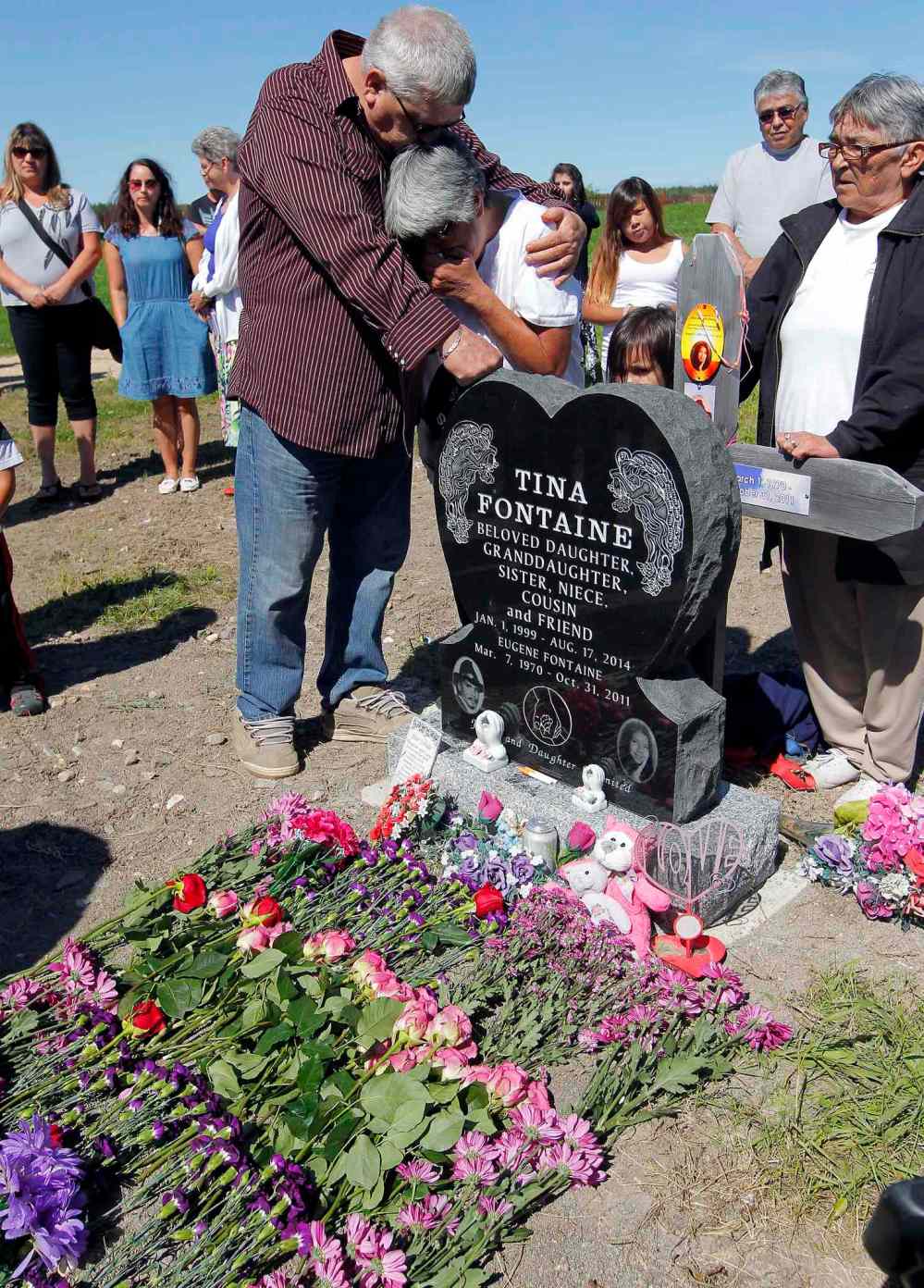
For more than a year, this city and province have labored under a suffocating shame for Tina Fontaine’s death. On Aug. 17, 2014, Fontaine’s body, wrapped in a plastic bag, was pulled from the Red River. The pure tragedy of her death, and the knowledge that both child welfare and police agencies missed opportunities to save her from a destructive life on the street, helped spark a national grief and outrage that is still palpable today.
That an arrest would be made this week – the same week that the Liberal government in Ottawa launched the first phase of an inquiry into missing and murdered indigenous women (MMIW) – only amplifies the emotion surrounding the Fontaine case. And perhaps signals that, from her death, there will be positive change.
That change was already evident at the Winnipeg Police Service news conference announcing Cormier’s arrest. Hosted by Dep. Chief Danny Smyth and Sgt. John O’Donovan of the WPS homicide unit, the news conference was a triumph in accountability.
Even though there are practical limits on what can be said at this early stage of a criminal prosecution, the two officers talked fairly openly about the investigation and how they came to identify a habitual criminal with no known profession or address, as the prime suspect in Fontaine’s death.
They connected the dots between Cormier, a home where human trafficking and prostitution activities were known to occur, and Fontaine. They established that Fontaine and the suspect under arrest had several “encounters” and that it was on the occasion of the last of these that it is believed Fontaine was murdered.
The police talked openly and without reservation as well about their own shortcomings in the days prior to Fontaine’s death. It is now well known that two police officers pulled over a car containing an unidentified man, later excluded as a suspect, and Fontaine. Despite the fact the driver was impaired, and Fontaine was a minor, police let her go. Back on the street downtown, Fontaine was last seen a few hours later.
The officers offered more complete details about how the results of an internal investigation into the two officers were sent to Manitoba Justice for the consideration of criminal charges. And how after the Crown declined to press charges, one officer was disciplined and has returned to duty, while the other has left the force.
The effort put in by Smyth and O’Donovan was concise, professional and accountable. Gone were the days when police left out far more than they included in statements on this case. Or, where they simply declined to comment without explanation.
What can we deduce from the additional information provided alongside Cormier’s arrest?
The WPS did, in fact, make the investigation of Fontaine’s death a priority. More details on this will become available as we begin to see the evidence collected against Cormier, and the lengths to which WPS had to go in order to build a case against him. However, it was noted that the investigation included help from two RCMP divisions and police services in Calgary and Vancouver. This was clearly a case that involved serious and determined legwork.
We also know that, on the face of it, the WPS took seriously the actions of the two officers who came into contact with Fontaine but failed to return her to safety.
And finally, that the WPS was not solely responsible for failing Fontaine. Child welfare authorities were also in contact with Fontaine in her final hours but failed as well to keep her off the street. That system has undergone significant change since Fontaine’s death to provide greater control over vulnerable children in care.
That final point is one that should be emphasized. It is evident from the timeline that Fontaine had repeatedly fled from those that could have kept her safe and off the street. That does not, in and of itself, excuse our collective failure to keep her safe. But it does fully reveal the magnitude of the challenge facing cops and social workers in these cases.
If possible, it would be extremely helpful if the national MMIW inquiry has an opportunity to study the WPS investigation into the Fontaine murder. The inquiry will no doubt find a wealth of information about two key issues in these cases.

First, the desperate circumstances that combine to victimize young indigenous women. And second, and no less important, the high degree of difficulty facing police when they try to investigate those cases.
It is hard to deny some sense of relief that an arrest has been made in one of the more high-profile cases involving a missing or murdered indigenous woman. If there is anything that truly tempers our relief, it is the knowledge that Tina Fontaine is just one of hundreds of similar victims.
And that we are still a long way away from closing those cases.
dan.lett@freepress.mb.ca
Dan Lett is a columnist for the Free Press, providing opinion and commentary on politics in Winnipeg and beyond. Born and raised in Toronto, Dan joined the Free Press in 1986. Read more about Dan.
Dan’s columns are built on facts and reactions, but offer his personal views through arguments and analysis. The Free Press’ editing team reviews Dan’s columns before they are posted online or published in print — part of the our tradition, since 1872, of producing reliable independent journalism. Read more about Free Press’s history and mandate, and learn how our newsroom operates.
Our newsroom depends on a growing audience of readers to power our journalism. If you are not a paid reader, please consider becoming a subscriber.
Our newsroom depends on its audience of readers to power our journalism. Thank you for your support.
Dan Lett is a columnist for the Free Press, providing opinion and commentary on politics in Winnipeg and beyond. Born and raised in Toronto, Dan joined the Free Press in 1986. Read more about Dan.
Dan’s columns are built on facts and reactions, but offer his personal views through arguments and analysis. The Free Press’ editing team reviews Dan’s columns before they are posted online or published in print — part of the our tradition, since 1872, of producing reliable independent journalism. Read more about Free Press’s history and mandate, and learn how our newsroom operates.
Our newsroom depends on a growing audience of readers to power our journalism. If you are not a paid reader, please consider becoming a subscriber.
Our newsroom depends on its audience of readers to power our journalism. Thank you for your support.
Related Articles
Arrest brings new optimism for grieving sister

Advertisement Advertise With Us
Advertisement Advertise With Us