

Special Olympics make special memories
Movement founded in 1978 keeps growing

Advertisement
Read this article for free:
or
Already have an account? Log in here »
To continue reading, please subscribe:
Digital Subscription
One year of digital access for only $1.44 a week*
- Enjoy unlimited reading on winnipegfreepress.com
- Read the E-Edition, our digital replica newspaper
- Access News Break, our award-winning app
- Play interactive puzzles
*Billed as $5.77 plus GST every four weeks. After 52 weeks, price increases to the regular rate of $19.95 plus GST every four weeks. Offer available to new and qualified returning subscribers only. Cancel any time.
To continue reading, please subscribe:
Add Free Press access to your Brandon Sun subscription for only an additional
$1 for the first 4 weeks*
- Enjoy unlimited reading on winnipegfreepress.com
- Read the E-Edition, our digital replica newspaper
- Access News Break, our award-winning app
- Play interactive puzzles
*Your next Brandon Sun subscription payment will increase by $1.00 and you will be charged $17.95 plus GST for four weeks. After four weeks, your payment will increase to $24.95 plus GST every four weeks.
Read unlimited articles for free today:
or
Already have an account? Log in here »
Hey there, time traveller!
This article was published 26/02/2016 (3754 days ago), so information in it may no longer be current.
Niki Carr and Gerry Sinclair may have different lives and challenges, but there is at least one thing they have in common: they are athletes.
Carr and Sinclair are just two of the thousands of children and adults living with special needs who have been part of Special Olympics Manitoba since it began in Manitoba in 1978.
For Carr, who is on a curling team, the reason is simple.
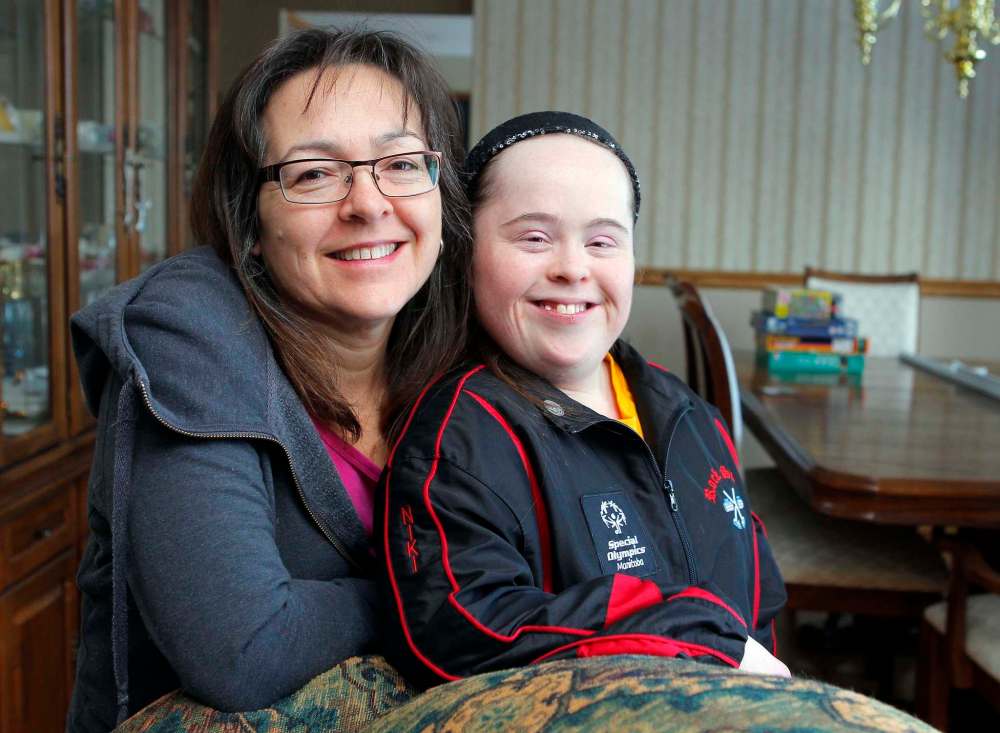
“I love to win,” Carr, 29, said laughing.
“But I just play to have fun. I’ve met lots of friends.”
Sinclair, 21, who has played on a floor hockey team for three years and is preparing to compete at the national Winter Games in Newfoundland next month, said “You meet a whole bunch of people.
“You get to go travelling. You get to try different possibilities.”
It’s what local founders Ted Irvine and Dan Johnson were hoping for when they began the organization in 1978. It was officially incorporated two years later.
Today, Special Olympics Manitoba has 1,650 athletes playing 18 sports including five-pin and 10-pin bowling, swimming, athletics, basketball, floor hockey, curling and cross-country skiing.
Irvine, who played hockey with a few NHL teams back in the 1960s and 1970s, was playing with the New York Rangers when the foundation created by broadcasting legend Harry “Red” Foster began inviting him to Special Olympics fundraisers and events. Foster had founded Special Olympics Canada a year after Eunice Kennedy Shriver, the sister of John, Robert and Ted Kennedy, created the movement in 1968, which has since grown to 4.5 million athletes in 170 countries around the world.
Irvine’s contributions grew so much he was awarded the NHL’s Charlie Conacher Humanitarian Award in 1975, an award that, before it was retired, was also given through the years to Jean Beliveau, Bobby Orr and Wayne Gretzky.
Irvine said after he hung up his skates, the Foster Foundation called him with a request.
“They said Manitoba doesn’t have a Special Olympics chapter, and can you start one?” he said.
“I went to the school to see if anyone could help, and Dan Johnson called me after. We started the Manitoba chapter.”
Irvine said a team was organized and competed at the national championships in Regina a short time later.
“I’ve never been so proud in my whole life to stand onstage and see all our kids with their brown-and-white uniforms on.”
But Irvine said the Games also had another special memory.
“We knew we were going to win gold in the 100-yard dash — we knew we had the fastest person. Our kid took off and ran like the wind. But his buddy fell, and he stopped and picked him up.
“They came last, but that cemented Special Olympics for us. It taught us about sport that you try your hardest, but don’t forget your friends.”
Johnson, who was working with students with special needs in a Winnipeg school in the late 1970s, said he remembers clearly the day Irvine walked in and said he wanted to start a local Special Olympics chapter in Winnipeg.
“We were running an athletic club out of the school on Wellington (Avenue), but there was no access into the community for our athletes to do things,” he said.
As well, Johnson, who went on to become the first executive director of Special Olympics Manitoba, said they would teach the students how to cross-country ski, but when they went into meets with non-special-needs students while they were allowed to compete, they had almost no chance of winning.
“Where do they go after school or after the workshop is done for the day? Special Olympics filled that void.”
Fitting for a city and province covered with snow for several months that the first sports were cross-country skiing and snowshoeing, but it has now grown to include a multitude of sports for both winter and summer.
Simon Mundey, president and CEO of Special Olympics Manitoba, said what’s nice about Special Olympics is as athletes age, or their abilities change, they can go on to compete in other sports. The organization has athletes starting at two years of age.
“It starts at the community-based grassroots level where every athlete, no matter what ability, can come out,” he said.
“But a lot want to compete so they move up through the regional, national, and in some cases up to the international level. They can participate and compete to their level of ability.”
Mundey said each sport is broken up into different divisions to group athletes together in the same gender, age and ability. The organization also makes sure they have a high ratio of coaches — the 800 are all volunteers — to athletes.
“We want to make the experience as positive and fulfilling (to the athletes) as possible,” he said.
“Our volunteers are fabulous. The passion they bring to the organization is inspiring… you can work with an athlete, and you can see growth. It might not be as fast, but the reward is watching someone do something you spent hours on.”
Mundey said the organization gets a bit of government funding, but the bulk comes from donations and fundraising events.
Hong Thai has been a volunteer coach for about five years now, teaching fundamental skills for different sports to athletes aged five to 13.
“Special Olympics is all about inclusivity,” she said.
“It gives them a sense of independence as well. They’ll say I don’t like hockey, but I want to try soccer instead… you don’t want to treat them like they have a disability. You are working with ability.”
Thai, who played basketball with the University of Winnipeg Wesman, said there’s a difference between the competition she used to play in and Special Olympic athletes.
“You felt pressure to be the best you could be, but with Special Olympics you see athletes having genuine fun. You don’t see that in generic sport.”
Carr’s mother, Diane, said her daughter lives with Down syndrome and joined Special Olympics in junior high school. She first competed in track and field, including running, shot put and long jump, before moving on to rhythmic gymnastics and, after an injury, curling.
“She loved curling right from the start,” Diane said.
“The camaraderie is great, too. They are all such a group. They just meld together.”
Diane said she has also seen her daughter grow through Special Olympics to now being very talkative.
“She’s incredibly sociable. It has given her friendships outside the school she never would have had.”
Sinclair said he has been with Special Olympics since he was 10 when his parents signed him up for it.
“I’m happy they got me involved,” he said.

“I would tell others you should join Special Olympics because you will meet a lot of people, go travelling and do a bunch of sports.”
Carr said there was one last thing she had to say: she wanted to wish her teammates good luck in Newfoundland.
“Go for the gold,” she said.
kevin.rollason@freepress.mb.ca
Kevin Rollason is a general assignment reporter at the Free Press. He graduated from Western University with a Masters of Journalism in 1985 and worked at the Winnipeg Sun until 1988, when he joined the Free Press. He has served as the Free Press’s city hall and law courts reporter and has won several awards, including a National Newspaper Award. Read more about Kevin.
Every piece of reporting Kevin produces is reviewed by an editing team before it is posted online or published in print — part of the Free Press‘s tradition, since 1872, of producing reliable independent journalism. Read more about Free Press’s history and mandate, and learn how our newsroom operates.
Our newsroom depends on a growing audience of readers to power our journalism. If you are not a paid reader, please consider becoming a subscriber.
Our newsroom depends on its audience of readers to power our journalism. Thank you for your support.
The Children’s Hospital Foundation is looking for a few good books — actually several thousand. The foundation, which is having a book sale from April 26 to 30, wants people to drop off books 24/7 at fire halls all across Winnipeg. The foundation raised $170,000 during a sale earlier this month, up $56,000 from last year.
Variety the Children’s Charity of Manitoba is holding a Heart Bowl March 12. The fundraiser, being held at LaVerendrye Bowling Lanes from 1 p.m. to 4 p.m., features bowling, lunch by Pita Pit and a pro-bowler on each team. Tickets are $25 per person or $125 for a team of five, while lane sponsorships are $250. To sign up call 204-982-1050 or email admin@varietymanitoba.com.
There’s still time to go to the Bravo Gala and help Manitoba Opera. The fundraiser March 5 features dinner, an operatic performance, live and silents auctions and dancing with the Danny Kramer event band. Tickets cost $195 or $2,250 for a corporate table of 10 and can be purchased by calling 204-942-7473 or emailing calvares @manitobaopera.mb.ca.
The Jon Sigurdsson Chapter IODE, a women’s charitable organization, is celebrating its 100th anniversary in Manitoba by giving $10,000 to the Children’s Rehabilitation Foundation. The donation, which will be used to purchase adaptive bicycles for children living with special needs, will be presented to the CRF next month.
Registration and fundraising has begun for this summer’s Walk for ALS. The walk, taking place June 18, is part of the largest volunteer-led fundraiser for ALS across the country. To register, go to www.walkforals.ca.
You can pick up a freshly baked cinnamon roll and coffee for $4 — and help adults living with special needs in the community. The L’Arche Tova Cafe, at 119 Regent Ave. West, has the special from Monday to Saturday from 8 a.m. to 2 p.m. The café also has a new menu and now features ready to cook frozen tourtieres and other frozen meals.
How to help Special Olympics Manitoba:
To donate: go to www.specialolympics.mb.ca and follow the donation links or send a cheque to 304-145 Pacific Ave., Winnipeg, MB, R3B 2Z6.
To volunteer: go to www.specialolympics.mb.ca and follow the volunteer links or call 204-925-5625.
Kevin Rollason is a general assignment reporter at the Free Press. He graduated from Western University with a Masters of Journalism in 1985 and worked at the Winnipeg Sun until 1988, when he joined the Free Press. He has served as the Free Press’s city hall and law courts reporter and has won several awards, including a National Newspaper Award. Read more about Kevin.
Every piece of reporting Kevin produces is reviewed by an editing team before it is posted online or published in print — part of the Free Press‘s tradition, since 1872, of producing reliable independent journalism. Read more about Free Press’s history and mandate, and learn how our newsroom operates.
Our newsroom depends on a growing audience of readers to power our journalism. If you are not a paid reader, please consider becoming a subscriber.
Our newsroom depends on its audience of readers to power our journalism. Thank you for your support.
Advertisement Advertise With Us
Advertisement Advertise With Us