

Implications of the Daniels case
Advertisement
Read this article for free:
or
Already have an account? Log in here »
To continue reading, please subscribe:
Digital Subscription
One year of digital access for only $1.44 a week*
- Enjoy unlimited reading on winnipegfreepress.com
- Read the E-Edition, our digital replica newspaper
- Access News Break, our award-winning app
- Play interactive puzzles
*Billed as $5.77 plus GST every four weeks. After 52 weeks, price increases to the regular rate of $19.95 plus GST every four weeks. Offer available to new and qualified returning subscribers only. Cancel any time.
To continue reading, please subscribe:
Add Free Press access to your Brandon Sun subscription for only an additional
$1 for the first 4 weeks*
- Enjoy unlimited reading on winnipegfreepress.com
- Read the E-Edition, our digital replica newspaper
- Access News Break, our award-winning app
- Play interactive puzzles
*Your next Brandon Sun subscription payment will increase by $1.00 and you will be charged $17.95 plus GST for four weeks. After four weeks, your payment will increase to $24.95 plus GST every four weeks.
Read unlimited articles for free today:
or
Already have an account? Log in here »
Hey there, time traveller!
This article was published 26/04/2016 (3694 days ago), so information in it may no longer be current.
My late friend Harry Daniels has again succeeded in advancing the constitutional evolution of Canada in what must be the most misunderstood case in history. What should happen now?
Harry and the Congress of Aboriginal Peoples (CAP) argued all the way to the Supreme Court of Canada that the federal government must acknowledge its authority to include Métis and non-status Indians in legislation to guide aboriginal policy. In mid-April, the Supreme Court agreed.
This legal journey began in 1999 when Harry was instrumental in getting Métis people included in section 35 of the Constitution Act, that guarantees the rights of all the aboriginal peoples including Indians and Inuit peoples.
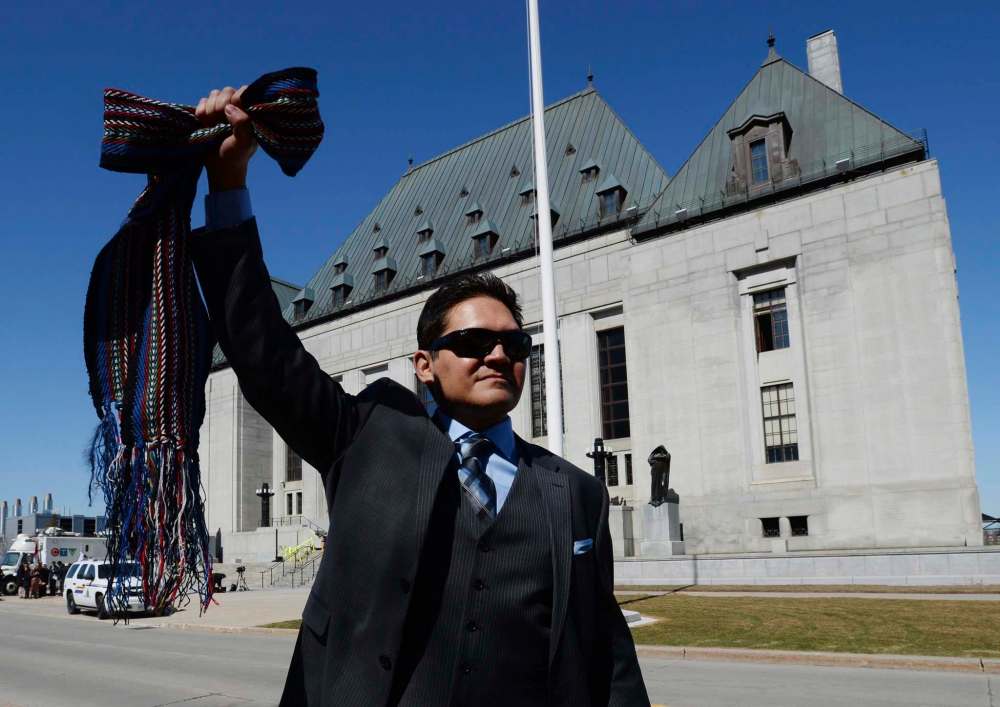
Federal policy has always had three main objects: to get rid of aboriginal people by assimilation into the general population, to cut expenditures, and to move responsibility to the provinces for social services. The legislation to do that was the Indian Act of 1876 and its numerous amendments to reach these goals. With the inclusion of aboriginal rights in the Constitution, those old policy objectives were now indefensible. The Constitution requires government action to make aboriginal rights effective.
The Daniels decision invites governments to recognize all the aboriginal peoples in Canada, to make their rights effective, and to legislate for other policy purposes as well. The provincial governments must also be engaged because recent court cases have established that provinces have duties to respect the rights of aboriginal peoples when making laws within their sphere of authority (such as natural resources).
None of this is easy in practice. That is one reason governments, who only act on political imperatives, have avoided the issue of official recognition. The current federal government has promised a new policy approach which has been described as a “nation-to-nation” relationship, along with the adoption of the standards in the United Nations Declaration on the Rights of the Indigenous Peoples. Time will tell if this will truly mean the replacement of the historic policies of cultural genocide with new legislation that abides by the UNDRIP and recognizes all the indigenous peoples.
In the Daniels decision, the Supreme Court left open the issue of identifying the “Indians” and “Métis” now included in the federal law-making power. But some observations by the Supreme Court may have important implications for future cases or for negotiations. All the legislation which has historically responded to the Métis people has dealt with the Métis in Western Canada.
Now, this decision may also provide some assurance to the many people in the rest of Canada that non-status Indians are included in the federal power. If an aboriginal community has historic aboriginal rights, such as hunting or fishing, it may identify itself by any name — Métis or Indian or other names — without concern about fitting into this or that constitutional category.
Many persons call themselves “Métis” based on the popular misconception that being of “mixed-blood” has constitutional or legal meaning. Both the federal and provincial governments already have the constitutional power under the equity clause of the Charter of Rights and Freedoms to create programs or services for the “Charter Métis,” those persons who suffer disadvantage on account of their so-called race. There is also a constitutional spending power available to both levels of government which allows governments to spend money on matters outside their legislative authority. The Daniels decision does not change the law but may influence how it is used.
How should governments respond to the duty to negotiate the implementation of the aboriginal rights of the Métis and non-status communities?

At the moment, “Indians” not included in the Indian Act and self-described Métis individuals have organized themselves as corporations governed by general corporations law. The modern legislated agreements with Inuit people, who are not in the Indian Act, are the model for a new policy of recognition.
In 1996, the federal Royal Commission on Aboriginal Peoples recommended new courts or tribunals be created. Their purpose would be to recommend to the federal government who would be the legitimate and accountable representatives of aboriginal communities that have rights. These bodies must have representation from the aboriginal peoples concerned. The first step for consideration for official recognition must be a referendum in a community.
The alternative is the steadfast pre-Daniels decision talk and delay policy, described by Canada’s first prime minister, Sir John A. Macdonald, in 1884: “I think the true policy is rather to encourage them to specify their grievances in memorials and send them with or without delegations to Ottawa. This will allow time for the present effervescence to subside, and on the approach of winter, the climate will keep things quiet until next spring.”
Keeping things quiet should no longer be an option.
Paul Chartrand, a Métis from St. Laurent, is a former professor of law now in legal practice with Boudreau Law in Winnipeg. He has advised the federal and provincial governments on aboriginal policies as a member of the Royal Commission on Aboriginal Peoples and Manitoba’s Aboriginal Justice Implementation Commission.