

Portage Avenue retail must be allowed to grow
Advertisement
Read this article for free:
or
Already have an account? Log in here »
To continue reading, please subscribe:
Monthly Digital Subscription
$0 for the first 4 weeks*
- Enjoy unlimited reading on winnipegfreepress.com
- Read the E-Edition, our digital replica newspaper
- Access News Break, our award-winning app
- Play interactive puzzles
*No charge for 4 weeks then price increases to the regular rate of $19.95 plus GST every four weeks. Offer available to new and qualified returning subscribers only. Cancel any time.
Monthly Digital Subscription
$4.99/week*
- Enjoy unlimited reading on winnipegfreepress.com
- Read the E-Edition, our digital replica newspaper
- Access News Break, our award-winning app
- Play interactive puzzles
*Billed as $19.95 plus GST every four weeks. Cancel any time.
To continue reading, please subscribe:
Add Free Press access to your Brandon Sun subscription for only an additional
$1 for the first 4 weeks*
*Your next subscription payment will increase by $1.00 and you will be charged $16.99 plus GST for four weeks. After four weeks, your payment will increase to $23.99 plus GST every four weeks.
Read unlimited articles for free today:
or
Already have an account? Log in here »
Hey there, time traveller!
This article was published 23/06/2016 (3483 days ago), so information in it may no longer be current.
In a vacant storefront at the corner of Portage Avenue and Carlton Street, the Downtown Winnipeg BIZ has opened its latest “Launch It! Retail Incubator” initiative, where vacant downtown commercial space is given, free of charge, to emerging entrepreneurs and artists as a form of pop-up retail.
A relatively new phenomenon in cities, pop-up retail is where commercial space is leased on a short-term basis, typically at greatly reduced rents. From an urbanist perspective, pop-up retail can add colour and foot traffic to what might otherwise be a vacant storefront. Certainly, this is the hope of the Downtown BIZ, who in recent years has made valiant attempts at luring hipsters south from the Exchange District.
Winnipeggers of a certain age may remember the space at Portage and Carlton as the longtime home of Holt Renfrew, Canada’s pre-eminent upscale fashion outlet. More recently, it was the location of the slightly less upscale denim emporium, Warehouse One.
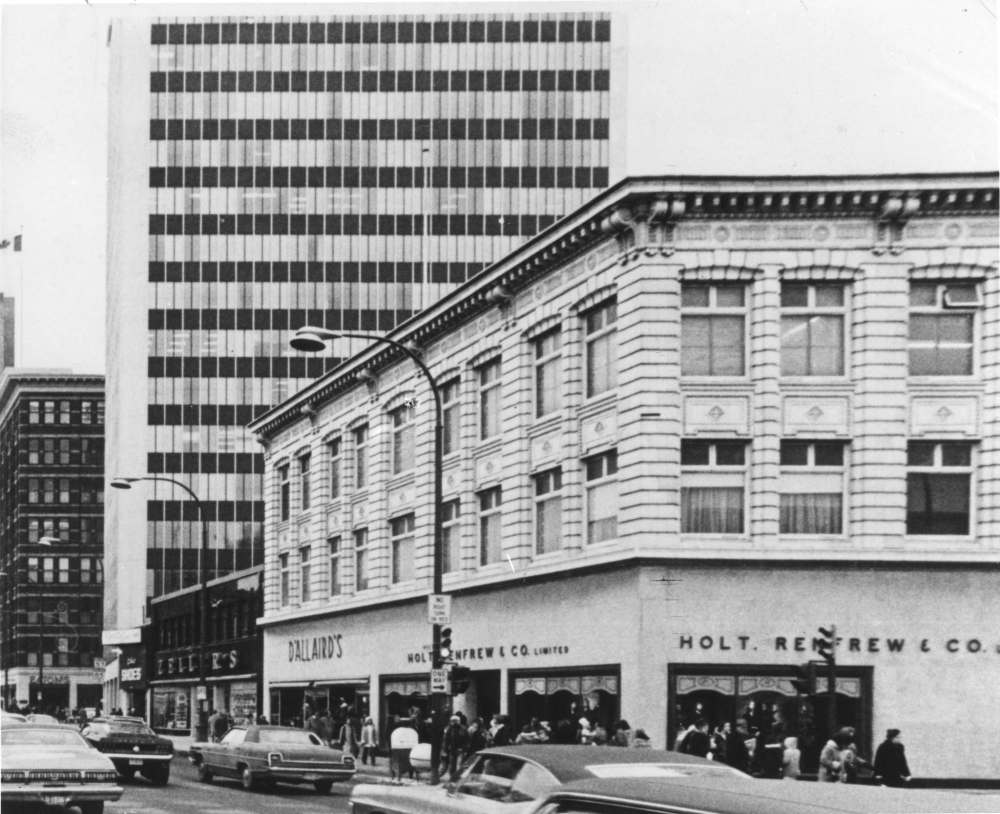
Constructed in 1912, the three-storey building is notable for its gracefully simple application of cut stone and Chicago-influenced design. At ground level were four narrow retail spaces, each only five to six metres wide. Within a few years, Holt Renfrew moved in, helping to augment Portage Avenue’s retail hegemony. Over time, Holt Renfrew came to occupy most of the building before moving to the Portage Place shopping mall in 1987.
What is worth considering in the case of this building is not how much Portage Avenue’s commercial vitality has declined, but how some still imagine it hasn’t. The ground-floor space hosting the pop-up shop is currently for lease at a net rent of $366 per square metre. At 520 square metres, this works out to a net rent of $15,860 a month. Not bad for an Apple Store, but laughable for any local entrepreneur seriously looking at Portage Avenue in 2016.
(As a comparison, the former Desart space in the heart of Osborne Village is leasing for $291 per square metre.)
Sentiment plays a large part in market expectations on Portage Avenue. Any lifelong Winnipegger over the age of 60 can remember when the avenue was still a place one would get dressed up to visit. For younger generations, this era lives on in archival photos and the recollections of parents and grandparents.
Unwillingness to accept that Portage Avenue can be anything less than what it is in the city’s collective memory has often informed the thinking that only major-scaled interventions are worthwhile there. With enough large-scale destinations compelling people to visit, the wishful thinking goes, a host of occupied storefronts and continually busy sidewalks will magically reappear.
This ignores Portage Avenue’s greatness, like that of any great city street, started small and built up incrementally. Certainly, the opening of Eaton’s department store in 1905 helped set the stage, but the countless small ventures that emerged were what inspired true market confidence and made Portage Avenue a draw far greater than the sum of its many parts. People simply wanted to be there.

Today, Portage Avenue retail space is not given to emerging entrepreneurs not because they don’t want to lease there but because it is too expensive to do so.
Even if rents cannot be lowered under market conditions, new retail floorspace can be made smaller. Not only does this provide suitable space for specialized enterprises, but it can allow businesses to expand into additional space over time. It was with a great deal of foolishness and irony Portage Avenue’s best collection of small retail spaces were demolished for the construction of Portage Place, that all-in attempt at resuscitating the avenue’s golden age.
Regardless of whether Portage Avenue eventually regains its place as Winnipeg’s high street, transforms into a Bowery of sports pubs and their attendant bro culture, or simply becomes a better local street for nearby downtown neighbourhoods, it will need to start small and build up through succession. Commercial spaces should be subdivided, and metrics for determining rent values should better reflect demand.
The Downtown BIZ appears to be moving away from pretending Portage Avenue’s retail will suddenly pick up where it left off decades ago, and has turned to the more-attainable goal of trying to make it an interesting and cool place to be. Planning, development, and design should follow suit. Whatever Portage Avenue grows into, it must first be allowed to start growing.
Robert Galston is a master’s candidate in the city planning department at the University of Manitoba.