

Canada must improve rail-crossing safety
Advertisement
Read this article for free:
or
Already have an account? Log in here »
To continue reading, please subscribe:

Digital Subscription
One year of digital access for only $205*
- Enjoy unlimited reading on winnipegfreepress.com
- Read the E-Edition, our digital replica newspaper
- Access News Break, our award-winning app
- Play interactive puzzles
*First annual payment billed as $205.00 + GST for one year. This annual subscription will automatically renew at $233.00 + GST every 52 weeks (10% off the regular annual price of $259.35). Offer available to new and qualified returning subscribers only. Cancel any time.
To continue reading, please subscribe:
Add Free Press access to your Brandon Sun subscription for only an additional
$1 for the first 4 weeks*
- Enjoy unlimited reading on winnipegfreepress.com
- Read the E-Edition, our digital replica newspaper
- Access News Break, our award-winning app
- Play interactive puzzles
*Your next Brandon Sun subscription payment will increase by $1.00 and you will be charged $17.95 plus GST for four weeks. After four weeks, your payment will increase to $24.95 plus GST every four weeks.
Read unlimited articles for free today:
or
Already have an account? Log in here »
Hey there, time traveller!
This article was published 08/09/2016 (3593 days ago), so information in it may no longer be current.
On average in Canada, in each of the last 10 years, there have been approximately 200 accidents and 30 fatalities as a result of train/vehicle collisions at railway crossings.
Over the past 15 years, I have personally done critical-incident stress debriefings with more than 100 train crews. These accidents are devastating and life-changing for the victims, families of the victims and the train crews.
The sad reality of these accidents is many of them could be prevented if better and cost-effective safety measures were in place at these railway crossings.
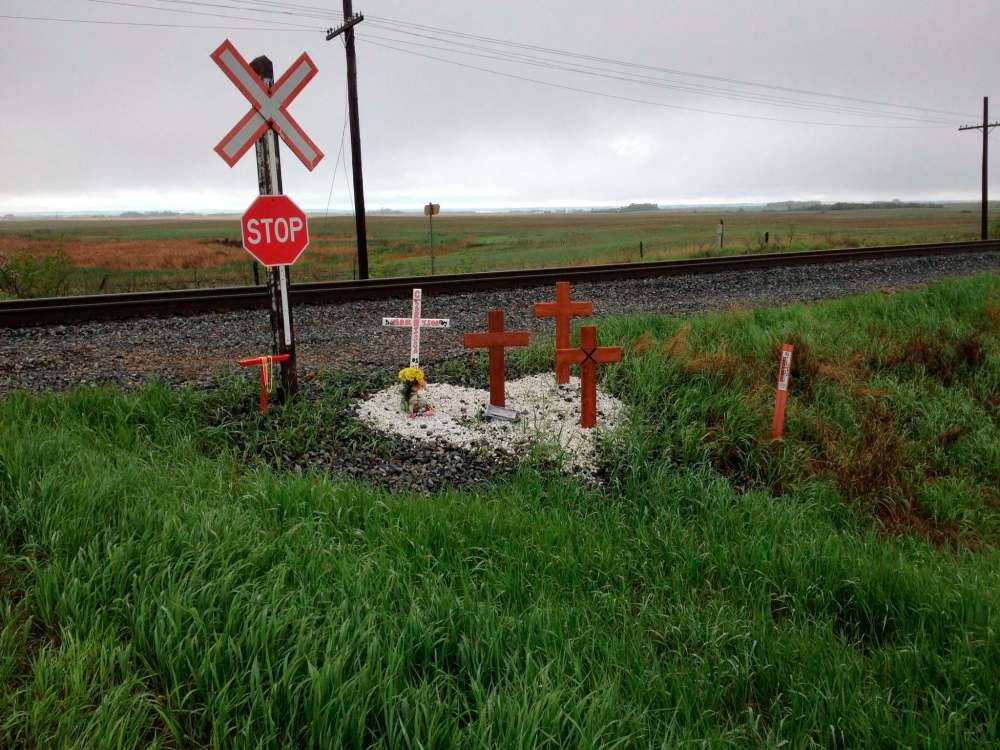
Transport Canada is trying to address this problem by spending $11 million this year to improve safety at railway crossings as part of its grade-crossing improvement program. However, $11 million is a drop in the bucket when you consider there are 21,000 or more railway crossings in Canada. In Manitoba alone there are 48 crossings needing some sort of upgrade. If this money is going to be used to add lights, bells and/or crossing arms, it won’t go very far to address this very real problem.
The fact is the vast majority of railway crossings don’t have an automated warning system with bells, lights and crossing arms. Most of these crossings do not generate enough traffic to qualify for expensive upgrades under the crossing-improvement program. These passive crossings, though, are often the site of the most horrific accidents.
I visited one just outside Broadview, Sask. Like other passive crossings, it is set off the highway. The prairie sky dominates in the distance. A ditch runs along the crossing with yellow lady’s slippers growing in it. It is a quiet, peaceful setting. The only difference between this crossing and many others like it is four crosses are embedded in the ground beside it.
These crosses commemorate the lives of one young adult and three children who died in a vehicle/train accident Aug. 9, 2012. The Transportation Safety Board of Canada investigated. Among many observations, it pointed out that in 1996, more than half the accidents and 60 per cent of the fatalities in the United States occurred at passive crossings. This report also indicated the long-term solution to reduce or eliminate collisions at passive crossings would be the use of low-cost, in-vehicle safety and advisory warning systems that alert motorists to the presence of a train.
The Transportation Safety Board, in its bulletin of March 26, 2014, criticized Transport Canada, claiming it is missing the mark in regard to the development of lower-cost advance-warning systems employing GPS, magnetic flux and radar to detect approaching trains. It would not cost much to equip a car’s navigational system with a device that would provide the driver of a vehicle with a visual and aural warning a train is approaching.
Low-cost, solar-powered signals activated off a train beacon could be put in place, replacing harder-to-see warning signs. It would also be possible to create a smartphone app that would warn a driver of the proximity of a train.
The point is, we have the technology to reduce train/vehicle accidents and to save lives. Motor vehicles are already benefiting from technologies that share, receive and process data from the surrounding environment, resulting in increased vehicle safety. Why, then, does it seem Transport Canada is engaged in the expensive practice of installing more lights, bells and crossing arms and not at investigating cheaper technological solutions to improve railway-crossing safety?

The answer may have to do with the challenge of creating synergy and collaboration among private industries, local and federal governments and academia.
Is there a solution to this challenge? Strong leadership would help. We need industry and government leaders to make railway-crossing safety a priority. These leaders will have to ask themselves some tough questions, such as what human lives are worth, what they are willing to do and how much they are willing to spend to save lives.
At the end of the critical-incident stress debriefings I did with railway crews, I would often ask them the following question: “As difficult as this experience was, did you learn anything about yourself, or life, that will help you as you move forward in life?” I have often asked myself this question in regard to these debriefings. Through these experiences, I have learned we can do better when it comes to railway-crossing safety. We must do better.
Mac Horsburgh worked for 15 years as a contract employee with CP Rail doing employee and family assistance counselling and critical-incident stress debriefing.