

City should study benefits of in-house waste collection
Advertisement
Read this article for free:
or
Already have an account? Log in here »
To continue reading, please subscribe:

Digital Subscription
One year of digital access for only $205*
- Enjoy unlimited reading on winnipegfreepress.com
- Read the E-Edition, our digital replica newspaper
- Access News Break, our award-winning app
- Play interactive puzzles
*First annual payment billed as $205.00 + GST for one year. This annual subscription will automatically renew at $233.00 + GST every 52 weeks (10% off the regular annual price of $259.35). Offer available to new and qualified returning subscribers only. Cancel any time.
To continue reading, please subscribe:
Add Free Press access to your Brandon Sun subscription for only an additional
$1 for the first 4 weeks*
- Enjoy unlimited reading on winnipegfreepress.com
- Read the E-Edition, our digital replica newspaper
- Access News Break, our award-winning app
- Play interactive puzzles
*Your next Brandon Sun subscription payment will increase by $1.00 and you will be charged $17.95 plus GST for four weeks. After four weeks, your payment will increase to $24.95 plus GST every four weeks.
Read unlimited articles for free today:
or
Already have an account? Log in here »
Hey there, time traveller!
This article was published 13/09/2016 (3620 days ago), so information in it may no longer be current.
This fall, Winnipeg city council will determine the future of waste and recycling collection in Manitoba’s capital. Current contracts with Emterra Environmental and Progressive Waste Services will expire in 2017. At least eight private companies have expressed interest in putting forward a proposal, and it will be up to council to select from the various applicants.
While garbage is generally not a “sexy” topic, there are many reasons the public should be paying attention.
Winnipeg has been struck by years of garbage woes. Emterra Environmental, in particular, has been the focus of many complaints when it comes to service quality, from toppled trash bins to missed pickups. The Free Press has reported extensively on Emterra’s performance, but problems go deeper than poor service.
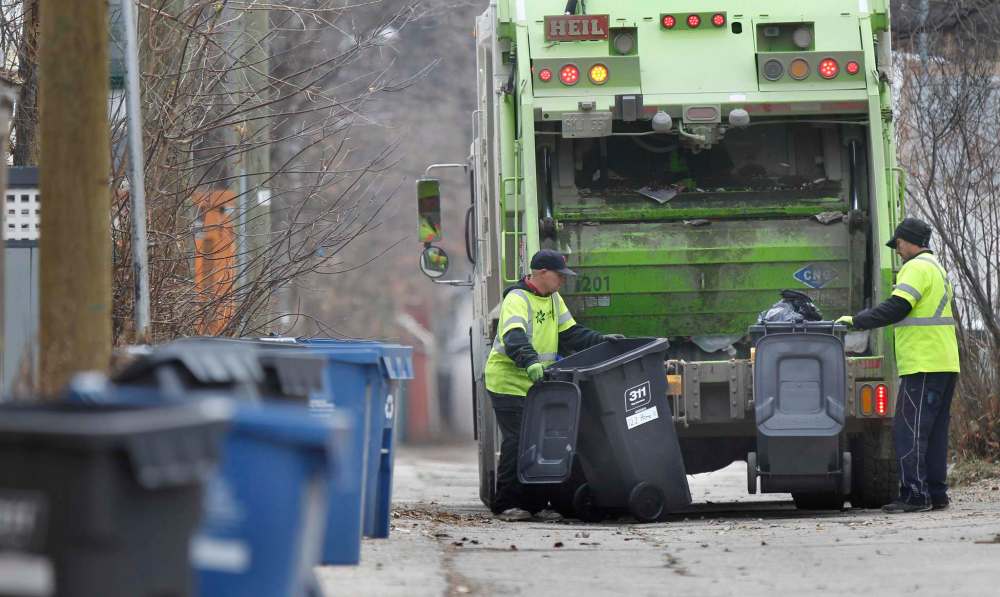
According to a 2015 CTV Winnipeg report, the city was investigating Emterra’s safety practices. Between 2012 and the time of the report, the company had 118 claims with the Workers Compensation Board of Manitoba. In the report, Emterra defended its record, saying it qualifies for the lowest WCB premiums.
With 118 claims in less than three years, it’s not clear how Emterra keeps its WCB premiums low. Further, because its business model includes the use of private contractors who do their own hiring, would workers who are injured while on the private contractors’ payroll show up on WCB records as Emterra employees?
Emterra does not have a good record with Manitoba’s Workplace Safety and Health Branch. According to the branch’s website, nine stop-work orders were issued between April 22, 2015, and June 15, 2016. Contraventions include a lack of personal protective equipment, a serious incident involving an equipment inspection and safe work procedures.
CTV claimed every day Emterra hires between two and 20 “swampers” — people who work collecting garbage. They are hired through a company that specializes in day labourers (EZ Workforce). The practice of using day labour is a prime example of precarious work: temporary, back-breaking and poorly paid with no benefits.
As councillors think about how to improve service and ensure workers are treated properly, they should be considering the evidence showing the contracting out of government services does not always result in saving money. To meet an acceptable standard of due diligence, the city should do its own cost analysis to see whether it could do garbage collection for a competitive cost.
When, earlier this year, the City of Winnipeg put out a call for interested parties, the request for proposals stated: “… the city will have no obligation to award a contract where: (c) the prices are materially in excess of the city’s cost to perform the work, or a significant portion thereof, with its own forces.”
The only way councillors will truly know whether cost savings and quality improvements are achievable by operating the service in-house is if the city does its own costing. This has not been done, despite the growing countrywide trend in the remunicipalization of city services.
A new Columbia Institute report cites lower costs and improved quality of service as the main reasons for “insourcing” work that has been previously outsourced to the private sector.
This insourcing trend is seen in the United Kingdom and United States, and the Columbia report details 15 Canadian examples of partial or full insourcing decisions for services ranging from waste water treatment, snow removal and road and sidewalk repair.
Cities such as Port Moody, B.C.; Conception Bay South, N.L.; St. John, N.B.; and Sherbrook, Que., have all recently insourced all or part of their solid-waste collection. In each case, costs have come down and where service was a problem, its quality improved.
The City of Ottawa, similar in size to Winnipeg, provides an interesting case study of how successful insourcing can be.
In 2011, Ottawa brought garbage collection back in-house after finding municipal workers could do the job better and more economically. As a result of insourcing this service, the city has saved more than $677,000 over the term of the municipal contracts.

The City of Toronto recently grappled with the idea of contracting out areas of the city that still operated with public garbage collection services. (Toronto’s waste service is currently 50 per cent contracted out.)
The Toronto experience found contracting out garbage collection does not necessarily mean reduced costs, resulting in council’s decision to maintain the service areas operated by public workers.
Winnipeg city councillors reviewing the upcoming proposals need to take a step back and consider the best way to provide solid-waste pickup services to Winnipeggers.
There is a good chance councillors will find city ownership and responsibility over garbage collection is the best way to ensure quality services and cost savings to the taxpayer.
Lynne Fernandez holds the Errol Black Chair in Labour Issues at the Canadian Centre for Policy Alternatives, Manitoba.