

School system an ‘inspiration to the rest of Canada’
Advertisement
Read this article for free:
or
Already have an account? Log in here »
To continue reading, please subscribe:
Monthly Digital Subscription
$0 for the first 4 weeks*
- Enjoy unlimited reading on winnipegfreepress.com
- Read the E-Edition, our digital replica newspaper
- Access News Break, our award-winning app
- Play interactive puzzles
*No charge for 4 weeks then price increases to the regular rate of $19.00 plus GST every four weeks. Offer available to new and qualified returning subscribers only. Cancel any time.
Monthly Digital Subscription
$4.75/week*
- Enjoy unlimited reading on winnipegfreepress.com
- Read the E-Edition, our digital replica newspaper
- Access News Break, our award-winning app
- Play interactive puzzles
*Billed as $19 plus GST every four weeks. Cancel any time.
To continue reading, please subscribe:
Add Free Press access to your Brandon Sun subscription for only an additional
$1 for the first 4 weeks*
*Your next subscription payment will increase by $1.00 and you will be charged $16.99 plus GST for four weeks. After four weeks, your payment will increase to $23.99 plus GST every four weeks.
Read unlimited articles for free today:
or
Already have an account? Log in here »
Hey there, time traveller!
This article was published 16/12/2016 (3294 days ago), so information in it may no longer be current.
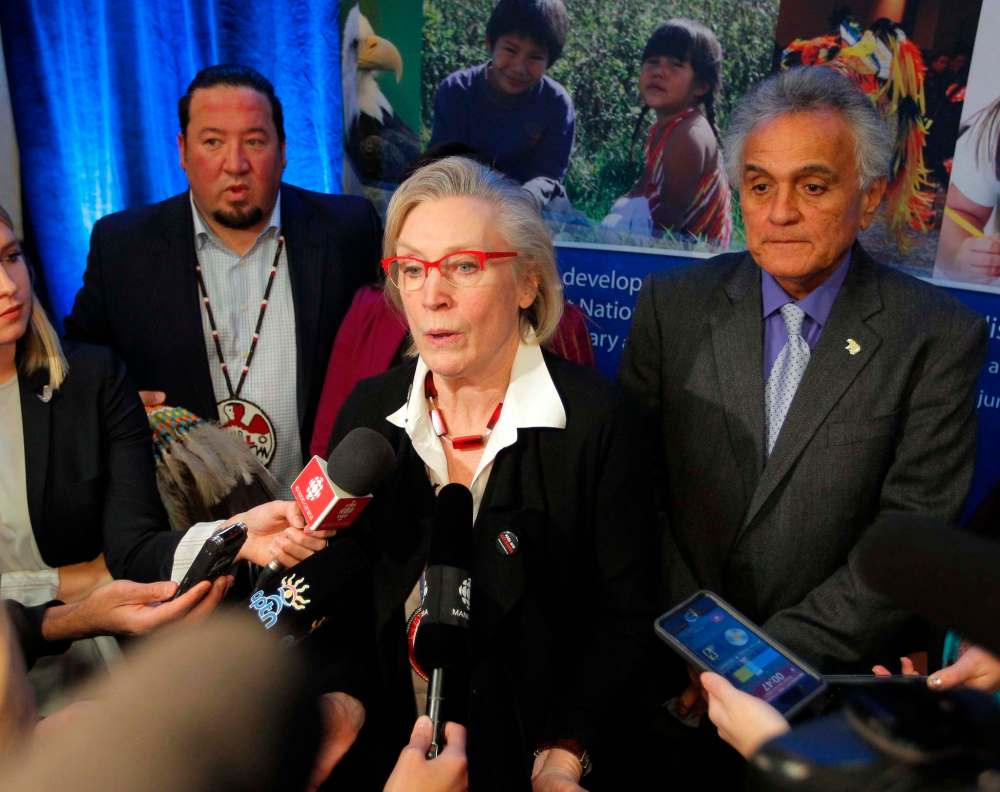
Manitoba First Nations are the first in Canada to have their own school board and indigenous leaders framed the importance of the agreement with their personal testimonies.
Indigenous Affairs Minister Carolyn Bennett was in Winnipeg this morning for an event where several First Nations signed on for the initial phase of the Manitoba First Nations School Board. It is set to begin operating in time for the 2017-18 school year.
Grand Chief Sheila North Wilson, of Manitoba Keewatinowi Okimakanak, said she attained perfect school attendance for 10 straight years, after her parents and grandparents drilled into her the importance of education.
Grand Chief Terrance Nelson of Southern Chiefs Organization keeps his mother’s graduation picture in his wallet — she graduated from Lakehead University in Thunder Bay as a language teacher at age 62.
“Investing in education is a helluva lot better than having the province invest in welfare,” said Nelson at the ceremonial signing.
It’s also better than paying $300 per day to house people in prisons, he said, noting that 70 per cent of inmates in Manitoba prisons are aboriginal.
A who’s who of aboriginal leaders attended the historic signing on Friday, as well as federal Indigenous Affairs Minister Carolyn Bennett. In an opening prayer, Elder Gertie Ballantyne of Brokenhead Ojibway Nation said the agreement that allows greater self-determination over aboriginal education “will give our children a stronger foundation to do better in the future.”
Meanwhile, Bennett called the signing “transformational change” and said it’s now incumbent on Manitoba to serve as “an amazing inspiration to the rest of Canada.”
First Nation educators said the indigenous school board will result in both increased graduation rates and greater retention of teachers.
Funding per student will rise to up to $18,000, versus $4,000 to $5,000 previously, officials said.
It will also help stem teacher turnover in indigenous communities by paying salaries comparable to those of provincial teachers.
“It’s not unusual for some communities to have three or four different teachers in a single year,” said Nora Murdoch of Fisher River Cree Nation, who is the school board’s first superintendent, officially called the director of system development.
“It’s historic because it’s the first time First Nations have really collaborated and joined forces for education,” she said.
While an indigenous school board gives First Nations control of education, it will still follow the provincial curriculum. However, it will now be able to add programs customized to indigenous people in areas such as language and history.

The initial phase of the school board will include nine First Nations and 2,100 students: Bloodvein, Brokenhead, Dakota Plains Wahpeton, Fox Lake, Keeseekoowenin, Lake Manitoba, Pinaymootang, Roseau River and Sagkeeng.
Three more First Nations — Lake St. Martin, Mathias Colomb, and York Factory — are close to signing, which would bring enrolment to 3,000 students.
Not every First Nation is signed up. Bands have to relinquish control of education funding to be part of the school board.
Besides larger budgets, an indigenous school board should mean greater program flexibility, more networking and sharing of resources between schools. It should also mean an interactive distance education network, and lower administrative costs through shared functions.
bill.redekop@freepress.mb.ca
Related Articles
Manitoba First Nations to get school board
Advertisement Advertise With Us
Advertisement Advertise With Us
History
Updated on Saturday, December 17, 2016 9:05 AM CST: Edited