

Manitoba First Nations to get school board
First initiative of its kind in Canada
Advertisement
Read this article for free:
or
Already have an account? Log in here »
To continue reading, please subscribe:
Monthly Digital Subscription
$0 for the first 4 weeks*
- Enjoy unlimited reading on winnipegfreepress.com
- Read the E-Edition, our digital replica newspaper
- Access News Break, our award-winning app
- Play interactive puzzles
*No charge for 4 weeks then price increases to the regular rate of $19.00 plus GST every four weeks. Offer available to new and qualified returning subscribers only. Cancel any time.
Monthly Digital Subscription
$4.75/week*
- Enjoy unlimited reading on winnipegfreepress.com
- Read the E-Edition, our digital replica newspaper
- Access News Break, our award-winning app
- Play interactive puzzles
*Billed as $19 plus GST every four weeks. Cancel any time.
To continue reading, please subscribe:
Add Free Press access to your Brandon Sun subscription for only an additional
$1 for the first 4 weeks*
*Your next subscription payment will increase by $1.00 and you will be charged $16.99 plus GST for four weeks. After four weeks, your payment will increase to $23.99 plus GST every four weeks.
Read unlimited articles for free today:
or
Already have an account? Log in here »
Hey there, time traveller!
This article was published 16/12/2016 (3294 days ago), so information in it may no longer be current.
OTTAWA — Manitoba First Nations will become the first in Canada to have their own school board designed and operated by First Nations people, as the federal government and provincial indigenous leaders signed an education agreement Friday.
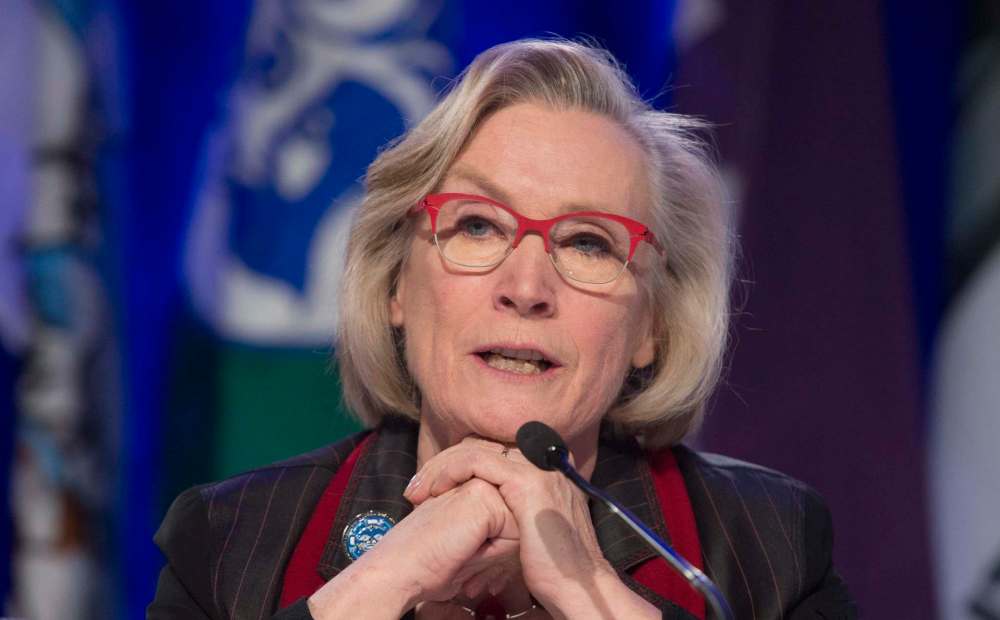
Indigenous Affairs Minister Carolyn Bennett was in Winnipeg for an event where as many as 12 First Nations will sign on for the initial phase of the Manitoba First Nations School System.
It will begin in time for the 2017-18 school year.
The agreement will come with a hefty new investment — several thousands dollars more per student — to bring up funding to levels comparable with provincially funded schools in Manitoba.
Most reserve schools receive only about $4,000 to $5,000 per student.
Meanwhile, Manitoba will spend an average of $13,016 per student in this school year.
For years, Ottawa argued it was spending more to educate students on reserves than the provinces, but it’s not an equal comparison. Only 13 First Nations have high schools, meaning students have to attend public schools to finish their education — and Ottawa pays full price to those school boards for tuition.
In the Frontier School Division in the north — where many reserve children from remote communities are sent to study — the tuition is more than $20,000 a year.
The Manitoba First Nations School System will manage and administer both elementary and high school education for participating First Nations, with additional communities welcome to join.
It will be designed by First Nations, making it unique in Canada.
The school board will focus on enhancing programming in indigenous languages, culture and anyting that improves academic achievement.
The agreement puts back into motion a process that derailed four years ago when the First Nations Education Act introduced by the former Conservative government fell apart without enough buy-in by indigenous communities, who felt they were having it thrust upon them without consultation.
The act never passed, and the attached funding evaporated with it.
Prime Minister Justin Trudeau promised $2.6 billion for First Nations education during last year’s federal election and, while the money was included in the budget, it was spread out over five years rather than four, disappointing many communities.
As well, the bulk of that money isn’t scheduled to roll out until the final two years, including $800 million in 2020-21, after the next election.
There was $287.5 million included in this year’s budget for improving primary and secondary education on reserves.
Bennett was warned in a briefing note prepared by her department shortly after taking office that the state of schools on reserves was dismal.
Band-operated schools lack a proper curriculum, training for teachers and supports such as school boards.
They are largely left to operate on their own, although Manitoba reserves have all received some support from the Manitoba First Nations Education Resource Centre — a support agency created by the Assembly of Manitoba Chiefs that will form the basis for the new school board.
Manitoba’s Public Schools Act and the Education Administration Act oversee off-reserve schools with 150 pages of rules, regulations and requirements.
The Indian Act covers education in just three pages, leaving schools that are underfunded, have high staff turnover and lack of access to materials to determine on their own how many education days there should be and what kids will learn.
While many follow provincial curriculum where possible, it is made harder when sometimes even basic education materials such as textbooks are in short supply.
Many of the schools don’t have libraries or gyms.

In 2011, a Senate committee that studied the issue of education on reserves found a dismal situation with low-quality services being provided in substandard facilities, which led to extremely low graduation rates.
It found 70 per cent of children growing up on a reserve will never graduate from high school.
Attendance rates are low, driven by a lack of trust in education systems among parents and grandparents scarred by residential school tragedies.
It recommended First Nations school boards as a possible solution, but experts have long said they had to be run by indigenous communities or parents and students simply will not trust them.
mia.rabson@freepress.mb.ca
Advertisement Advertise With Us
Advertisement Advertise With Us
History
Updated on Saturday, December 17, 2016 8:55 AM CST: Edited