

Hockey players are tougher than old skates
Advertisement
Read this article for free:
or
Already have an account? Log in here »
To continue reading, please subscribe:

Digital Subscription
One year of digital access for only $205*
- Enjoy unlimited reading on winnipegfreepress.com
- Read the E-Edition, our digital replica newspaper
- Access News Break, our award-winning app
- Play interactive puzzles
*First annual payment billed as $205.00 + GST for one year. This annual subscription will automatically renew at $233.00 + GST every 52 weeks (10% off the regular annual price of $259.35). Offer available to new and qualified returning subscribers only. Cancel any time.
To continue reading, please subscribe:
Add Free Press access to your Brandon Sun subscription for only an additional
$1 for the first 4 weeks*
- Enjoy unlimited reading on winnipegfreepress.com
- Read the E-Edition, our digital replica newspaper
- Access News Break, our award-winning app
- Play interactive puzzles
*Your next Brandon Sun subscription payment will increase by $1.00 and you will be charged $17.95 plus GST for four weeks. After four weeks, your payment will increase to $24.95 plus GST every four weeks.
Read unlimited articles for free today:
or
Already have an account? Log in here »
Hey there, time traveller!
This article was published 30/12/2016 (3541 days ago), so information in it may no longer be current.
If you ever doubted hockey players are among the toughest athletes, there’s always the big, bloody example of Matt Calvert.
On Nov. 18, the Columbus Blue Jackets forward and 27-year-old Brandon product took a Nick Holden slapshot to the face, opening a grotesque gash that required 36 stitches to close. What’s more, he returned with a huge bandage on his forehead and, in epic fashion, scored the game-winner while short-handed in a 4-2 Jackets’ win over the New York Rangers.
It’s a memory he’ll always cherish.
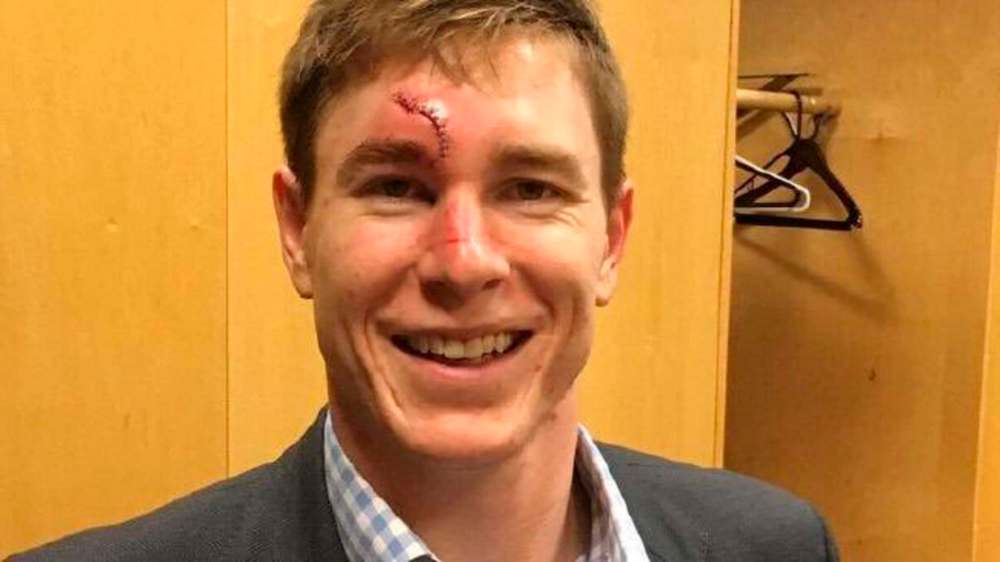
“You get hit to the head, you have a sheet over your head for 35 to 40 minutes and then you get up and the adrenalin’s pumping,” Calvert said Thursday. “You get hit with the puck, you’re in the middle of a hockey game and I just felt I was ready to go back out and play. I played a couple of games after that but ended up pulling myself, not feeling right. I felt good at the time, went through all the protocols and passed them all. With a concussion, you’ve gotta read your body… sometimes these things don’t show up ’til after.”
Calvert missed five games, but has returned to health and has been a big part of the club’s amazing 14-game winning streak.
Another astonishing development has been Calvert’s recovery from the wound. The horseshoe-shaped scar has all but disappeared, much to the relief of his wife and parents.
The Columbus doctor who repaired a 30-stitch facial cut suffered during a pre-game skate by then-Edmonton Oilers star Taylor Hall in 2012, also sewed up Calvert.
“(The cut) was right down to the skull and muscle, too,” said Calvert. “It took about 35, 40 minutes to repair it. He did a great job.”
fab freshman
Zach Werenski’s astonishing rise from the University of Michigan to standout first-pairing defenceman in Columbus in less than a year has been a revelation for head coach John Tortorella.
“He’s a helluva player,” said Tortorella. “He’s got such a bright future. We just have to make sure we coach him the right way and not get him into situations where it’s too much for him. But his mental aptitude as such a young kid playing the toughest position in the game, is off the charts.
Werenski, who has six goals and 24 points in 34 NHL games, finished his sophomore season at Michigan last spring and was immediately inserted into the lineup of the Lake Erie Monsters, Columbus’s AHL affiliate, en route to a Calder Cup title.
“It couldn’t have been better timing for this organization and him to step out of college and play four (playoff) rounds in the American Hockey League,” said Tortorella.
Olympic conundrum
Dallas Stars general manager Jim Nill loves the Olympic concept, but he’s having a hard time giving his support to the league’s possible involvement in the 2018 Pyeongchang Winter Games.
“I think it’s an honour to represent your country anytime you can and I know the players want to do that and they should…,” said Nill. “The problem is, on the flip side, the Olympics are in February… for the NHL, that’s like a restaurant on the beach shutting down in summer time. You can’t do it.”
Travelling to South Korea for a tournament to be played many time zones away from North American television markets doesn’t help.
“(There would be) more strain on the players travel-wise,” said Nill. “To watch the games is going to be harder, the games are going to be on at 3 or 4 in the morning. So, there’s just a lot of variables that come into play.

“I think everybody loves the Olympics, would love to go but there are some factors that come into play that we have to realize.”
The NHL’s condensed schedule in 2016-17, complicated by the World Cup and a mandated five-day mid-season break, is a reality difficult to ignore.
“It’s probably more magnified now because, I really believe, the league has settled in,” said Nill. “The (salary) cap system, the parity in the league — the league’s never been better.
“Every night is a playoff-style game and when you add this condensed schedule, every team’s going through playing six games in nine or 10 nights, with travel on top of it, it’s hard. It’s very taxing on the players and you’re seeing injuries because of it. To say this isn’t the cause of injuries is being pretty naive.”
mike.sawatzky@freepress.mb.ca Twitter: @sawa14
Quoteworthy
Blue Jackets forward Lucas Sedlak got the last laugh, potting a nice deflection goal in the third period of Columbus’s 5-3 win in Winnipeg Thursday night, but he definitely felt a monstrous hit he took from Jets blue-liner Dustin Byfuyglien earlier in the frame.
“It was a pretty hard hit. I didn’t even know it was him,” said Sedlak. “I was looking to make a play and suddenly I was down on my ass. Very hard hit.”
Related Articles
Jets cap 2016 with 6-2 loss to Islanders



Advertisement Advertise With Us
Advertisement Advertise With Us