

Next commissioner must learn from last one

Advertisement
Read this article for free:
or
Already have an account? Log in here »
To continue reading, please subscribe:
Digital Subscription
One year of digital access for only $1.44 a week*
- Enjoy unlimited reading on winnipegfreepress.com
- Read the E-Edition, our digital replica newspaper
- Access News Break, our award-winning app
- Play interactive puzzles
*Billed as $5.77 plus GST every four weeks. After 52 weeks, price increases to the regular rate of $19.95 plus GST every four weeks. Offer available to new and qualified returning subscribers only. Cancel any time.
To continue reading, please subscribe:
Add Free Press access to your Brandon Sun subscription for only an additional
$1 for the first 4 weeks*
- Enjoy unlimited reading on winnipegfreepress.com
- Read the E-Edition, our digital replica newspaper
- Access News Break, our award-winning app
- Play interactive puzzles
*Your next Brandon Sun subscription payment will increase by $1.00 and you will be charged $17.95 plus GST for four weeks. After four weeks, your payment will increase to $24.95 plus GST every four weeks.
Read unlimited articles for free today:
or
Already have an account? Log in here »
Hey there, time traveller!
This article was published 21/04/2017 (3331 days ago), so information in it may no longer be current.
With the clock on Jeffrey Orridge set to expire in the coming months, the search to find the next CFL commissioner is surely underway.
In the weeks since news broke the league and its top boss had agreed to part ways, effective June 30, the overwhelming consensus among pundits is Orridge had failed on many levels. Despite the number of unflattering reports, others have contended that, over his nearly two years of service, the CFL is in a better place.
Whether you agree with one sentiment or the other really doesn’t matter at this point — neither to Orridge nor to the league he’ll soon leave. Orridge, a graduate of Harvard Law School who boasts a long resumé filled with high-profile positions, will be unemployed only for as long as he chooses. As for the CFL, that, too, will go on without any disruption, as teams get ready for training camp next month.
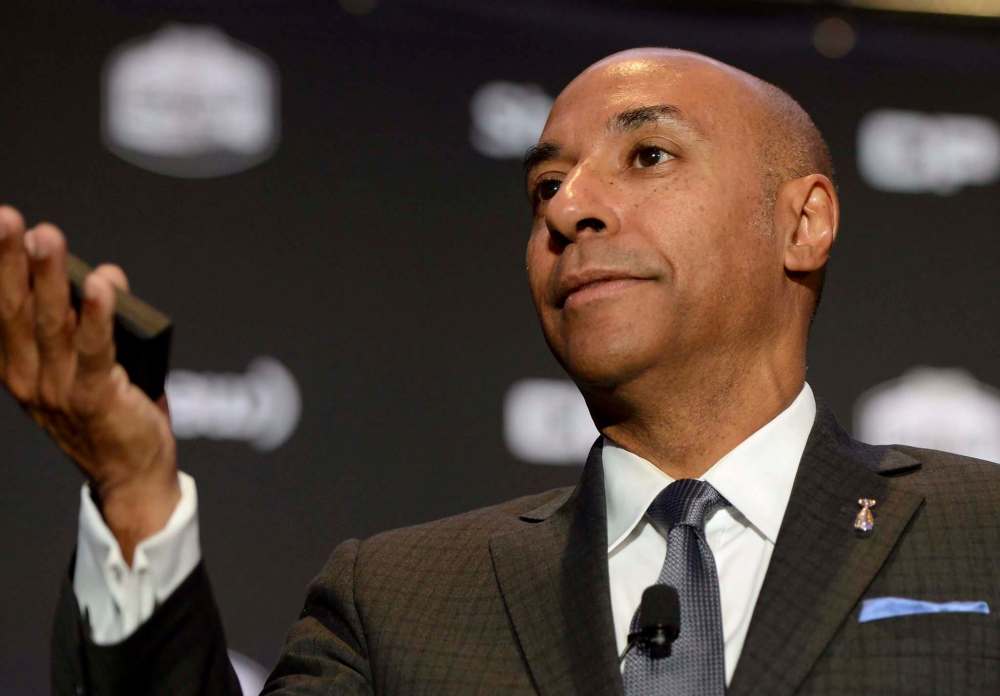
What must not be lost, however, are the lessons to be taken from Orridge’s brief tenure – if only to warn the next guy or gal who might be thinking a shot at being the next head honcho of the CFL feels like a perfect fit.
The first lesson to be learned from Orridge came seven months into his reign, during his first run at the league’s annual state-of-the-union address.
Standing in front of a sea of scribes in Winnipeg on the eve of the 2015 Grey Cup, it didn’t take long to realize where Orridge’s priorities stood.
While Orridge came locked and loaded with stats and figures on how he planned to boost audience numbers in the future, including methods to attract younger Canadians — a demographic the CFL so desperately wants and needs — the media was hammering him on past data regarding attendance numbers and TV ratings that painted a much different picture.
He looked confused when quizzed about the teams’ secret negotiation lists and wondered why anyone would want to know what he planned to do with the league’s referees, who constantly seemed to botch calls and extend games far too long.
To whoever gets the job: do yourself a serious favour and get to know the reporters who cover the league. Go out for coffee, shoot the crap and ask them what issues are plaguing the CFL. Orridge eventually did this, but only after he had his name run through the mud and it was apparent it was too little, too late.
There is a common belief the commissioner of the CFL needs to bleed the game inside and out; or he needs to be somebody who has either played the game or worked in the league and therefore better equipped to relate to the unique CFL fan base. While there is no doubt that would help — look no further than Mark Cohon or Tom Wright, former league bosses beloved by owners, players and fans — all that really matters in that list, at least when it comes to keeping your job, are the owners.
In the CFL, six teams are owned privately. The other three — Winnipeg, Saskatchewan and Edmonton — run off public funds. Each owner and CEO from the nine teams combines to make up the CFL Board of Governors, a group that ultimately hires and fires the commissioner. Unlike in the past, where the publicly-run teams were said to carry a lot more weight, often bailing out the privately run organizations, that no longer appears to be the case.
Imagine spending — or worse, losing — your hard-earned money trying to run a CFL club while other teams use cash from taxpayers to fund their football operations. When it comes to making an important decision, it only makes sense that an owner who is risking more than his or her job would have a greater influence on decisions.
Furthermore, many of these owners have been around for a while, are firm in what they believe the league should look like and how it should be run and struggle with buzzwords such as “digital platforms.”
Which brings us to lesson No. 2: When you arrive for your interview, showing up with a well-organized plan is just as important as your ability to explain it properly.
Any mandate that is put forth in front of the CFL board must be clear to all those in the room. Fancy words and charts will not jibe with some of the grey-hairs in the room, especially if they have no idea what it is you’re trying to achieve. The last thing you need is to lose trust of an owner — more on that in a bit — before you’ve even started.
Best tip: plan out where you hope to be by year one, two, five and 10; explain what you’re going to be doing in terms that won’t alienate your audience; and how, at the end of the day, you should be judged. With Orridge, it wasn’t always what he said but how he said it that forced many to turn cold on him.
Since 2000, only two commissioners in the CFL have lasted longer than three years, while in other sports leagues it’s not uncommon to see someone stick around for 10 or more. Part of that has to do with dollars and cents, with some top executives in other leagues being paid tens of millions of dollars. But a better explanation of the constant turnover in the CFL is mostly to do with the small number of teams and the large amount of power each owner has.
Ah, now for lesson 3: leverage is key.
When it takes only six votes to oust a commissioner and even few owners to piss off to get to that number, you’re going to want to make sure you at least have some power in the game. In order to properly implement your plan — and prevent yourself from being a glorified welcome mat — you need to have time. Quarterbacks get at least three years of practice before teams start to reap their rewards. Why should the big boss, too?
Simply put, the next commissioner needs to create a situation where he or she is too costly to replace. The CFL is at a crossroads and can’t mess up this next pick, which means the board will likely take it’s time in finding the right person.
That lucky candidate will need to broker a deal where it becomes too costly for him or her to be replaced just like that.
Working out a contract that will see the next commissioner in the big chair for at least five years — or else risk having to pay them if they’re fired — will not only ensure him or her isn’t worried about pleasing nine different and unique markets and instead can focus on the pre-approved plan that, again, has been clearly and thoroughly outlined.

Without that sense of job security, there’s a chance that you could lose your job simply by — get this — doing your job.
It’s hard to think Orridge made many friends in Saskatchewan when he levied historic fines on the Roughriders when they went completely rouge with the number of practice players they had working out with the team. Montreal couldn’t have been cool with him after their star receiver, Duron Carter, was issued a suspension when, after scoring a touchdown against Ottawa, got up and walked through the Redblacks sidelines before bumping into head coach Rick Campbell. Ditto for Hamilton Tiger-Cats head coach Kent Austin, who was fined and suspended one game for making contact with an official.
Just think about the politics and about the fact the same people the commissioner is hired to sanction and to monitor and to keep in line are the same people that can hire and fire you at will. As mentioned, it sometimes only takes a few grudges to have the rest fall in line.
jeff.hamilton@freepress.mb.ca twitter: @jeffkhamilton
Jeff Hamilton
Multimedia producer
Jeff Hamilton is a sports and investigative reporter. Jeff joined the Free Press newsroom in April 2015, and has been covering the local sports scene since graduating from Carleton University’s journalism program in 2012. Read more about Jeff.
Every piece of reporting Jeff produces is reviewed by an editing team before it is posted online or published in print — part of the Free Press‘s tradition, since 1872, of producing reliable independent journalism. Read more about Free Press’s history and mandate, and learn how our newsroom operates.
Our newsroom depends on a growing audience of readers to power our journalism. If you are not a paid reader, please consider becoming a subscriber.
Our newsroom depends on its audience of readers to power our journalism. Thank you for your support.
Commissioners of the Canadian Football League
(Name, birthplace, tenure, length of tenure)
Jeffrey Orridge (New York, NY) April 29, 2015 – Present (1 year, 11 months-plus)
*Jim Lawson (Toronto) Jan. 9, 2015 – April 28, 2015 (3 months, 2 weeks)
Mark Cohon (Toronto) April 17, 2007 – Jan. 9, 2015 (7 years, 8 months)
Tom Wright (Toronto) Nov. 23, 2002 – Nov. 20, 2006 (3 years, 12 months)
*David Braley (Burlington) March 20, 2002 – Nov. 22, 2002 (8 months, 1 week)
Michael Lysko (Toronto) Nov. 1, 2000 – March 19, 2002 (1 year, 4 months)
*John Tory (Toronto) Feb. 2, 1997 – Oct. 31, 2000 (3 years, 9 months)
Larry W. Smith (Montreal) Feb. 27, 1992 – Feb. 1, 1997 (4 years, 11 months)
J. Donald Crump (Toronto) Jan. 5, 1990 – Dec. 31, 1991 (1 year, 12 months)
#Bill Baker (Regina) Jan. 1, 1989 – Dec. 31, 1989 (12 months)
Doug Mitchell (Calgary) June 1, 1984 – Dec. 31, 1988 (4 years, 7 months)
Jake Gaudaur (Hamilton) April 2, 1968 – May 31, 1984 (16 years, 2 months)
Allan McEachern (Vancouver) Feb. 24, 1967 – April 1, 1968 (1 year, 1 month)
Ted Workman (Montreal) Feb. 23, 1967 – Feb. 24, 1967 (1 day)
Keith Davey (Toronto) Jan. 1, 1967 – Feb. 22, 1967 (1 month, 3 weeks)
G. Sydney Halter (Winnipeg) Jan. 19, 1958 – Dec. 31, 1966 (8 years, 11 months)
*Lawson, Barley and Tory were acting Commissioners
#In 1989, the role was split into two positions. Bill Baker held the title of president/chief operating officer. Roy McMurtry held the position of chairman/chief executive officer. During the period between Bill Baker’s resignation and Donald Crump’s appointment, Roy McMurtry continued in the role of chairman but did not hold the role of acting Commissioner. Similarily, between Crump’s resignation and Larry Smith’s appointment, Phil Kershaw held the role of chairman but was not acting commissioner. During these periods the commissioner position was vacant.
Source: CFLDb
Jeff Hamilton
Multimedia producer
Jeff Hamilton is a sports and investigative reporter. Jeff joined the Free Press newsroom in April 2015, and has been covering the local sports scene since graduating from Carleton University’s journalism program in 2012. Read more about Jeff.
Every piece of reporting Jeff produces is reviewed by an editing team before it is posted online or published in print — part of the Free Press‘s tradition, since 1872, of producing reliable independent journalism. Read more about Free Press’s history and mandate, and learn how our newsroom operates.
Our newsroom depends on a growing audience of readers to power our journalism. If you are not a paid reader, please consider becoming a subscriber.
Our newsroom depends on its audience of readers to power our journalism. Thank you for your support.
Advertisement Advertise With Us
Advertisement Advertise With Us