

Losing made NWT team stronger
Failing in Scotties relegation games forced rink to bear down, improve

Advertisement
Read this article for free:
or
Already have an account? Log in here »
To continue reading, please subscribe:

Digital Subscription
One year of digital access for only $205*
- Enjoy unlimited reading on winnipegfreepress.com
- Read the E-Edition, our digital replica newspaper
- Access News Break, our award-winning app
- Play interactive puzzles
*First annual payment billed as $205.00 + GST for one year. This annual subscription will automatically renew at $233.00 + GST every 52 weeks (10% off the regular annual price of $259.35). Offer available to new and qualified returning subscribers only. Cancel any time.
To continue reading, please subscribe:
Add Free Press access to your Brandon Sun subscription for only an additional
$1 for the first 4 weeks*
- Enjoy unlimited reading on winnipegfreepress.com
- Read the E-Edition, our digital replica newspaper
- Access News Break, our award-winning app
- Play interactive puzzles
*Your next Brandon Sun subscription payment will increase by $1.00 and you will be charged $17.95 plus GST for four weeks. After four weeks, your payment will increase to $24.95 plus GST every four weeks.
Read unlimited articles for free today:
or
Already have an account? Log in here »
Hey there, time traveller!
This article was published 26/01/2018 (3176 days ago), so information in it may no longer be current.
PENTICTON, B.C. — For three years, Kerry Galusha walked out under the Scotties lights, not knowing if she would stay for two days or a week. For two of those years, she went home with the bitter taste of sudden-death defeat.
That was the frustration of Curling Canada’s three-year relegation experiment: to come so close, but lose it all.
Well, those years are gone. Now, on the brink of the 2018 Scotties, which features more teams, a new format, and an end to that controversial pre-qualification tournament, Galusha and her Northwest territories teammates are in a unique position to see both sides of the coin.
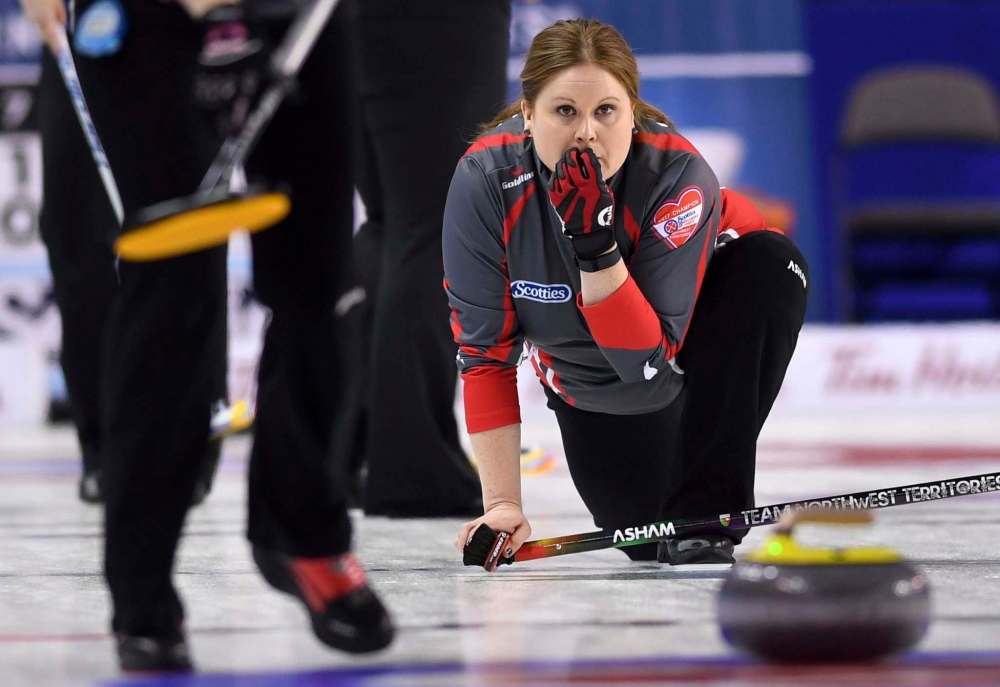
What doesn’t kill you makes you stronger, right?
“I’m happy that (the pre-qualification tournament) is gone because of the heartbreak teams felt,” she says, chatting on Friday afternoon at the South Okanagan Events Centre, where the Canadian championship kicks off today.
“We went through it. Then we watched Team New Brunswick go through it last year, and that was really hard on them. It’s really tough. But teams at the bottom of the pack do need to get better, and it forced us to get better.”
Galusha was a Scotties fixture until 2015, when the pre-qualification tournament debuted. After that, she lost two straight relegation finals: first to Northern Ontario’s Tracy Fleury (who is back this year), then to Team British Columbia.
After the 2015 defeat, Galusha was visibly frustrated.
But she vowed to work harder, and everything changed.
Last year, Galusha enlisted Ontario skip John Epping as coach, and stepped up the way her Yellowknife team practised.
At the Scotties, they surged out of relegation, and nearly made the playoffs with a team best 5-6 record.
Without the sting of those two relegation years, Galusha thinks, that might not have happened.
“We might have just been the same old N.W.T. team that was at the bottom of the pack every year,” she said.
Whatever happens here in Penticton, she won’t need to do that again. Nor will Team Nunavut or Yukon, or other regions that often land at the bottom of the national women’s curling standings — that’s the point of this new format.
In 2016, with smaller regions jostling for guaranteed spots, Curling Canada announced it would axe the pre-qualification battle in 2018’s national competitions (women’s and men’s), and replace it with a pooled 16-team round-robin format.
The 16th spot is reserved for a top-ranked Canadian team that didn’t win their province or territory.
This year, that will be the winner of a high-stakes wild-card game between former Manitoba champions Chelsea Carey and Kerri Einarson.
(That game ended after press time on Friday night; check winnipegfreepress.com for the whole story.)
Even without the new format, Galusha wouldn’t have had to repeat the pre-qualification round; last year’s breakout performance lifted Team N.W.T. out of relegation.
Still, it’s a big opportunity — and challenge — for her neighbours.
It’s hard for the northern teams. Competition is sparse and travel is a problem. Airfare out of Nunavut, in particular, can be astronomical.
“Just to Ottawa alone, you’re looking at about $2,000,” says Nunavut third Geneva Chislett.
So for them, the Scotties is both a huge jump and one of the only chances to get better.
Iqaluit has one curling club, with four sheets; most of its members play in a recreational mixed league. Only two teams entered the playdowns.
For the last two years, Chislett skipped the Nunavut champion team to the Scotties, but never escaped relegation, playing only three games each year. (She did win her first-ever game on national ice, against Team B.C. in 2016.)
Now, Chislett — who is nationally unranked — will have to face top squads such as Michelle Englot’s Team Canada.
“It’s a little bit nervewracking,” Chislett says.
“But it’s going to be nice to be able to play against teams like that. We’ll just play to the best of our ability. We have nothing to lose and everything to gain. It can only be up from here for us,” Chislett says.
The same is true for the curler on a more personal level. In July, her husband of 25 years, John Manning, and two other men were working on a boat in downtown Iqaluit when they were caught in a terrible explosion.
Manning was airlifted to hospital in Ottawa, but died three days later. This winter, Iqaluit businesses raised money to hold the city’s annual New Year’s Eve fireworks celebration in his honour; Manning had been a longtime supporter.
So it wasn’t easy for Chislett to face returning to the Scotties this year. To help ease the transition, on and off the ice, Chislett stepped back to third, and enlisted Ontario free agent and curling club manager Amie Shackleton as skip.
The squad practised for the first time on Friday morning.
“For us, it was a good choice,” Chislett says. “We met her, and it seems like I’ve known her all my life. I think she can offer us some help, and definitely a skill level — she’s used to playing on arena ice, where we’re not.”

It will be an uphill battle here for the Nunavut contenders. Yet perhaps these seven guaranteed round-robin games aren’t so much about this year as they are for the future; the team includes a junior curler, Denise Hutchings, at second.
“That’s the future of Nunavut curling,” Chislett says. “I’m hoping (being included) makes it more attractive to youth.
“Given that, I do think that Nunavut has to develop along with everyone else… I’m not sure what will happen if it doesn’t get to that stage. I just don’t know how that’s going to transpire… but I’m glad we’re able to participate.”
melissa.martin@freepress.mb.ca
Melissa Martin
Reporter-at-large
Melissa Martin reports and opines for the Winnipeg Free Press.
Every piece of reporting Melissa produces is reviewed by an editing team before it is posted online or published in print — part of the Free Press‘s tradition, since 1872, of producing reliable independent journalism. Read more about Free Press’s history and mandate, and learn how our newsroom operates.
Our newsroom depends on a growing audience of readers to power our journalism. If you are not a paid reader, please consider becoming a subscriber.
Our newsroom depends on its audience of readers to power our journalism. Thank you for your support.
2018 Scotties Tournament of Hearts
Round robin
Pool A
Jennifer Jones (Manitoba)
TBD* (wild card)
Tracy Fleury (Northern Ontario)
Mary-Anne Arsenault (Nova Scotia)
Sherry Anderson (Saskatchewan)
Sylvie Robichaud (New Brunswick)
Kerry Galusha (Northwest Territories)
Chelsea Duncan (Yukon)
Pool B
Casey Scheidegger (Alberta)
Michelle Englot (Team Canada)
Hollie Duncan (Ontario)
Kesa Van Osch (British Columbia)
Stacie Curtis (Newfoundland)
Robyn MacPhee (Prince Edward Island)
Emilia Gagne (Quebec)
Amie Shackleton (Nunavut)
Format
After a seven-game round robin, the top-four teams from each group will move on to a championship round, which begins Thursday. There, they will battle it out to decide which four teams will advance to next weekend’s playoffs.
Day 1 game to watch
The time difference makes for late games back in Manitoba, but fans will want to keep an eye on Jennifer Jones’ first match. She’ll open the Scotties against Saskatchewan veteran Sherry Anderson at 9 p.m. CST tonight.
Melissa Martin
Reporter-at-large
Melissa Martin reports and opines for the Winnipeg Free Press.
Every piece of reporting Melissa produces is reviewed by an editing team before it is posted online or published in print — part of the Free Press‘s tradition, since 1872, of producing reliable independent journalism. Read more about Free Press’s history and mandate, and learn how our newsroom operates.
Our newsroom depends on a growing audience of readers to power our journalism. If you are not a paid reader, please consider becoming a subscriber.
Our newsroom depends on its audience of readers to power our journalism. Thank you for your support.
Related Articles
Nova Scotia skip helms brilliant run as team within reach of top spot at Scotties





Advertisement Advertise With Us
Advertisement Advertise With Us