

Insecticide to be used in ash tree beetle battle
City to treat 1,000 trees, remove 800 amid borer invasion

Advertisement
Read this article for free:
or
Already have an account? Log in here »
To continue reading, please subscribe:
Monthly Digital Subscription
$1 per week for 24 weeks*
- Enjoy unlimited reading on winnipegfreepress.com
- Read the E-Edition, our digital replica newspaper
- Access News Break, our award-winning app
- Play interactive puzzles
*Billed as $4.00 plus GST every four weeks. After 24 weeks, price increases to the regular rate of $19.95 plus GST every four weeks. Offer available to new and qualified returning subscribers only. Cancel any time.
Monthly Digital Subscription
$4.99/week*
- Enjoy unlimited reading on winnipegfreepress.com
- Read the E-Edition, our digital replica newspaper
- Access News Break, our award-winning app
- Play interactive puzzles
*Billed as $19.95 plus GST every four weeks. Cancel any time.
To continue reading, please subscribe:
Add Free Press access to your Brandon Sun subscription for only an additional
$1 for the first 4 weeks*
*Your next subscription payment will increase by $1.00 and you will be charged $16.99 plus GST for four weeks. After four weeks, your payment will increase to $23.99 plus GST every four weeks.
Read unlimited articles for free today:
or
Already have an account? Log in here »
Hey there, time traveller!
This article was published 08/06/2018 (2794 days ago), so information in it may no longer be current.
The city will start injecting ash trees with insecticide, hoping to save at least a small proportion of Winnipeg’s canopy from the devastation of the emerald ash borer.
“If we do nothing, we will lose all of our ash trees,” city forester Martha Barwinsky told reporters outside Norwood Community Centre.
“Even with injections, there’s still some risk that, over time, we may not have our ash trees.”
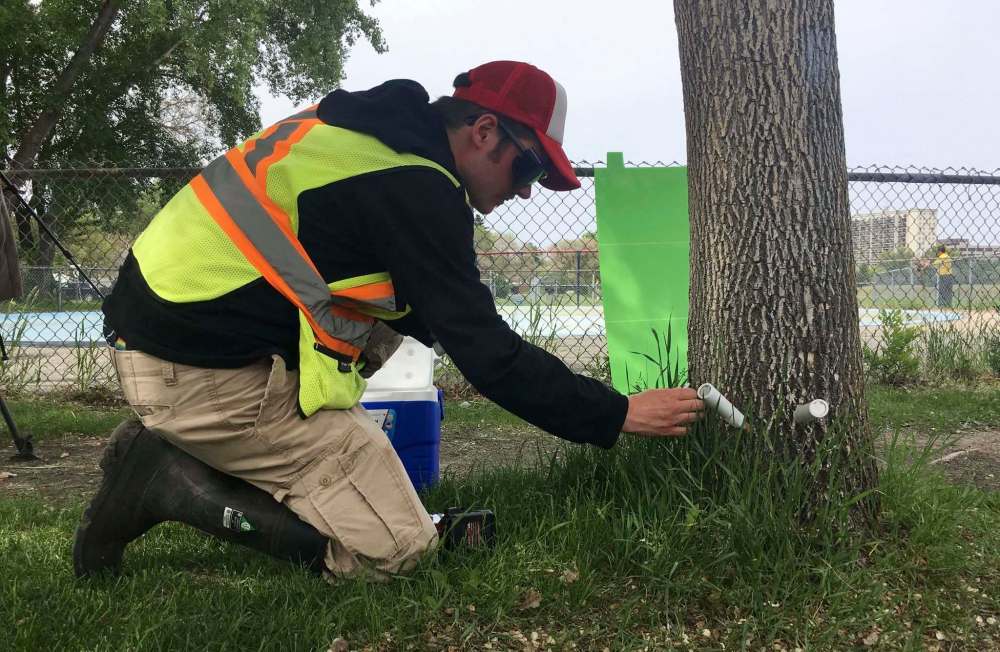
The city’s first-ever emerald ash borer control program will be in “high gear” starting Monday, said Ken Nawolsky, the superintendent of insect control in Winnipeg. The program, in which city staff will inject about 1,000 ash trees on public property to save them and remove 800 ash trees deemed “dangerous” (trees with a damaged structure at risk of falling), will take place over the next six weeks. The city will also install insect traps — sticky, bright green pyramids — at the top of the trees.
No one expects the insecticide program will save most of Winnipeg’s 356,000 ash trees. The city plans to treat only about 28,830 ash trees over the next decade because saving trees form the ash borer is difficult and expensive.
“The goal is to spread out the mortality of ash trees over time to allow more proactive management of tree removals and replacements, and to preserve our healthy ash trees for as long as possible,” city spokesman Kalen Qually wrote in a statement to the Free Press Friday.
Trees that will be injected, mainly in the Archwood neighbourhood area, have a grey circle on them. Those slated for removal have a purple mark.
Barwinsky estimates the long-term program will cost tens of millions of dollars over the next 10 years since the public ash trees will have to be injected every two years while the insect’s population is at its peak. So far, council has approved $1.3 million for this year’s response strategy.
The initiative comes after emerald ash borer larvae were detected for the first time in Winnipeg’s Archwood neighbourhood in November 2017. The invasive, wood-boring beetle attacks any healthy or stressed ash tree. The beetle also can infect and spread through firewood and wood chips.
Ash trees make up 30 per cent of the public canopy, so their removal will have “a significant impact” on the look of communities and boulevards, Barwinsky said, adding elms, lindens, hackberries, maples, bur oaks, maples and Ohio buckeyes will be planted in their place eventually.
“We’ll just have to get used to the fact that we won’t have that beautiful monoculture of cathedral (ash trees) along the way,” she said. “It will actually look more like a community forest.”

As for ash trees on private property, Barwinsky said Winnipeggers need to identify whether or not they have an ash tree on their property and, if they do, contact a professional arborist to do an assessment. If the tree is in good condition, she said an injection costs between $200 and $300, and it’s a long-term commitment of ongoing injections. Removing a tree costs about $1,000, she added.
The city’s taking care of only public property for now, but Barwinsky said it will be looking into potential ways to support private property owners in the future.
An ash tree can be identified by its ridge and furrow bark, which makes a repeating diamond-like pattern. Barwinsky said the trees also have an opposite branch structure, so if you look at a twig, the branches that come off the main stem grow on opposite sides of each other. Ash tree leaves also grow leaflets.
Insect control crews will be out doing treatments on an ongoing basis Monday through Friday between 6:30 a.m. and 2:30 p.m. until July.
maggie.macintosh@freepress.mb.caTwitter: @macintoshmaggie
Maggie Macintosh
Education reporter
Maggie Macintosh reports on education for the Free Press. Originally from Hamilton, Ont., she first reported for the Free Press in 2017. Read more about Maggie.
Funding for the Free Press education reporter comes from the Government of Canada through the Local Journalism Initiative.
Every piece of reporting Maggie produces is reviewed by an editing team before it is posted online or published in print — part of the Free Press‘s tradition, since 1872, of producing reliable independent journalism. Read more about Free Press’s history and mandate, and learn how our newsroom operates.
Our newsroom depends on a growing audience of readers to power our journalism. If you are not a paid reader, please consider becoming a subscriber.
Our newsroom depends on its audience of readers to power our journalism. Thank you for your support.
Winnipeggers don’t need to stock up on mosquito repellent yet, says Ken Nawolsky, the city’s superintendent of insect control. He predicts there will be “low mosquito numbers” across the city throughout the first part of June.
“So far, so good,” he told the Free Press Friday. “Mother Nature has been co-operating.
“We did have some localized, heavy rains in the western part of the city, areas over the last week and a half period received about 80 millimetres of rain, which was far greater than the eastern part of the city, so there might be a slight bump up in mosquito numbers there, but nothing that’s too annoying.”
As of Friday, the citywide mosquito trap count was two. Nawolsky said it was around 15 to 20 near this time two years ago.
Storms such as the one that happened in late May, during which parts of the city received the same or more rain than what’s been normally recorded for the entire month, make things unpredictable, he said. More storms mean more pools of stagnant water for mosquitoes to lay their eggs and breed in.
Nawolsky said it’s important for people to dump or drain any standing water on their property, emptying rain water from buckets, wheelbarrows, eavestroughs, birdbaths and anything else that holds water.
— Maggie Macintosh
Maggie Macintosh
Education reporter
Maggie Macintosh reports on education for the Free Press. Originally from Hamilton, Ont., she first reported for the Free Press in 2017. Read more about Maggie.
Funding for the Free Press education reporter comes from the Government of Canada through the Local Journalism Initiative.
Every piece of reporting Maggie produces is reviewed by an editing team before it is posted online or published in print — part of the Free Press‘s tradition, since 1872, of producing reliable independent journalism. Read more about Free Press’s history and mandate, and learn how our newsroom operates.
Our newsroom depends on a growing audience of readers to power our journalism. If you are not a paid reader, please consider becoming a subscriber.
Our newsroom depends on its audience of readers to power our journalism. Thank you for your support.
Advertisement Advertise With Us
Advertisement Advertise With Us
History
Updated on Friday, June 8, 2018 6:40 PM CDT: fixes typo
Updated on Saturday, June 9, 2018 9:30 AM CDT: Final
Updated on Saturday, June 9, 2018 11:11 AM CDT: Subhead fixed.