

City completes treatment of ash trees

Advertisement
Read this article for free:
or
Already have an account? Log in here »
To continue reading, please subscribe:

Digital Subscription
One year of digital access for only $205*
- Enjoy unlimited reading on winnipegfreepress.com
- Read the E-Edition, our digital replica newspaper
- Access News Break, our award-winning app
- Play interactive puzzles
*First annual payment billed as $205.00 + GST for one year. This annual subscription will automatically renew at $233.00 + GST every 52 weeks (10% off the regular annual price of $259.35). Offer available to new and qualified returning subscribers only. Cancel any time.
To continue reading, please subscribe:
Add Free Press access to your Brandon Sun subscription for only an additional
$1 for the first 4 weeks*
- Enjoy unlimited reading on winnipegfreepress.com
- Read the E-Edition, our digital replica newspaper
- Access News Break, our award-winning app
- Play interactive puzzles
*Your next Brandon Sun subscription payment will increase by $1.00 and you will be charged $17.95 plus GST for four weeks. After four weeks, your payment will increase to $24.95 plus GST every four weeks.
Read unlimited articles for free today:
or
Already have an account? Log in here »
Hey there, time traveller!
This article was published 27/07/2018 (2977 days ago), so information in it may no longer be current.
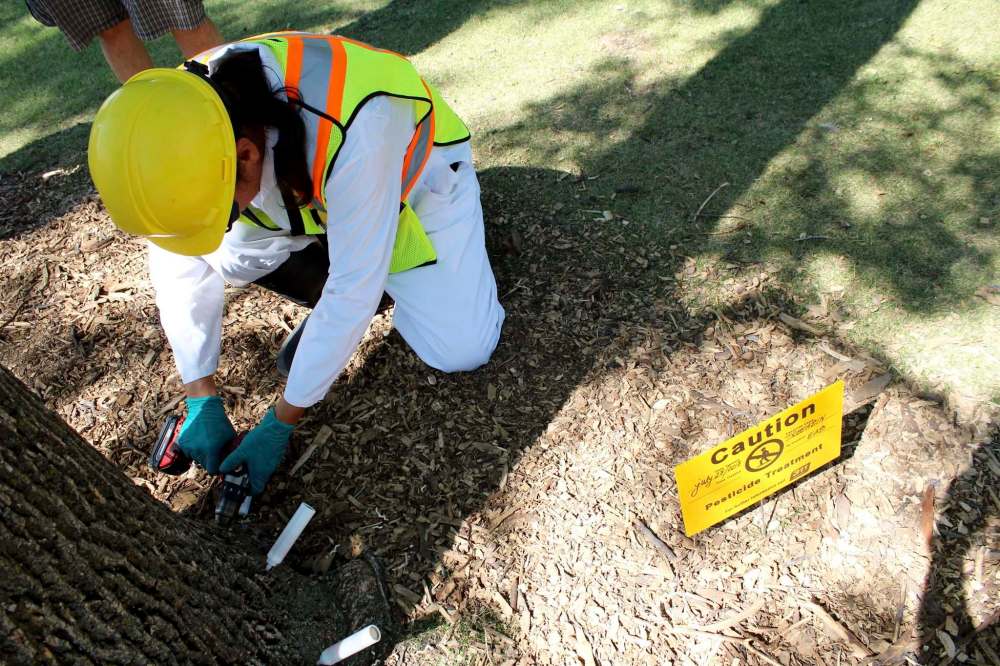
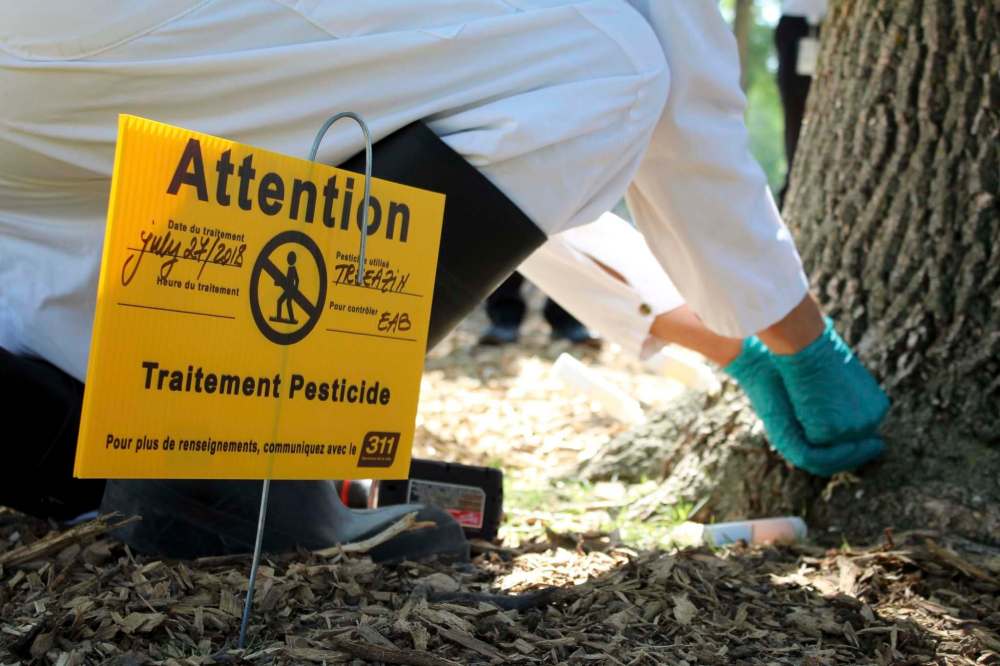
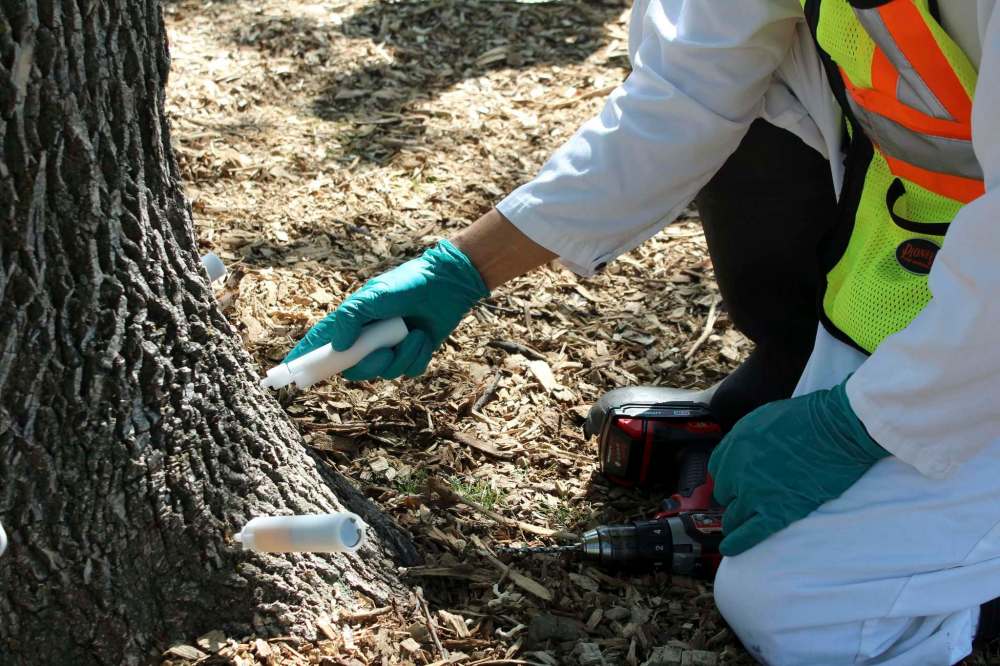
The last of the ash trees the city hopes to save from the emerald ash borer this year were injected with insecticide Friday.
Crowded under the shade of a leafy green ash tree in St. Vital Park, city councillors and representatives from the emerald ash borer control program announced 1,100 of Winnipeg’s urban ash trees had been treated in the lst two months.
Thanks to a donation from Trees Canada and BioForest Technologies, the city was able to inject 100 more ash trees with the TreeAzin product — a natural insecticide made from seeds of the neem tree that kills off the invasive, wood-boring species when it munches on the canopy — than it originally planned to. The donation of 12 litres of insecticide is valued at $6,800.
“Every bit helps,” Ken Nawolsky, superintendent of insect control in Winnipeg, said during an interview Friday.
“It’s really important that we inject as many trees as we can because that means one less tree is susceptible to the emerald ash borer, and if the beetle happens to attack that tree, they won’t be able to reproduce and then spread.”
The 1,100 trees, which the city hopes will now be fully protected from an ash borer threat, make up about 0.3 per cent of the city’s total ash canopy. The city plans to treat about 28,830 (eight per cent of Winnipeg’s total ash canopy) trees over the next decade because saving the trees is both difficult and expensive.
The emerald ash borer was first discovered in Winnipeg in November 2017. When the insect lays its eggs, the larvae embed themselves into the tree bark and block the flow of nutrients and water to the rest of the tree; they essentially “strangle” ash trees, said Dorothy Dobbie, a Tree Canada board member.

The insect can destroy an entire forest in 10 to 15 years, Nawolsky said. “What we’re trying to do is slow down the progress and movement of the emerald ash borer, so that we’re able to manage it better and then replace the trees that are dying so that we don’t lose them all at once.”
This year marks the start of the long-term fight to protect Winnipeg’s ash trees, he said, comparing the beetle battle to the city’s decades-long fight against Dutch elm disease.
Up to 800 ash trees will be removed by the end of the summer. Those trees, mostly in the Archwood neighbourhood, have been marked with purple dots.
Along with tree removals, the city will also continue doing “beetle surveillance” throughout the second half of the summer, by sampling tree limbs to see if there is any insect activity, Nawolsky added.
maggie.macintosh@freepress.mb.caTwitter: @macintoshmaggie
Maggie Macintosh
Education reporter
Maggie Macintosh reports on education for the Free Press. Originally from Hamilton, Ont., she first reported for the Free Press in 2017. Read more about Maggie.
Funding for the Free Press education reporter comes from the Government of Canada through the Local Journalism Initiative.
Every piece of reporting Maggie produces is reviewed by an editing team before it is posted online or published in print — part of the Free Press‘s tradition, since 1872, of producing reliable independent journalism. Read more about Free Press’s history and mandate, and learn how our newsroom operates.
Our newsroom depends on a growing audience of readers to power our journalism. If you are not a paid reader, please consider becoming a subscriber.
Our newsroom depends on its audience of readers to power our journalism. Thank you for your support.
Maggie Macintosh
Education reporter
Maggie Macintosh reports on education for the Free Press. Originally from Hamilton, Ont., she first reported for the Free Press in 2017. Read more about Maggie.
Funding for the Free Press education reporter comes from the Government of Canada through the Local Journalism Initiative.
Every piece of reporting Maggie produces is reviewed by an editing team before it is posted online or published in print — part of the Free Press‘s tradition, since 1872, of producing reliable independent journalism. Read more about Free Press’s history and mandate, and learn how our newsroom operates.
Our newsroom depends on a growing audience of readers to power our journalism. If you are not a paid reader, please consider becoming a subscriber.
Our newsroom depends on its audience of readers to power our journalism. Thank you for your support.
Advertisement Advertise With Us
Advertisement Advertise With Us
History
Updated on Friday, July 27, 2018 5:31 PM CDT: Adds photo
Updated on Saturday, July 28, 2018 8:10 AM CDT: Final