

Re:Act program helps meth addicts reclaim their lives

Advertisement
Read this article for free:
or
Already have an account? Log in here »
To continue reading, please subscribe:

Digital Subscription
One year of digital access for only $205*
- Enjoy unlimited reading on winnipegfreepress.com
- Read the E-Edition, our digital replica newspaper
- Access News Break, our award-winning app
- Play interactive puzzles
*First annual payment billed as $205.00 + GST for one year. This annual subscription will automatically renew at $233.00 + GST every 52 weeks (10% off the regular annual price of $259.35). Offer available to new and qualified returning subscribers only. Cancel any time.
To continue reading, please subscribe:
Add Free Press access to your Brandon Sun subscription for only an additional
$1 for the first 4 weeks*
- Enjoy unlimited reading on winnipegfreepress.com
- Read the E-Edition, our digital replica newspaper
- Access News Break, our award-winning app
- Play interactive puzzles
*Your next Brandon Sun subscription payment will increase by $1.00 and you will be charged $17.95 plus GST for four weeks. After four weeks, your payment will increase to $24.95 plus GST every four weeks.
Read unlimited articles for free today:
or
Already have an account? Log in here »
Hey there, time traveller!
This article was published 24/11/2019 (2491 days ago), so information in it may no longer be current.
A slow, September rain trickles down on Morberg House in St. Boniface, where 12 clients gear up for their mandatory, daily session of what’s called Re:Act programming.
The name is short for Recovery Education for Addictions and Complex Trauma.
Out of the 12 men currently living there, 11 are in recovery for a crystal meth addiction.
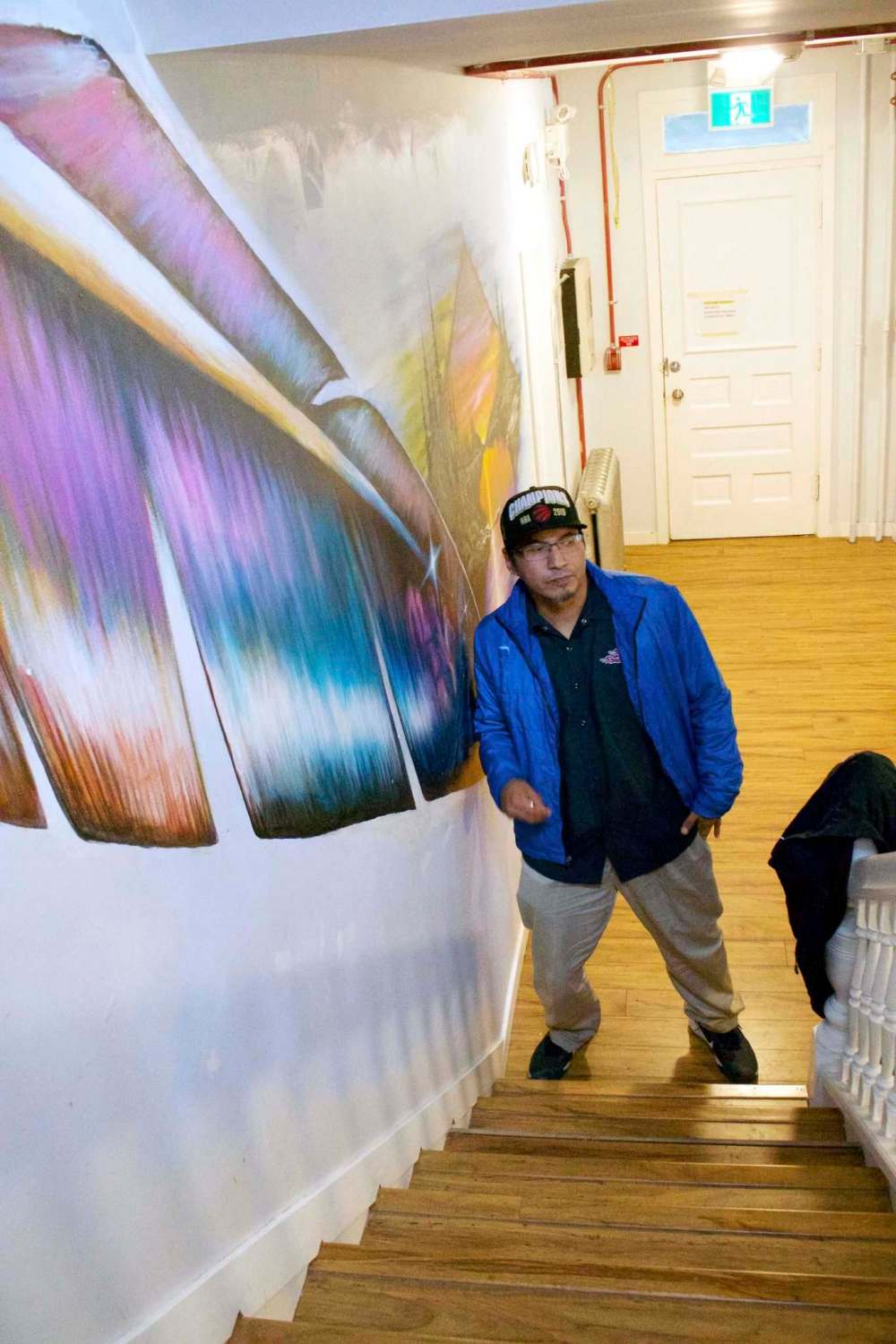
They nestle into the worn, mismatched couches in the living room of the century-old house. The smell of coffee and cigarettes hangs in the air.
Morberg House is a transitional residence for formerly homeless men in Winnipeg, recovering from various addictions. Darcy Daniels, a care-support specialist, noticed a huge difference in clients’ attitudes since bringing in Re:Act.
“It’s kind of cool,” Daniels said. “Everyone’s up, everyone’s dressed, everyone’s eating and they’re all starting to build structure. Something they lacked before.”
Morberg House runs on donations and some funding from the province’s income-assistance program — enough to cover residents’ rent each month. It also doesn’t operate like a typical transitional residence.
Daniels said if someone leaves and relapses, they are welcome to come back.
“It works — instead of them going out and going on a binge and back to where (they) were before. It takes 120 days to get over that hump where you start to feel like a normal person again after meth,” he said.
Daniels said that since Morberg House’s inception, he’s convinced the need for emergency services in the area has dropped dramatically.
Methamphetamine use has been on the rise in Winnipeg, with no signs of abating.
The Winnipeg Regional Health Authority reported that in 2015, the average number of hospital visits for meth-related issues were between one and two per day. By 2018, had it climbed to seven.
Psychosis is the most common side-effect of meth, as a result of addicts spending days without sleep or food. It can cause hallucinations and paranoid delusions.
Daniels said many people experiencing meth-induced psychosis get turned away from ERs because they are “unpredictable,” leaving them on the street.
For addicts who want help tackling their addiction, there are few options. Access to detox facilities is available, but it’s a lengthy process. Daniels says the average wait time for proper detox and rehab is two months.
Addicts must first be referred to a rapid access to addictions medicine (RAAM) clinic, where they are given a detox form to be filled out by a doctor or nurse practitioner.
If they successfully get the form filled out, make it through the wait-list and get placed in detox, it’s a 14-day process, followed by a 28-day Addictions Foundation of Manitoba (AFM) program.
AFM’s rehabilitation model is standardized across the board, with little customization for meth, with the exception for recommendations made to specific counsellors.
Kathleen Keating-Toews, the education and research specialist for AFM, said they look for the underlying issue of addiction.
“When someone is using a substance, whether that’s meth, whether that’s alcohol, they’re using that substance to get certain needs met,” she said. “And for a lot of people, they are self-medicating.”
Daniels relates, having subconsciously self-medicated since the age of nine for then-undiagnosed ADHD, and feeling like the drugs he took never worked.
“In ‘99 I got offered to smoke meth,” he said. “I tried it, and this guy’s looking at me, like, ‘Are you not high?’ And I said, ‘No. I think you guys got ripped off.’”
Janet Stevenson from St. Stephen’s Community House in Toronto has a different take on the catalyst for addiction.
“Substance use is a symptom of underlying factors such as poverty, homelessness, extensive histories of trauma,” said Stevenson, manager of clinical programs at St. Stephen’s. “I’m certainly not suggesting that’s not a piece of it. But I wouldn’t say that mental health equals addiction.”
Through the Ontario government, St. Stephen’s piloted a program called the Crystal Meth Project. It was a four-month-long pilot offering specific workshops and counselling to users. In the short time they had to test out the program, Stevenson said she noticed clients coming back, even after it ended.
“Those individuals that want to stay engaged with support, we were able to connect them,” she said. “(The) majority was internally within our other programs to ensure that they continue to access or have access to support.”
Stevenson said with specific programming for meth addicts, workers at St. Stephen’s can better help their clients achieve their goals, whether it’s decreasing use, finding housing or getting clean all together.
She said if more places gave clients options on how they wanted to receive care and support, overcoming the addiction crisis would be more successful.
“It can’t be one size fits all.”
St. Stephen’s is currently finalizing a proposal in hopes it can keep the program running and further serve addicts in Toronto.
Back in Winnipeg, community organizations such as Main Street Project are slowly expanding to accommodate more people. The province announced a pooled investment from different sectors of government to fund MSP’s new 120-bed homeless health centre.
Executive director Rick Lees wants to see a continuum of care for addicts, including procedures that won’t force them on the street if they relapse.
“It’s expected, it’s going to happen,” he said. “So you’re not kicked out of the system, but you move back through the system.”
He also urges politicians not to use the meth crisis as a “political football.”
“It’s not a political question, it’s an evidence-based science,” he said.
“We have politicians trying to develop policy around how to deal with addiction. They wouldn’t create policy around how to deal with cancer, so they need to stop that.”
Daniels agrees. He said the government needs to make services for addicts seeking recovery more accessible and affordable.
“It’s always about who’s going to pay for it?” Daniels said. “It’s in the policy, that’s how we start changing.”
Nicole Buffie
Multimedia producer
Nicole Buffie is a reporter for the Free Press city desk. Born and bred in Winnipeg, Nicole graduated from Red River College’s Creative Communications program in 2020 and worked as a reporter throughout Manitoba before joining the Free Press newsroom as a multimedia producer in 2023. Read more about Nicole.
Every piece of reporting Nicole produces is reviewed by an editing team before it is posted online or published in print — part of the Free Press‘s tradition, since 1872, of producing reliable independent journalism. Read more about Free Press’s history and mandate, and learn how our newsroom operates.
Our newsroom depends on a growing audience of readers to power our journalism. If you are not a paid reader, please consider becoming a subscriber.
Our newsroom depends on its audience of readers to power our journalism. Thank you for your support.
Nicole Buffie
Multimedia producer
Nicole Buffie is a reporter for the Free Press city desk. Born and bred in Winnipeg, Nicole graduated from Red River College’s Creative Communications program in 2020 and worked as a reporter throughout Manitoba before joining the Free Press newsroom as a multimedia producer in 2023. Read more about Nicole.
Every piece of reporting Nicole produces is reviewed by an editing team before it is posted online or published in print — part of the Free Press‘s tradition, since 1872, of producing reliable independent journalism. Read more about Free Press’s history and mandate, and learn how our newsroom operates.
Our newsroom depends on a growing audience of readers to power our journalism. If you are not a paid reader, please consider becoming a subscriber.
Our newsroom depends on its audience of readers to power our journalism. Thank you for your support.
Advertisement Advertise With Us
Advertisement Advertise With Us
History
Updated on Monday, December 16, 2019 10:28 AM CST: Notes a doctor or nurse practitioner can fill out form and detox is a 14 day process.