

Time capsules help students value history

Advertisement
Read this article for free:
or
Already have an account? Log in here »
To continue reading, please subscribe:
Monthly Digital Subscription
$1 per week for 24 weeks*
- Enjoy unlimited reading on winnipegfreepress.com
- Read the E-Edition, our digital replica newspaper
- Access News Break, our award-winning app
- Play interactive puzzles
*Billed as $4.00 plus GST every four weeks. After 24 weeks, price increases to the regular rate of $19.95 plus GST every four weeks. Offer available to new and qualified returning subscribers only. Cancel any time.
Monthly Digital Subscription
$4.99/week*
- Enjoy unlimited reading on winnipegfreepress.com
- Read the E-Edition, our digital replica newspaper
- Access News Break, our award-winning app
- Play interactive puzzles
*Billed as $19.95 plus GST every four weeks. Cancel any time.
To continue reading, please subscribe:
Add Free Press access to your Brandon Sun subscription for only an additional
$1 for the first 4 weeks*
*Your next subscription payment will increase by $1.00 and you will be charged $16.99 plus GST for four weeks. After four weeks, your payment will increase to $23.99 plus GST every four weeks.
Read unlimited articles for free today:
or
Already have an account? Log in here »
Hey there, time traveller!
This article was published 08/05/2020 (2178 days ago), so information in it may no longer be current.
Years from now, students will remember 2020 by the toilet paper rolls, dog selfies, and handwritten self-reflections they buried in their backyards during a pandemic.
COVID-19 time capsules are a new trend among teachers looking to keep students engaged from afar.
The assignments require students to be critical thinkers and make connections, at the same time as they reflect on an unprecedented period of distance learning in their early lives.
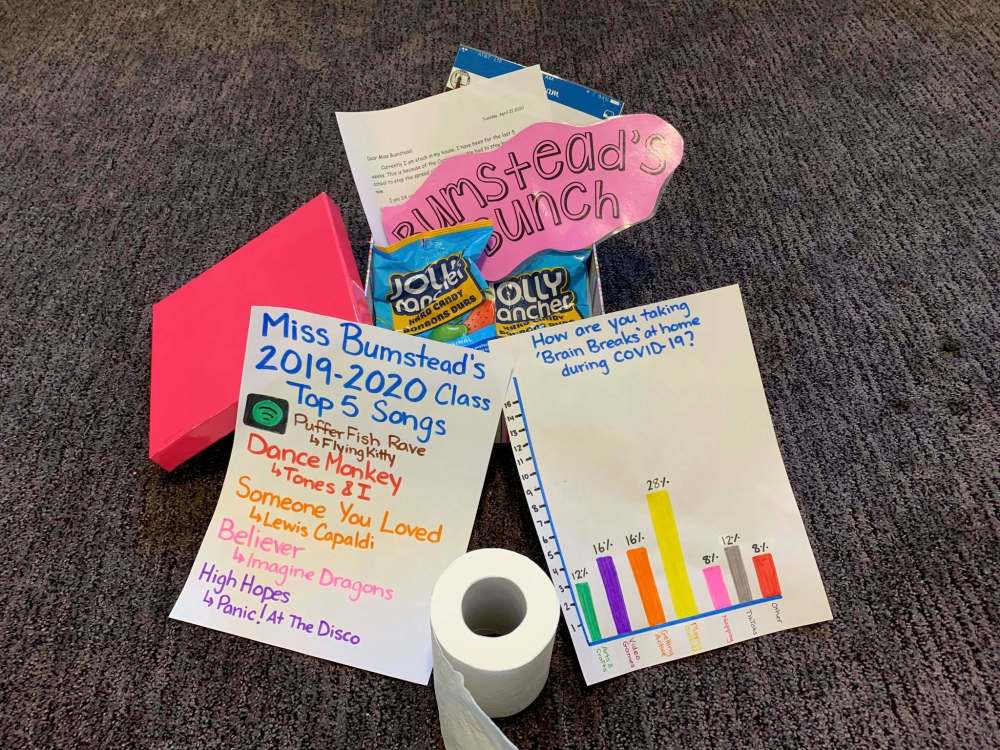
“We learn about the gold rush and the Great Depression and all of (the First and Second World Wars) in social studies,” said Christine Bumstead, recalling how she virtually introduced the project to her class at Morden Middle School.
“One day, we’re going to be learning about what we’re living right now.”
Bumstead, a Grade 6 teacher, said the time capsule project has forced the 11- and 12-year-olds who think of history as irrelevant “olden days” to reconsider.
In recent weeks, her students have been collecting news article clippings, graphing classmates’ physical-distancing activities and writing letters about 2020 to their future selves. Among the other objects they’ve selected for the capsules: painted rocks, new TV show reviews, empty toilet paper rolls and flour bags.
In Bumstead’s box, there’s a class photo, a playlist of her students’ favourite songs and a decorated toilet paper roll.
Both she and her students are expected to retrieve their capsules in five years. One student has set an alarm on his iPad for 2025.
In other digital classrooms across the province, students have been keen on collecting personal artwork, journal entries and photos of both their pets and baking recipes as 2020 artifacts.
“Pets are really a big coping piece, right now. We always have visitors on our online (Microsoft) Teams,” said Alison Ward, who has, with help from her colleagues at Frontenac School in Windsor Park, assigned nearly 100 grade 3-4 students with the project.

Ward said the exercise requires students to practise writing and researching skills, as much as it requires them to reflect on the positives of the current situation.
Michelle Shewchuk, a teacher at Ecole St. Avila, echoed those thoughts Wednesday.
“Many of them are becoming more independent learners or are trying to figure it out independently, and that was my goal,” said Shewchuk, adding the grade 3-4 class capsule reflections have brought her to tears.
Both students and their parents at the Fort Richmond neighbourhood school in Winnipeg have been writing letters about their time at home, from online Easter dinner to social-distancing Ramadan celebrations.
— Maggie Macintosh
Maggie Macintosh
Education reporter
Maggie Macintosh reports on education for the Free Press. Originally from Hamilton, Ont., she first reported for the Free Press in 2017. Read more about Maggie.
Funding for the Free Press education reporter comes from the Government of Canada through the Local Journalism Initiative.
Every piece of reporting Maggie produces is reviewed by an editing team before it is posted online or published in print — part of the Free Press‘s tradition, since 1872, of producing reliable independent journalism. Read more about Free Press’s history and mandate, and learn how our newsroom operates.
Our newsroom depends on a growing audience of readers to power our journalism. If you are not a paid reader, please consider becoming a subscriber.
Our newsroom depends on its audience of readers to power our journalism. Thank you for your support.
Maggie Macintosh
Education reporter
Maggie Macintosh reports on education for the Free Press. Originally from Hamilton, Ont., she first reported for the Free Press in 2017. Read more about Maggie.
Funding for the Free Press education reporter comes from the Government of Canada through the Local Journalism Initiative.
Every piece of reporting Maggie produces is reviewed by an editing team before it is posted online or published in print — part of the Free Press‘s tradition, since 1872, of producing reliable independent journalism. Read more about Free Press’s history and mandate, and learn how our newsroom operates.
Our newsroom depends on a growing audience of readers to power our journalism. If you are not a paid reader, please consider becoming a subscriber.
Our newsroom depends on its audience of readers to power our journalism. Thank you for your support.
Advertisement Advertise With Us
Advertisement Advertise With Us
History
Updated on Friday, May 8, 2020 2:34 PM CDT: fixes web problem with accent