

Ignorance still biggest obstacle holding back Indigenous rights
Time for Liberals to fulfil promise on United Nations Declaration on Rights of Indigenous Peoples

Advertisement
Read this article for free:
or
Already have an account? Log in here »
To continue reading, please subscribe:

Digital Subscription
One year of digital access for only $205*
- Enjoy unlimited reading on winnipegfreepress.com
- Read the E-Edition, our digital replica newspaper
- Access News Break, our award-winning app
- Play interactive puzzles
*First annual payment billed as $205.00 + GST for one year. This annual subscription will automatically renew at $233.00 + GST every 52 weeks (10% off the regular annual price of $259.35). Offer available to new and qualified returning subscribers only. Cancel any time.
To continue reading, please subscribe:
Add Free Press access to your Brandon Sun subscription for only an additional
$1 for the first 4 weeks*
- Enjoy unlimited reading on winnipegfreepress.com
- Read the E-Edition, our digital replica newspaper
- Access News Break, our award-winning app
- Play interactive puzzles
*Your next Brandon Sun subscription payment will increase by $1.00 and you will be charged $17.95 plus GST for four weeks. After four weeks, your payment will increase to $24.95 plus GST every four weeks.
Read unlimited articles for free today:
or
Already have an account? Log in here »
Hey there, time traveller!
This article was published 14/09/2020 (2166 days ago), so information in it may no longer be current.
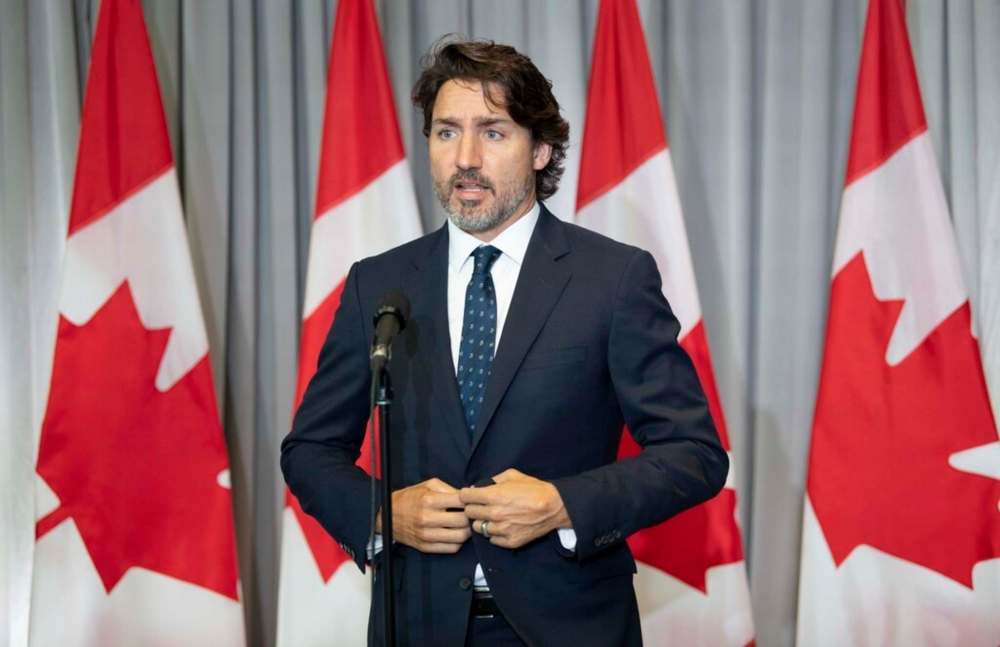
The federal Liberal government, and Prime Minister Justin Trudeau, have a tendency to say the “right things” when it comes to Indigenous rights and reconciliation.
Virtually from the beginning, Trudeau has said “no relationship is more important to me and to Canada than the one with Indigenous Peoples,” while committing to clearly defining Indigenous individual and collective rights and recognizing self-determination.
These words have been declared on minister mandate letters, pronounced on national television, and appeared on Twitter, such as this past weekend’s anniversary of the United Nations Declaration on the Rights of Indigenous Peoples, passed by the UN on Sept. 13, 2007.
“Today is the 13th anniversary of #UNDRIP,” Minister of Crown-Indigenous Relations Carolyn Bennett tweeted Sept. 13. “This impt Declaration sets out the individual and collective rights of Indigenous Peoples around the world. Canada fully endorses the Declaration as we work with First Nations, Inuit, and Métis to accelerate the path to self-determination.”
Bennett then tweeted out a familiar promise: that Canada will “introduce legislation to implement the Declaration by the end of the year.”
Implementing the declaration means Indigenous Peoples would get the same rights as other human beings across the world. As the UN describes it: “The document emphasizes the rights of Indigenous Peoples to live in dignity, to maintain and strengthen their own institutions, cultures and traditions and to pursue their self-determined development, in keeping with their own needs and aspirations.”
The key, and I suppose controversial, word here is “self-determination.” This means that by 2021, if the Liberals follow through, Indigenous nations would be recognized, affirmed, and enabled to express their independence however they see fit.
They will form their own institutions and develop, deliver, and follow their own laws. They will govern on their own territories and they would, most importantly, get stolen land or land owed to them back. They will partner with other governments and businesses on development projects and initiatives using “free, prior, and informed consent” for both sides.
So, this is pretty impressive language and a revolutionary step for the country.
Canada wasn’t always this friendly to the declaration. Unlike 144 other countries who ratified the declaration, Canada was one of four countries to originally refuse, only recently “endorsing” it in 2016. An “endorsement” is not law though.
And yet, the declaration has found its way into Canadian law. In a set of legal gymnastics possible only in Canada, the declaration was implemented by British Columbia’s provincial government last November.
So, are Indigenous nations self-determining only in B.C.? Do they operate under two different and very contradictory sets of laws (the federal Indian Act is antithetical to self-determination, for instance)? Do Indigenous Peoples need non-Indigenous governments to verify their independence? Doesn’t this defeat the purpose?
Whether or not the declaration is passed into federal law by the end of the year, the biggest obstacle to it is not politics but ignorance.
The Conservative party, which rejected it in 2007, is the most steadfast against the declaration. All of Canada’s other federal parties have committed to implement it.
While former Conservative leader Andrew Scheer often described the declaration as containing “many laudable goals” he took issue with what he called an Indigenous “veto” embedded in the “free, prior, and informed consent” clause. New leader Erin O’Toole is now using this language too.
What Conservatives mean is that Indigenous nations can be independent as long as their “independence” never interferes with Canadian desires.
Indigenous nations can establish their own schools or child welfare system or maybe even govern some of their own lands but must always, forever, acquiesce to Canadian rule. This isn’t self-determination, by the way: it’s surrender. Indigenous nations don’t want a “veto,” they want partners.
It doesn’t matter how many times Conservatives use the term “veto.” It doesn’t matter.
The Supreme Court has already ruled unanimously in the 2014 Tsilhqot’in decision that Aboriginal title is “the right to control the land.”
That means if an Indigenous nation can legally prove historical use and occupancy over any lands, they have “title” and the “right to choose” what happens with their territories. Canadian law cannot supersede this title except under unique circumstances.

Canada has no rights to simply take Indigenous land without free, prior, and informed consent. Call this a veto or not — it doesn’t matter. Canadian law says so.
This is precisely why B.C. was prompted to pass the declaration; there was no legitimate reason to stop it.
And there is no legitimate reason to not implement it now.
So, let’s do the right thing for everyone.
niigaan.sinclair@freepress.mb.ca
Niigaan Sinclair is Anishinaabe from Peguis First Nation and a professor in the Department of Indigenous Studies at the University of Manitoba. He’s been a columnist for the Free Press since 2018. Read more about Niigaan.
Every piece of writing Niigaan produces is reviewed by an editing team before it is posted online or published in print — part of the Free Press‘s tradition, since 1872, of producing reliable independent journalism. Read more about Free Press’s history and mandate, and learn how our newsroom operates.
Our newsroom depends on a growing audience of readers to power our journalism. If you are not a paid reader, please consider becoming a subscriber.
Our newsroom depends on its audience of readers to power our journalism. Thank you for your support.
Niigaan Sinclair is Anishinaabe from Peguis First Nation and a professor in the Department of Indigenous Studies at the University of Manitoba. He’s been a columnist for the Free Press since 2018. Read more about Niigaan.
Every piece of writing Niigaan produces is reviewed by an editing team before it is posted online or published in print — part of the Free Press‘s tradition, since 1872, of producing reliable independent journalism. Read more about Free Press’s history and mandate, and learn how our newsroom operates.
Our newsroom depends on a growing audience of readers to power our journalism. If you are not a paid reader, please consider becoming a subscriber.
Our newsroom depends on its audience of readers to power our journalism. Thank you for your support.
Advertisement Advertise With Us
Advertisement Advertise With Us