

Council to decide fate of police-in-schools program

Advertisement
Read this article for free:
or
Already have an account? Log in here »
To continue reading, please subscribe:

Digital Subscription
One year of digital access for only $205*
- Enjoy unlimited reading on winnipegfreepress.com
- Read the E-Edition, our digital replica newspaper
- Access News Break, our award-winning app
- Play interactive puzzles
*First annual payment billed as $205.00 + GST for one year. This annual subscription will automatically renew at $233.00 + GST every 52 weeks (10% off the regular annual price of $259.35). Offer available to new and qualified returning subscribers only. Cancel any time.
To continue reading, please subscribe:
Add Free Press access to your Brandon Sun subscription for only an additional
$1 for the first 4 weeks*
- Enjoy unlimited reading on winnipegfreepress.com
- Read the E-Edition, our digital replica newspaper
- Access News Break, our award-winning app
- Play interactive puzzles
*Your next Brandon Sun subscription payment will increase by $1.00 and you will be charged $17.95 plus GST for four weeks. After four weeks, your payment will increase to $24.95 plus GST every four weeks.
Read unlimited articles for free today:
or
Already have an account? Log in here »
Hey there, time traveller!
This article was published 29/09/2020 (2208 days ago), so information in it may no longer be current.
Winnipeg city council will vote Wednesday on whether to extend the police-in-schools program, which has been under fire from several community advocates who want it to end.
While the Winnipeg Police Service says the school resource officer program helps prevent crime and build relationships between law enforcement and the community, others argue the officers’ presence in schools sparks fear in racialized students, and can compromise their educational outcomes.
Coun. Markus Chambers, the chairman of the Winnipeg Police Board, said he hopes council approves the agreement to extend the program, in which 19 officers would visit schools in six divisions, until June 2023.
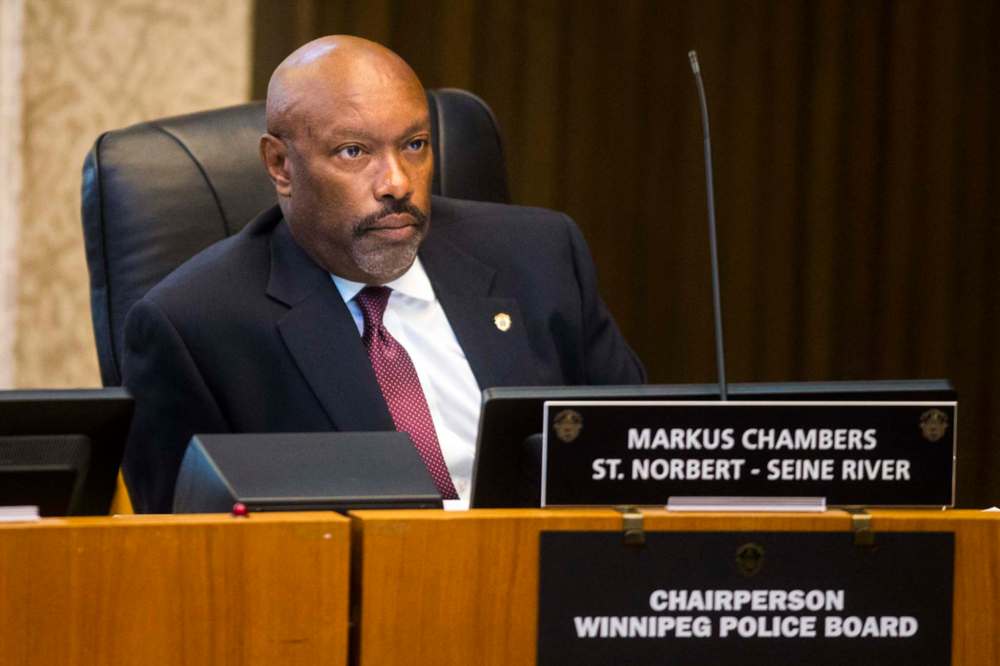
Chambers said he believes the program helps pupils cope with safety risks and bullying, and raises awareness of drug abuse.
“There’s a lot of great aspects of the program that I think we still need to consider,” he said.
Chambers said he volunteered for a Stay in School program at Gordon Bell High School in the 1990s, an effort that included former Winnipeg Police Service chief Devon Clunis. The councillor said that program provided presentations and activities that he believes are similar to what is offered now.
“It was a very effective way of building relationships and mentorships,” said Chambers.
By contrast, some Winnipeggers believe inviting police into schools causes more harm than good for specific groups of students, such as Indigenous pupils and those of colour.
“Police are a (frightening) presence for a lot of marginalized students and as long as there is a uniformed police officer in the schools, they are pushing people away by association and they’re making schools more exclusive places,” said Cam Scott, an organizer with Police-Free Schools Winnipeg.
Instead of funding the program, Scott said governments should invest in breakfast programs, nurses and/or support workers.
A city report notes the provincial government is expected to provide $1.7 million for the program until 2023, while school divisions will cover $3.4 million of the cost. The Winnipeg Police Service expects to provide nearly $3 million of in-kind support.
If governments and police refuse to end the program, Scott said his organization expects to lobby school boards.
Joe Curnow, a University of Manitoba professor who teaches racial justice courses, said she’s concerned that placing police in schools could make marginalized students less likely to succeed.
“It makes it really hard to create spaces where either reconciliation or anti-racism or culturally relevant and culturally sustaining pedagogies can thrive,” said Curnow.
The professor said she believes racialized students are more likely to be “over-policed” in their communities, so an officer’s presence at school can trigger anxiety.
Chambers said he would support a review of the program to help address the concerns of its opponents but remains convinced the benefits outweigh any flaws.
“There is still a lot of support for the program” (among) school divisions, parents and students, he said.

However, not all councillors are convinced the program should continue as is. Coun. Sherri Rollins said she won’t support the extension.
“I am not going to be supporting the motion because community-based organizations called on us to reallocate resources and to consider some police accountability,” said Rollins.
Joyanne.pursaga@freepress.mb.ca
Twitter: @joyanne_pursaga
Joyanne is city hall reporter for the Winnipeg Free Press. A reporter since 2004, she began covering politics exclusively in 2012, writing on city hall and the Manitoba Legislature for the Winnipeg Sun before joining the Free Press in early 2020. Read more about Joyanne.
Every piece of reporting Joyanne produces is reviewed by an editing team before it is posted online or published in print — part of the Free Press‘s tradition, since 1872, of producing reliable independent journalism. Read more about Free Press’s history and mandate, and learn how our newsroom operates.
Our newsroom depends on a growing audience of readers to power our journalism. If you are not a paid reader, please consider becoming a subscriber.
Our newsroom depends on its audience of readers to power our journalism. Thank you for your support.
Joyanne is city hall reporter for the Winnipeg Free Press. A reporter since 2004, she began covering politics exclusively in 2012, writing on city hall and the Manitoba Legislature for the Winnipeg Sun before joining the Free Press in early 2020. Read more about Joyanne.
Every piece of reporting Joyanne produces is reviewed by an editing team before it is posted online or published in print — part of the Free Press‘s tradition, since 1872, of producing reliable independent journalism. Read more about Free Press’s history and mandate, and learn how our newsroom operates.
Our newsroom depends on a growing audience of readers to power our journalism. If you are not a paid reader, please consider becoming a subscriber.
Our newsroom depends on its audience of readers to power our journalism. Thank you for your support.
Related Articles
Police-in-schools program easily passes at city hall
Advertisement Advertise With Us
Advertisement Advertise With Us