From stand down to stare down While social media captured troubling images of police chumming it up with occupiers, Ottawa residents took back their streets
Read this article for free:
or
Already have an account? Log in here »
To continue reading, please subscribe:

Digital Subscription
One year of digital access for only $205*
- Enjoy unlimited reading on winnipegfreepress.com
- Read the E-Edition, our digital replica newspaper
- Access News Break, our award-winning app
- Play interactive puzzles
*First annual payment billed as $205.00 + GST for one year. This annual subscription will automatically renew at $233.00 + GST every 52 weeks (10% off the regular annual price of $259.35). Offer available to new and qualified returning subscribers only. Cancel any time.
To continue reading, please subscribe:
Add Free Press access to your Brandon Sun subscription for only an additional
$1 for the first 4 weeks*
- Enjoy unlimited reading on winnipegfreepress.com
- Read the E-Edition, our digital replica newspaper
- Access News Break, our award-winning app
- Play interactive puzzles
*Your next Brandon Sun subscription payment will increase by $1.00 and you will be charged $17.95 plus GST for four weeks. After four weeks, your payment will increase to $24.95 plus GST every four weeks.
Read unlimited articles for free today:
or
Already have an account? Log in here »
Hey there, time traveller!
This article was published 19/02/2022 (1647 days ago), so information in it may no longer be current.
Last Saturday, on a road somewhere outside Ottawa, an Ontario Provincial Police officer pulled over a driver who had some distracting lights on his vehicle. The driver was on his way to bolster the anti-mandate siege that had choked the city for two weeks; but the officer issued no ticket, and nothing in the way of stern warning.
Instead, while a passenger filmed the interaction on the phone, the officer amiably rested his arm on the driver’s door and smiled as he gabbed with the pair about social media platform TikTok. They laughed a lot. It was comfortable. So it was no surprise when the officer expressed his approval of the protests occupying Ottawa’s streets.
“I get what you guys are doing, I support you guys 100 per cent,” he said. “I’ve heard nothing but great things for our protesters… Wait ‘til you get there.”
This is OPP pretty much cheering these people on as they get to ‘Ottawa’.
“Wait till you get there ��”
“I get what you guys are doing”
“I support you guys 100%”Cops are not here to keep people safe. /2 pic.twitter.com/t2w7feVrFl
— Coalition Against More Surveillance (@CAMSOttawa) February 13, 2022
The driver half-jokingly asked if the officer wanted to come to the city with them.
“I want to,” the officer replied. “But we need some officers up here… Us OPP, we’re a little bit different than municipality police. We’re not going to go start taking jerry cans and stuff. We’re just there to help kinda keep the peace.”
On Monday, the OPP Tweeted that it was “aware” of a video “that has raised concerns about professionalism and depicts opinions that are not in line with the OPP’s values.” The OPP’s professional standards unit had launched an investigation, the Tweet went on to say, but it would not comment on the outcome of that process.
The video spread like wildfire on social media over the weekend. The response, from some of the majority of Canadians who oppose the occupations, was aghast: not because the interaction seemed an anomaly worth remarking on, but because it was one of a series, a long list of events that captured a notably amenable police response to the occupations.
Consider how, on Monday, RCMP at the border blockade near Coutts, Alta., seized a cache of weapons and ammunition. The raid was part of an investigation that led to the arrests of 13 people for what police called a serious threat; among the objects seized was body armour bearing a patch associated with a neo-fascist militia that desires open civil war.
Just one day after that raid, a video surfaced of RCMP officers embracing departing protesters at the Coutts blockade. There is no suggestion the remainder were linked to the same militia, or had the same goals — they say they had been infiltrated by an “extreme element” — but the contrast was jarring.
Coutts police honors, greets and hugs truckers who have blocked the US – Canada border for 18 consecutive days. pic.twitter.com/RL4F7l0JBh
— RadioGenova (@RadioGenova) February 15, 2022
Here, a thought. One of the things that became eminently clear over the last few weeks is that the protests were able to push Canada to a crisis point in part because nobody in charge seemed to know what to do about it. Some in the public advocated for a harsh police crackdown; I didn’t. One ought not cheer the use of state violence against citizens.
But there is a lot of open road between violent police action and what police across Canada did for most of the last three weeks, which was either a whole lot of nothing, or outright chumminess with the same movement that was bringing a city and then a nation to its knees. The latter is something we must remember, after this flashpoint has passed.
Nowhere was that more clear than in Ottawa, where police inaction allowed occupiers to dig in for the long haul, setting up infrastructure ranging from hot tubs to supply depots and a fully powered stage for evening street parties. Police could have done more to limit the physical ability to establish that kind of infrastructure and logistical support.
There were public overtures on that end, early in the occupation, when the Ottawa Police Service announced it would begin seizing jerry cans used to refill constantly-running trucks; on the same day, journalists spotted protesters lugging jerry cans, some empty and some used to refill vehicles, right past police cruisers without interference.
Meanwhile, a retired OPP officer released a video urging current officers to “do the right thing,” “stand down” and refuse to take action against the protest. A video surfaced of an OPP officer playfully letting protesters sit in the back of his cruiser as if it were a carnival attraction.
The stark contrast to a familiar picture of police treatment of Indigenous resistance is obvious.
The stark contrast to a familiar picture of police treatment of Indigenous resistance is obvious. In the last few years alone, the state has wielded appalling violence against Indigenous protesters; there have been Indigenous-led direct actions that have not ended in police violence, but they certainly don’t tend to result in videos of police joking along with them.
Meanwhile, Ottawa protesters complain that media hasn’t given enough focus to how they are “peaceful” and “non-violent.” In his video, the retired OPP officer described it as a “peaceful, respectful coming-together of family and strangers alike,” that “truly felt like a Canada Day celebration.” I’m sure it does, to those who are inside it, amongst like-minded people.
But all of that glosses over the fact that a sustained occupation of a city is an incredibly aggressive act. In its tactics, the siege of downtown Ottawa affected residents far more than politicians; leaders are stressed for their reputations, but people living near the convoy zone were pushed to the limit as horns blared into their family’s homes all day and night.
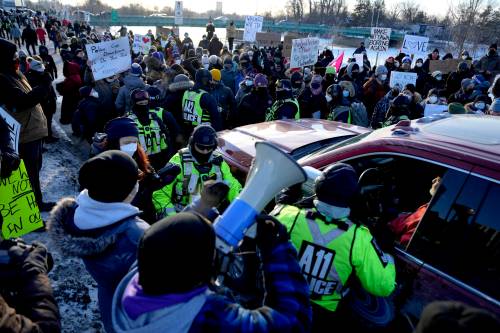
So residents begged police to enforce basic laws, to no avail. Finally, some took matters into their own hands: on Saturday, hundreds gathered at one intersection to block a line of vehicles headed to join the convoy. They held the line for over five hours; when one driver agreed to leave, residents made him scrape a convoy decal off his windshield first.
What was so remarkable about this event is how, in the end, the residents had done more to physically take back their city and prevent reinforcements in one afternoon, than Ottawa police seemingly had in two weeks. On Tuesday Ottawa’s police chief resigned, still insisting he had done all he could to respond to the occupation.

The reasons given for the inaction typically include that Ottawa police are outnumbered, and that they feared an attempt to take a firmer hand would lead to worse escalation. These have some truth — police actions certainly will inflame tensions — but they cannot explain away how troubling it is that, in this crisis, we saw how police stood beside those who provoked it.
That general tenor may be about to change. As I write these words Thursday morning, police in Ottawa appear to be massing for a harder response to the occupation there. But by now, through video and reporting and inaction, we’ve seen all we need to see about how police responded. And when this crisis is over, we’ll have to wrestle with what it means.
The question is, what will we do about it?
melissa.martin@freepress.mb.ca

Melissa Martin
Reporter-at-large
Melissa Martin reports and opines for the Winnipeg Free Press.
Every piece of reporting Melissa produces is reviewed by an editing team before it is posted online or published in print — part of the Free Press‘s tradition, since 1872, of producing reliable independent journalism. Read more about Free Press’s history and mandate, and learn how our newsroom operates.
Our newsroom depends on a growing audience of readers to power our journalism. If you are not a paid reader, please consider becoming a subscriber.
Our newsroom depends on its audience of readers to power our journalism. Thank you for your support.
Related Articles
Police arrest at least 100 in Ottawa protest sweep