

School’s air quality issue remains mystery for parents

Advertisement
Read this article for free:
or
Already have an account? Log in here »
To continue reading, please subscribe:

Digital Subscription
One year of digital access for only $205*
- Enjoy unlimited reading on winnipegfreepress.com
- Read the E-Edition, our digital replica newspaper
- Access News Break, our award-winning app
- Play interactive puzzles
*First annual payment billed as $205.00 + GST for one year. This annual subscription will automatically renew at $233.00 + GST every 52 weeks (10% off the regular annual price of $259.35). Offer available to new and qualified returning subscribers only. Cancel any time.
To continue reading, please subscribe:
Add Free Press access to your Brandon Sun subscription for only an additional
$1 for the first 4 weeks*
- Enjoy unlimited reading on winnipegfreepress.com
- Read the E-Edition, our digital replica newspaper
- Access News Break, our award-winning app
- Play interactive puzzles
*Your next Brandon Sun subscription payment will increase by $1.00 and you will be charged $17.95 plus GST for four weeks. After four weeks, your payment will increase to $24.95 plus GST every four weeks.
Read unlimited articles for free today:
or
Already have an account? Log in here »
Hey there, time traveller!
This article was published 26/01/2023 (1336 days ago), so information in it may no longer be current.
Brokenhead Ojibway Nation residents have more questions than answers about the source and extent of air-quality concerns that sent almost a dozen people to hospital two weeks ago, and have cancelled their children’s classes since.
“It’s not being talked about and I don’t want this to get pushed under the rug. They put our children’s lives at risk and somebody needs to be held accountable,” said mother Yuly Abaunza Zega.
Sergeant Tommy Prince School, a nursery-to-Grade 9 building and part of the Manitoba First Nations Education Resource Centre’s school system, dismissed students early when air-quality alarms were triggered Jan. 13.
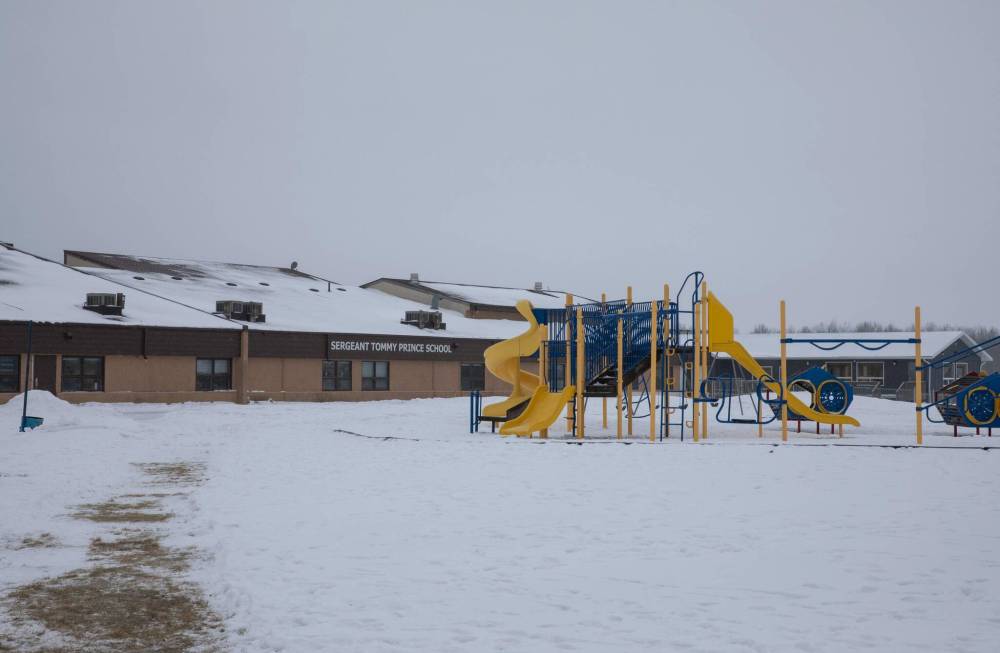
Conflicting reports about the polluted environment — which community members believe is behind bouts of sudden fatigue, nausea and related symptoms staff and students have reported in recent weeks — are circulating in the absence of updates.
“Initial inspection of the school carried out Jan. 19, 2023, has ruled out carbon monoxide and carbon dioxide as causes of the illness of students and staff,” Jennifer Cooper, spokeswoman for Indigenous Services Canada, said in a statement to the Free Press.
“The school has an electrical heating system, not natural gas, and hospital tests on the affected patients have confirmed (the above).”
Experts are doing air sampling and inspecting equipment to identify the problem so it can be fixed, Cooper said, adding the school board is looking into alternative education delivery methods in the meantime.
School administrators initially cited vague air-quality concerns for the sudden closure. The principal, education director and various First Nation departments named carbon dioxide as the concern in various communications distributed throughout the weekend that followed.
“It was discovered that the carbon dioxide (CO2) levels reached a strength to be considered toxic air quality,” states a letter signed by principal Patsy Bercier and Wendell Sinclair, director of education.
The Jan. 15 notice states the building’s furnaces were outfitted with air purifier units earlier in the school year and the equipment was not installed properly, in turn causing a lack of fresh air intake.
Shared Health indicated 11 people attended emergency departments Jan. 13 in connection to exposures at the school. The agency declined to provide shared symptom details to protect patient privacy, but a spokesperson said the files all mention carbon monoxide rather than CO2.
Both CO and CO2 are colourless and odourless gases. The former is found in combustion fumes and can be fatal, with symptoms ranging from nausea to unconsciousness. Exposure to significant amounts of the latter, which impact one’s ability to concentrate, is extremely rare in comparison.
“The only time where you see CO2 (result in) effects like vomiting are when CO2 is so high that the actual issue is it’s pushing oxygen out of the air, people aren’t getting enough air to breathe,” said Jeffrey Siegel, a professor of civil engineering at the University of Toronto.
While Siegel said CO2 is almost never the cause of air-quality problems itself, he indicated high levels of it usually suggest there is poor ventilation in a building and something else is wrong.
An unpleasant odour, chemical reaction to a cleaning product, byproducts of alternative air cleaner equipment, and mould or moisture issues — each combined with poor ventilation — are all possibilities in this case, according to the academic who studies indoor air quality.
Alternatively, Siegel said community members may be suffering from sick building syndrome.
Brokenhead Chief Gordon Bluesky said the initial air testing stage is underway and leaders were awaiting results Wednesday.
“The school will be closed until engineers and other experts can diagnose the issue, fix the problem, and ensure the air quality of the school is up to safety standards,” according to a joint statement published by the First Nation and education resource centre last week.
“The well-being of our students and staff is the biggest priority,” centre director Charles Cochrane said in the Jan. 17 release. “As soon as we were informed of the issue, action was taken to ensure the children of Brokenhead were safe.”
Abaunza Zega said she was anxious about sending her eldest to kindergarten in the first place and the air-quality situation has worsened matters.

The mother of two said she is scared the problem affected her five-year-old and explained why the young student came home from school exhausted and started vomiting, seemingly out of nowhere, on a recent afternoon.
“We are supposed to trust the school, but how are we supposed to trust it now? Our trust has been broken,” she said Wednesday, at which point she had not heard from the school in 10 days.
The community should be involved in the investigation and provided with a final report on the subject, Siegel said. “The relationship has to be repaired — and it’s probably just as important as the indoor air quality.”
maggie.macintosh@freepress.mb.ca
Twitter: @macintoshmaggie
Maggie Macintosh
Education reporter
Maggie Macintosh reports on education for the Free Press. Originally from Hamilton, Ont., she first reported for the Free Press in 2017. Read more about Maggie.
Funding for the Free Press education reporter comes from the Government of Canada through the Local Journalism Initiative.
Every piece of reporting Maggie produces is reviewed by an editing team before it is posted online or published in print — part of the Free Press‘s tradition, since 1872, of producing reliable independent journalism. Read more about Free Press’s history and mandate, and learn how our newsroom operates.
Our newsroom depends on a growing audience of readers to power our journalism. If you are not a paid reader, please consider becoming a subscriber.
Our newsroom depends on its audience of readers to power our journalism. Thank you for your support.
Maggie Macintosh
Education reporter
Maggie Macintosh reports on education for the Free Press. Originally from Hamilton, Ont., she first reported for the Free Press in 2017. Read more about Maggie.
Funding for the Free Press education reporter comes from the Government of Canada through the Local Journalism Initiative.
Every piece of reporting Maggie produces is reviewed by an editing team before it is posted online or published in print — part of the Free Press‘s tradition, since 1872, of producing reliable independent journalism. Read more about Free Press’s history and mandate, and learn how our newsroom operates.
Our newsroom depends on a growing audience of readers to power our journalism. If you are not a paid reader, please consider becoming a subscriber.
Our newsroom depends on its audience of readers to power our journalism. Thank you for your support.
Related Articles
Elevated carbon dioxide levels in school sends 11 people to hospital
Advertisement Advertise With Us
Advertisement Advertise With Us