

Student absenteeism remains under educators’ microscope

Advertisement
Read this article for free:
or
Already have an account? Log in here »
To continue reading, please subscribe:

Digital Subscription
One year of digital access for only $205*
- Enjoy unlimited reading on winnipegfreepress.com
- Read the E-Edition, our digital replica newspaper
- Access News Break, our award-winning app
- Play interactive puzzles
*First annual payment billed as $205.00 + GST for one year. This annual subscription will automatically renew at $233.00 + GST every 52 weeks (10% off the regular annual price of $259.35). Offer available to new and qualified returning subscribers only. Cancel any time.
To continue reading, please subscribe:
Add Free Press access to your Brandon Sun subscription for only an additional
$1 for the first 4 weeks*
- Enjoy unlimited reading on winnipegfreepress.com
- Read the E-Edition, our digital replica newspaper
- Access News Break, our award-winning app
- Play interactive puzzles
*Your next Brandon Sun subscription payment will increase by $1.00 and you will be charged $17.95 plus GST for four weeks. After four weeks, your payment will increase to $24.95 plus GST every four weeks.
Read unlimited articles for free today:
or
Already have an account? Log in here »
Hey there, time traveller!
This article was published 10/05/2023 (1253 days ago), so information in it may no longer be current.
There are early signs the worst of student absenteeism is in school board leaders’ rear-view mirrors, along with the COVID-19 pandemic, but record non-attendance levels remain a pressing issue.
The Louis Riel School Division’s winter absence rate, a figure calculated with data collected from December through March, is 12.5 per cent this year — a drop, albeit smaller than a single percentage point — from 2021-22.
There appears to be a “leveling off” of absences across all grades, said superintendent Christian Michalik, who noted non-attendance figures climbed in autumn, but new winter statistics mirror those recorded last year.
Winnipeg Free Press Files
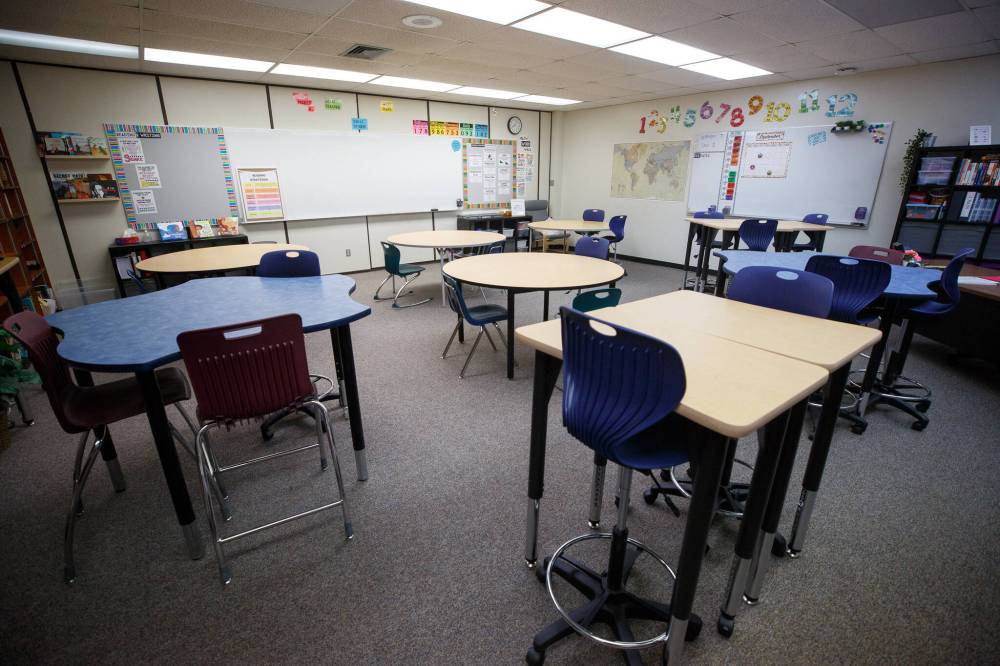
There appears to be a “leveling off” of absences across all grades in Louis Riel School Division with it’s winter absence rate hitting 12.5 per cent this year, a drop from 2021-22.
The Winnipeg division published a report on local absenteeism statistics, a follow-up to an autumn edition, this month. It acknowledges students typically miss more classes over the winter period, an annual occurrence linked to factors ranging from illness to weather.
“We struck a task force and we definitely are trying to understand the complexity of what are factors that contribute to a student being absent, a prolonged absence or a frequency of absences that is cause for concern,” Michalik said.
A group of educational assistants, teachers, social workers, psychologists, youth care workers, principals and senior administrators in LRSD have been meeting to discuss responses to the higher-than-usual non-attendance.
Despite the latest statistics, the division leader said he remains deeply worried about trends in student presence and the “vicious cycle” of absenteeism.
The number of K-12 students who are “chronically absent” (anyone who has missed 10 per cent or more of all instructional days) remains remarkably high.
More than 41 per cent of LRSD’s student population falls into that category. And in kindergarten, there continue to be more children who have spotty attendance records than otherwise this year.
Between 2014-15 and 2018-19, the average winter absence rate was 8.9 per cent. The percentage of students deemed chronically absent throughout the last five school years unaffected by the novel coronavirus was, on average, 22.9 per cent.
The Winnipeg School Division recently began notifying individual communities about the local level of non-attendance in K-12 classrooms with banners posted on every building’s respective website.
There are three levels: normal; slightly below normal; and significantly below normal — each of which is tailored to a specific school’s historic attendance patterns.
Should a school enter the final and most alarming level, discussions between the principal, divisional directors and superintendent will be triggered in order to examine and address the issue, said WSD spokeswoman Radean Carter.
Carter said the updated protocols were rolled out in response to the board of trustees’ request to publish data and in anticipation of new requirements the province is instituting in the fall.
There were concerns about particularly high levels of absenteeism in January and February, owing to respiratory illnesses, she said, adding figures have been on a decline since.
All but one of WSD’s buildings are currently reporting status quo levels.
The education department released a new policy directive, in turn requiring boards to update policies on chronic absenteeism before the end of the current school year, and launched a public awareness campaign in January.

Critics accused provincial officials for being naive in their approach to re-engaging students who have stopped attending classes regularly by spending money on costly billboard ads bearing the phrase “School, Keep Going.”
Manitoba Education’s school and community support unit has been providing guidance to divisions on interpreting the directive since the announcement, a provincial spokesperson said in a statement Wednesday.
The spokesperson did not say whether any new policies have been submitted to date.
maggie.macintosh@freepress.mb.ca
Twitter: @macintoshmaggie
Maggie Macintosh
Education reporter
Maggie Macintosh reports on education for the Free Press. Originally from Hamilton, Ont., she first reported for the Free Press in 2017. Read more about Maggie.
Funding for the Free Press education reporter comes from the Government of Canada through the Local Journalism Initiative.
Every piece of reporting Maggie produces is reviewed by an editing team before it is posted online or published in print — part of the Free Press‘s tradition, since 1872, of producing reliable independent journalism. Read more about Free Press’s history and mandate, and learn how our newsroom operates.
Our newsroom depends on a growing audience of readers to power our journalism. If you are not a paid reader, please consider becoming a subscriber.
Our newsroom depends on its audience of readers to power our journalism. Thank you for your support.
Maggie Macintosh
Education reporter
Maggie Macintosh reports on education for the Free Press. Originally from Hamilton, Ont., she first reported for the Free Press in 2017. Read more about Maggie.
Funding for the Free Press education reporter comes from the Government of Canada through the Local Journalism Initiative.
Every piece of reporting Maggie produces is reviewed by an editing team before it is posted online or published in print — part of the Free Press‘s tradition, since 1872, of producing reliable independent journalism. Read more about Free Press’s history and mandate, and learn how our newsroom operates.
Our newsroom depends on a growing audience of readers to power our journalism. If you are not a paid reader, please consider becoming a subscriber.
Our newsroom depends on its audience of readers to power our journalism. Thank you for your support.
Advertisement Advertise With Us
Advertisement Advertise With Us