

Hong Kong leader defends removing politically sensitive books from public libraries
Advertisement
Read this article for free:
or
Already have an account? Log in here »
To continue reading, please subscribe:

Digital Subscription
One year of digital access for only $205*
- Enjoy unlimited reading on winnipegfreepress.com
- Read the E-Edition, our digital replica newspaper
- Access News Break, our award-winning app
- Play interactive puzzles
*First annual payment billed as $205.00 + GST for one year. This annual subscription will automatically renew at $233.00 + GST every 52 weeks (10% off the regular annual price of $259.35). Offer available to new and qualified returning subscribers only. Cancel any time.
To continue reading, please subscribe:
Add Free Press access to your Brandon Sun subscription for only an additional
$1 for the first 4 weeks*
- Enjoy unlimited reading on winnipegfreepress.com
- Read the E-Edition, our digital replica newspaper
- Access News Break, our award-winning app
- Play interactive puzzles
*Your next Brandon Sun subscription payment will increase by $1.00 and you will be charged $17.95 plus GST for four weeks. After four weeks, your payment will increase to $24.95 plus GST every four weeks.
Read unlimited articles for free today:
or
Already have an account? Log in here »
Hey there, time traveller!
This article was published 18/05/2023 (1235 days ago), so information in it may no longer be current.
HONG KONG (AP) — Hong Kong’s leader said Thursday the city’s public libraries would not recommend books featuring “bad ideologies” to residents after they pulled titles related to the 1989 Tiananmen Square crackdown and certain political figures, further shrinking the city’s freedoms.
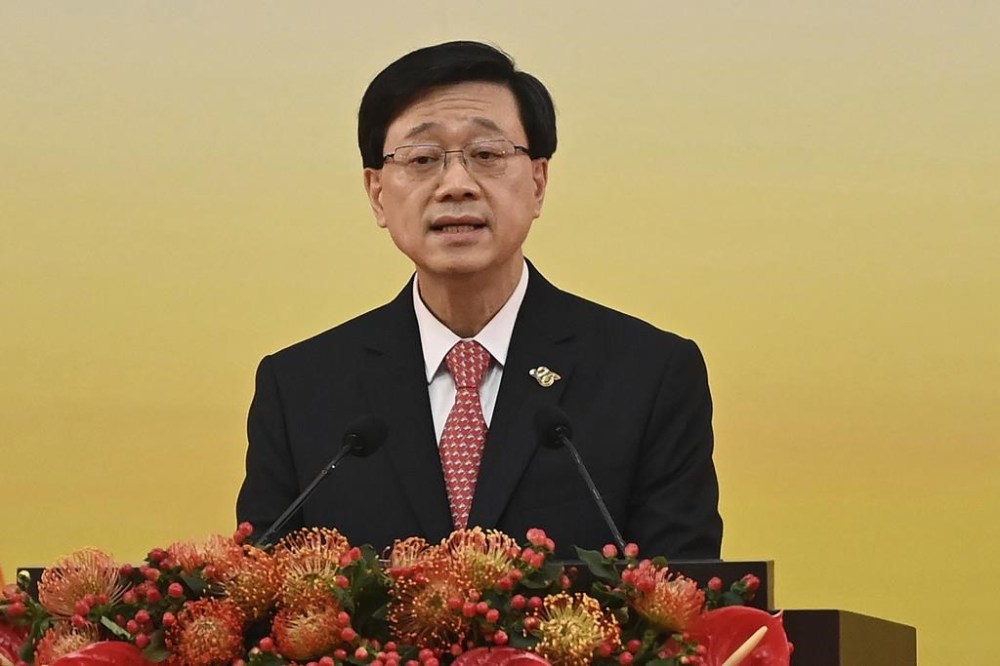
Chief Executive John Lee was addressing a lawmaker’s question about dozens of books in public libraries that were taken down without a clear explanation. Those include publications about the bloody crackdown and others written by pro-democracy politicians and political commentators.
Hong Kong is a former British colony that returned to China’s rule in 1997, promising to retain its Western-style freedoms. But the city’s cultural and creative sectors said the city’s freedoms have shrunk since Beijing imposed a tough national security law following massive pro-democracy protests in 2019.
Critics said the book pulling would further undermine Hong Kong’s reputation for having free access to information and freedom of expression.
But Lee defended the sweeping law at the legislature, saying Hong Kong’s freedoms are protected by the city’s constitution.
“The books we offer for residents to borrow are those that we recommend,” he said. “We would never recommend books that are illegal and violate copyrights. We would never recommend those that we deem to be featuring bad ideologies.”
He said residents could still find such books to read elsewhere. He did not elaborate on what was considered “bad ideologies” and why the books were removed.
Asked why the books were removed, the Leisure and Cultural Services Department said public libraries review and withdraw materials that do not conform to “the collection development” from time to time. If any material is suspected of being contrary to the interests of national security or violating laws, the libraries will immediately suspend services of the material in question for review, it said.
The removal of the books was reported by local media outlets after a Chinese newspaper stopped publishing works by the city’s most prominent political cartoonist on Sunday following government complaints. Comic strip collections by the cartoonist were also no longer available in public libraries.
Political scholar Ivan Choy said one book he co-authored was pulled despite a previous endorsement by former Secretary for Constitutional and Mainland Affairs Stephen Lam. Lam wrote the foreword for the title and said it was the most comprehensive book on the city’s electoral system, Choy said.
“We wrote this book as academics and are not trying to make any political statements. So I feel they have overreacted,” he said.
After the books were pulled and the publication of political cartoons halted, Choy questioned how Hong Kong could still stay as an international metropolitan without being broad-minded and inclusive. He added China wants Hong Kong to become an international cultural exchange center, where the East meets the West.
He said the changes keep Hong Kong from living up to its reputation.
Since a sweeping security law was enacted in 2020, the city’s art and media communities have learned to be wary of crossing vaguely defined red lines in producing art and other content that might be perceived as challenging the Chinese Communist Party’s control.
The group that organized Hong Kong’s annual vigil in remembrance of the Tiananmen Square crackdown also voted to disband in 2021 under the shadow of the security law. The annual vigil was the only large-scale public commemoration of the event on Chinese soil and was attended by massive crowds until authorities banned it in 2020, citing anti-pandemic measures.
Supporters say the group’s closure shows that the freedoms and autonomy promised when Hong Kong returned to China in 1997 are diminishing.
This year, a massive vigil is unlikely to take place in its usual spot, Victoria Park in Causeway Bay, on June 4. Instead, some pro-Beijing groups will host a bazaar to celebrate the city’s handover to Chinese rule there.