Critical incident report puts spotlight on HSC overcrowding, staff levels Hospital had no available monitored beds; one hour later, patient died in its hallway
Read this article for free:
or
Already have an account? Log in here »
To continue reading, please subscribe:

Digital Subscription
One year of digital access for only $205*
- Enjoy unlimited reading on winnipegfreepress.com
- Read the E-Edition, our digital replica newspaper
- Access News Break, our award-winning app
- Play interactive puzzles
*First annual payment billed as $205.00 + GST for one year. This annual subscription will automatically renew at $233.00 + GST every 52 weeks (10% off the regular annual price of $259.35). Offer available to new and qualified returning subscribers only. Cancel any time.
To continue reading, please subscribe:
Add Free Press access to your Brandon Sun subscription for only an additional
$1 for the first 4 weeks*
- Enjoy unlimited reading on winnipegfreepress.com
- Read the E-Edition, our digital replica newspaper
- Access News Break, our award-winning app
- Play interactive puzzles
*Your next Brandon Sun subscription payment will increase by $1.00 and you will be charged $17.95 plus GST for four weeks. After four weeks, your payment will increase to $24.95 plus GST every four weeks.
Read unlimited articles for free today:
or
Already have an account? Log in here »
Hey there, time traveller!
This article was published 30/06/2023 (1172 days ago), so information in it may no longer be current.
Health Sciences Centre’s emergency department was overcrowded and dealing with a surge in critically ill or injured patients when a man died while waiting for care in a hallway, according to a review.
The man was forced to wait in an EMS arrivals hallway because a backlog of patients meant a monitored bed was not available, hospital operator Shared Health confirmed Friday, while releasing limited details.
The patient was assessed and triaged by staff, but his condition deteriorated about an hour after he arrived by ambulance, the review found.
He could not be revived and was declared dead in the early hours of Feb. 27.
RUTH BONNEVILLE / WINNIPEG FREE PRESS Health Sciences Centre’s emergency department was crowded and overwhelmed by a spike in critically ill or injured patients when a man died while waiting for care in a hallway, according to a review of the incident.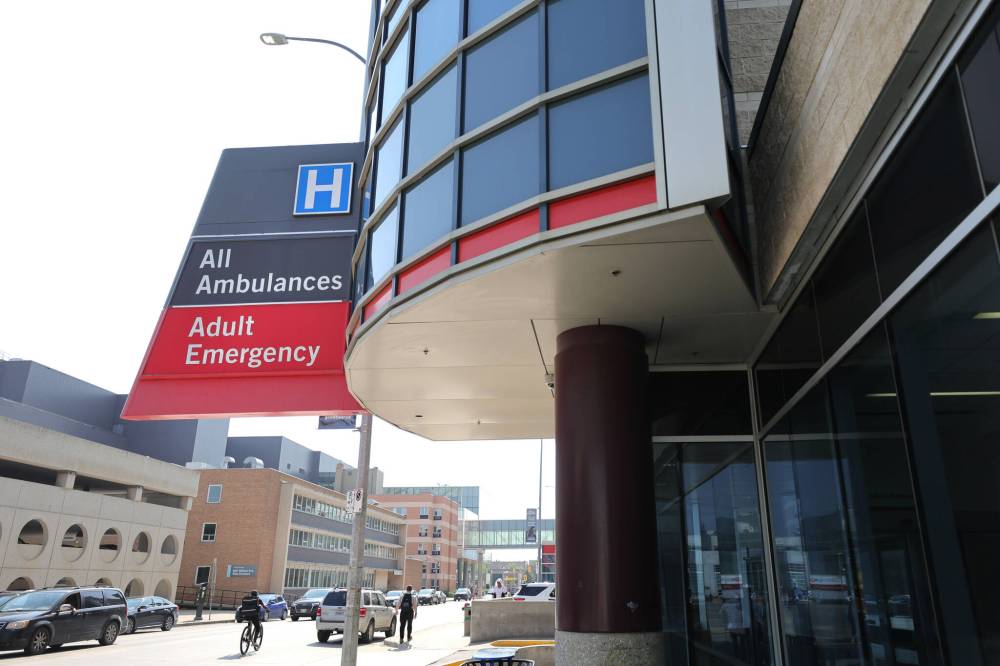
More than 50 patients were waiting at the time, said Dr. Shawn Young, HSC chief operating officer. “That’s a pretty rare phenomenon, but we frequently see 20, 30 and sometimes 40 patients waiting.”
The downtown Winnipeg ED has 58 spaces, said Jennifer Cumpsty, executive director of acute health services at Manitoba’s largest hospital.
She said Manitobans should not lose confidence in the health-care system or hesitate to seek treatment in the wake of the patient’s death.
In the 24 hours before the man arrived, 13 high-acuity patients — more than double the daily average — required life-saving treatment in the ED. The spike “exacerbated” existing capacity challenges, the review found.
Staffing levels were near baseline, “maybe off by one,” said Young.
RUTH BONNEVILLE / WINNIPEG FREE PRESS Jennifer Cumpsty, HSC executive director of acute care services, and Dr. Shawn Young, the hospital’s chief operating officer, held a press conference on the critical incident findings Friday.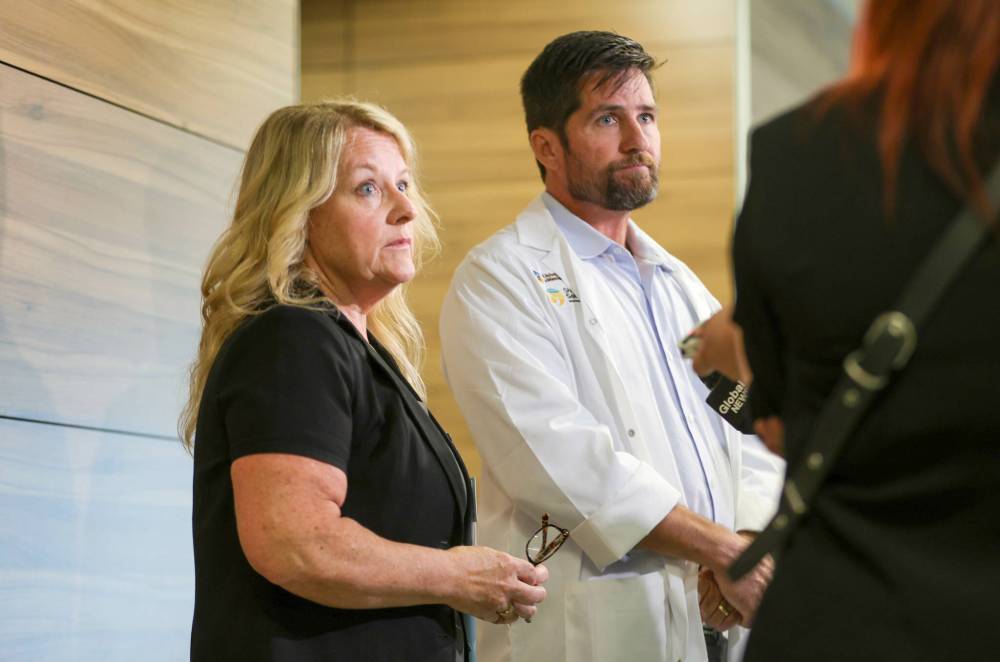
Cumpsty said the standard is 25 nurses, while the number of physicians or health-care aides depends on patient needs. She said support has been offered to staff who were working when the patient died.
Manitoba Nurses Union president Darlene Jackson said it’s time to consider whether current baseline staffing levels are adequate, given workloads are heavier than before and patients have complex needs.
“We’ve had bottlenecks in that department for years, and it’s not getting any better,” she said Friday by phone. “It took a very unfortunate event, such as this, to have that department looked at, and I think that’s very unfortunate.”
On the night the patient died, the median wait time in the ED was more than two hours, the review found.
Many patients wait longer than that, according to Jackson.
JOHN WOODS / WINNIPEG FREE PRESS files
At 5 p.m. Friday, the wait time was more than eight hours, with 47 patients yet to have an initial assessment and 48 others having had one, according to an online dashboard.
When there is a surge, employees from other units are asked to help move patients out of the ED, said Cumpsty.
To make room on wards at HSC, patients are moved to other hospitals or facilities, such as personal care homes, when possible.
Daily meetings are held to discuss the movement of patients, said Young.
The Feb. 27 death has put a renewed focus on the longstanding shortage of beds and staff.
“We used to have more beds. We are down over the years… It is a challenge right now to open beds because of the staffing.–Dr. Shawn Young, HSC chief operating officer
“We used to have more beds. We are down over the years,” said Young. “It is a challenge right now to open beds because of the staffing.
“Would I love to open 30 beds tomorrow? For sure. But, would I be able to staff them? Absolutely not.”
HSC has opened six more medicine beds, with plans for six more this summer depending on staff, he added.
Thomas Linner, provincial director of the Manitoba Health Coalition, said the patient’s death is an indictment on the system.
“Chaos in emergency departments and the health-care system has been bubbling over for some time, and it’s due to short-staffing,” he said.
JESSICA LEE / WINNIPEG FREE PRESS files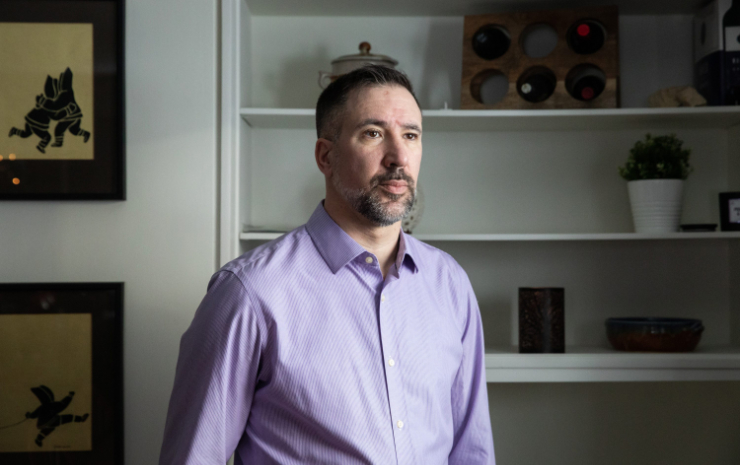
The review, conducted by Shared Health’s patient safety team, is intended to improve patient care and prevent similar incidents. It does not assign blame.
Provincial legislation prevents the full report from being made public.
Officials did not disclose the man’s age, the reason he was taken to HSC, nor his cause of death.
The review has led to three recommendations.
The first is for Shared Health to continue to try to improve patient flow and ease ED backlogs. Some of the work began more than a year before the man’s death.
“This definitely puts more push behind what we need to do.”–Jennifer Cumpsty, executive director of acute health services
“This definitely puts more push behind what we need to do,” said Cumpsty.
The other recommendations are for HSC to review patient assessment practices and workflows for ordering tests, and to update standard processes for staff classifications in the ED.
Shared Health said it will create over-capacity protocols to rapidly move stable patients to non-traditional areas of care or alternate sites when there is a backlog.
Young said a new minor treatment clinic will help ease congestion in the ED.
Related Articles
Report on HSC hallway death delayed








Premier Heather Stefanson was unavailable for an interview Friday, said her spokesman, who offered condolences to the patient’s family.
Health Minister Audrey Gordon was not available because she was out of the country following a family member’s death, a spokeswoman said.
As for efforts to address shortages, Stefanson’s spokesman pointed to the government’s plan to add 2,000 health-care workers via $200 million in funding.
He said 300 workers from the Philippines have accepted job offers in Manitoba following a recruitment drive, with more to come.
NDP Leader Wab Kinew said government cuts have led to reduced capacity, with the Feb. 27 death being a stark reminder the system needs to be fixed.
“Hallway medicine is a symptom of the crisis in health care.”–NDP Leader Wab Kinew
“Hallway medicine is a symptom of the crisis in health care,” he said.
Kinew and Liberal Leader Dougald Lamont said HSC staff had previously warned a patient could die in the waiting room or a hallway.
Emergency rooms at three Winnipeg hospitals — Concordia, Seven Oaks General and Victoria General — were previously converted to urgent care centres.
Lamont said the Tory government’s consolidation has contributed to overcrowding. “They have cut the health-care system too deep, and this is a direct consequence of it.”
February’s incident has drawn comparisons to the 2008 death of Brian Sinclair, an Indigenous man who waited in HSC’s ED for 34 hours.
An inquest led to 63 recommendations, including improvements to the ED’s intake process, and an apology from the NDP government in 2014.
chris.kitching@freepress.mb.ca
Twitter: @chriskitching

Chris Kitching is a general assignment reporter at the Free Press. He began his newspaper career in 2001, with stops in Winnipeg, Toronto and London, England, along the way. After returning to Winnipeg, he joined the Free Press in 2021, and now covers a little bit of everything for the newspaper. Read more about Chris.
Every piece of reporting Chris produces is reviewed by an editing team before it is posted online or published in print — part of the Free Press‘s tradition, since 1872, of producing reliable independent journalism. Read more about Free Press’s history and mandate, and learn how our newsroom operates.
Our newsroom depends on a growing audience of readers to power our journalism. If you are not a paid reader, please consider becoming a subscriber.
Our newsroom depends on its audience of readers to power our journalism. Thank you for your support.