Protesters demand premiers’ attention on landfill search issue

Drums and demands for a search of local landfills for the remains of missing women reverberated Monday at a meeting of Canada’s premiers and Indigenous leaders in Winnipeg.

Read this article for free:


or

Already have an account? Log in here »

To continue reading, please subscribe:

Subscribe and receive a limited-edition Free Press branded hat or tote.

Digital Subscription

One year of digital access for only $205*

  • Enjoy unlimited reading on winnipegfreepress.com
  • Read the E-Edition, our digital replica newspaper
  • Access News Break, our award-winning app
  • Play interactive puzzles

*First annual payment billed as $205.00 + GST for one year. This annual subscription will automatically renew at $233.00 + GST every 52 weeks (10% off the regular annual price of $259.35). Offer available to new and qualified returning subscribers only. Cancel any time.

To continue reading, please subscribe:

Add Free Press access to your Brandon Sun subscription for only an additional

$1 for the first 4 weeks*

  • Enjoy unlimited reading on winnipegfreepress.com
  • Read the E-Edition, our digital replica newspaper
  • Access News Break, our award-winning app
  • Play interactive puzzles
Start now

*Your next Brandon Sun subscription payment will increase by $1.00 and you will be charged $17.95 plus GST for four weeks. After four weeks, your payment will increase to $24.95 plus GST every four weeks.

Hey there, time traveller!
This article was published 10/07/2023 (1168 days ago), so information in it may no longer be current.

Drums and demands for a search of local landfills for the remains of missing women reverberated Monday at a meeting of Canada’s premiers and Indigenous leaders in Winnipeg.

The first ministers had gathered at the Leaf horticultural attraction at Assiniboine Park to hear delegations from Indigenous political organizations and leaders ahead of formal Council of the Federation meetings this week, hosted by Manitoba Premier Heather Stefanson.

While that group met on the second floor of the biome, a group of protesters gathered in the main floor lobby.

JOHN WOODS / THE CANADIAN PRESS
                                Powered by drums and a megaphone, protesters outside the Leaf at Assiniboine Park called for a search of the Brady Road and Prairie Green landfills for the remains of at least two Indigenous women police have said were slain by an alleged serial murderer.

JOHN WOODS / THE CANADIAN PRESS

Powered by drums and a megaphone, protesters outside the Leaf at Assiniboine Park called for a search of the Brady Road and Prairie Green landfills for the remains of at least two Indigenous women police have said were slain by an alleged serial murderer.

Powered by drums and a megaphone, they called for a search of the Brady Road and Prairie Green landfills for the remains of at least two Indigenous women police have said were slain by an alleged serial murderer.

Jeremy Anthony Michael Skibicki has been charged with four counts of first-degree murder in the deaths of Marcedes Myran, Morgan Harris, Rebecca Contois and an unidentified woman whom the Indigenous community has named Buffalo Woman.

Winnipeg police believe the remains of Myran and Harris were transported by garbage trucks to Prairie Green, north of the city, where they were buried.

Harris’s daughter, Cambria, called on the premiers to listen and acknowledge families devastated by the events and to offer their support in giving the slain women a proper resting place.

JOHN WOODS / THE CANADIAN PRESS
                                Protester Cambria Harris, daughter of Morgan Harris, called on the premiers to listen and acknowledge families devastated by the events and to offer their support in giving the slain women a proper resting place.

JOHN WOODS / THE CANADIAN PRESS

Protester Cambria Harris, daughter of Morgan Harris, called on the premiers to listen and acknowledge families devastated by the events and to offer their support in giving the slain women a proper resting place.

She was surrounded by about a dozen other protesters, including Sue Caribou, whose niece, Tanya Nepinak, was last seen in September 2011. Police suspected Nepinak’s body was put in a garbage bin and transported to Brady Road. A search was conducted in 2012; her body was never found.

“When you don’t say anything, you are condoning the continuous dumping and violence against Indigenous women,” Harris said via a loudspeaker.

“These are the people, these are the victims of your system that you put in place to take us apart. Hear us finally, and acknowledge that this happening, and that you are going to do something, because if you are not going to step up, I ask that you step down.”

“When you don’t say anything, you are condoning the continuous dumping and violence against Indigenous women.”–Cambria Harris

Assembly of First Nations regional chief Cindy Woodhouse said she raised the issue during the meeting, which was also attended by Métis National Council president Cassidy Caron; Native Women’s Association of Canada president Carol McBride; Congress of Aboriginal Peoples Chief Elmer St. Pierre; Manitoba Métis Federation president David Chartrand; and Treaty One Inc. chairman Gordon Bluesky.

On July 5, Stefanson informed the Harris and Myran families the province would not support a proposed search of Prairie Green, owing to safety concerns.

JOHN WOODS / THE CANADIAN PRESS
                                Assembly of First Nations regional chief Cindy Woodhouse said she raised the issue during the meeting.

JOHN WOODS / THE CANADIAN PRESS

Assembly of First Nations regional chief Cindy Woodhouse said she raised the issue during the meeting.

Woodhouse said a feasibility study conducted by the Assembly of Manitoba Chiefs, with support from the federal government, determined a search is possible — and told the premiers as much.

“And then for the province to just shut it down, that’s absolutely unacceptable,” Woodhouse said. “They need to come back to the table and start working with the Assembly of Manitoba Chiefs, with the families that have been impacted.

“I can’t even imagine what those people are feeling.”

Monday’s meeting was also a chance to garner support from the other premiers, she said. “It’s a Canadian issue. It’s unfortunate, and it’s unfortunate that we even have to have these discussions, and I think that our women deserve more.”

At the conclusion of the three-hour meeting, Stefanson said her decision not to support a search of Prairie Green is final.

JOHN WOODS / THE CANADIAN PRESS
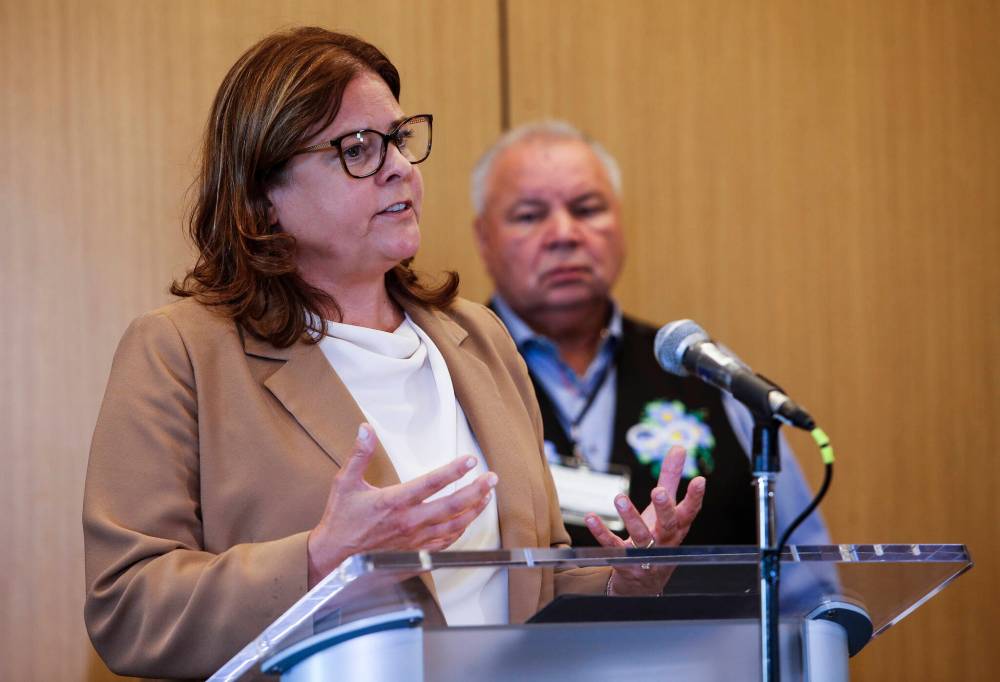
At the conclusion of the three-hour meeting, Premier Heather Stefanson said her decision not to support a search of Prairie Green landfill is final.

JOHN WOODS / THE CANADIAN PRESS

At the conclusion of the three-hour meeting, Premier Heather Stefanson said her decision not to support a search of Prairie Green landfill is final.

The complexity and viability of the proposed excavation cannot be ignored, and there are other ways to work together on the issue of missing and murdered Indigenous women, girls and two-spirit people, she said.

“We have made our decision,” Stefanson. “We want to be there for the families and offer the supports and help them heal through this process.”

Many other issues, including housing and the environment, were discussed, said Stefanson,.

The annual COF summer meeting continues Tuesday, with premiers set to discuss affordability, health care and a range of economic issues. The event concludes Wednesday evening.

danielle.dasilva@freepress.mb.ca

Report Error Submit a Tip

More Stories

Not falling back means time loop remains unclosed

Jen Zoratti 4 minute read Yesterday at 2:01 AM CDT

I demand restitution. Where’s my hour?

In the traditional fall-back, spring-forward time change set up — you know, ol’ trusty that’s been effect for lo these 63 years — we lost an hour in the spring that we got back in the fall.

That was the social contract: you commit to feeling like you’re on cold medication for a week in March because you know a glorious extra hour of sleep will be returned to you in November. (Unless, of course, you have little kids, but look: we all make our choices.)

Well, that transaction, flawed as it was, isn’t happening this year. That hour you sacrificed to the sun gods in the spring? Gone. Not coming back. We’ve sprung forward and we shan’t be falling back — not in November, and (possibly) not ever. The scale shall remain unbalanced and the loop shall remain unclosed as Manitoba has adopted permanent daylight time.

A life’s story: activist, educator, organizer knew the true meaning of community

Janine LeGal 7 minute read Preview

A life’s story: activist, educator, organizer knew the true meaning of community

Janine LeGal 7 minute read Yesterday at 3:00 AM CDT

Somewhere between a love for sharing stories and a love of community connections, Michael (Mike) Maunder lived his life. Giving voice to people and neighbourhoods was a passion for the natural-born community organizer.

An author, teacher and principal, Maunder lived in a one-bedroom apartment in West Broadway and devoted himself to community development, education and neighbourhood renewal.

He maintained a connection with Augustine United Church, whose commitment to social justice he appreciated, volunteered at the Sandy-Saulteaux Spiritual Centre, and found comfort in a Buddhist prayer community.

Maunder died on July 15 at the age of 80.

Read
Yesterday at 3:00 AM CDT

AC/DC fans power up with pre-show pop-up

By Sheldon Birnie 4 minute read Preview

AC/DC fans power up with pre-show pop-up

By Sheldon Birnie 4 minute read Friday, Sep. 18, 2026

Those getting ready to rock on Sunday night at Princess Auto Stadium, can prime their engines at AC/DC’s PWR/UP Pop-Up this weekend.

Fans lined up all the way down Fort Street south of the Pyramid Cabaret for a special preview event on Friday night.

“We’re so excited,” said Marcella Ceron shortly after getting into the Pyramid. Ceron and her husband were hoping to win tickets to Sunday’s concert, one of a number of promotions running throughout the pop-up’s tenure at the downtown bar. “We were in line since 5 o’clock.”

According to organizers, the venues across Canada have been handpicked – including the Commodore Ballroom in Vancouver and Foufounes Électriques in Montreal, among others — owing to their reputations as “places where fans already gather and music culture lives.”

Read
Friday, Sep. 18, 2026

Cabernet Sauvignon star of wine festival

Ben Sigurdson 5 minute read Preview

Cabernet Sauvignon star of wine festival

Ben Sigurdson 5 minute read Yesterday at 3:00 AM CDT

The Winnipeg Wine Festival will celebrate the king of red wine grapes next weekend — the theme of this year’s festival, which takes place Sept. 25 and 26 at the RBC Convention Centre, is Cabernet Sauvignon.

Cab Sauv, as it’s also known, is the world’s most widely planted wine grape of any colour, first coming to prominence in the 1800s in France’s Bordeaux region, where the grape is still popular. Rather than single-variety wines, Bordeaux reds tend to be blends, with those coming from the left bank of the Gironde estuary being Cabernet-dominant, while right-bank wines are Merlot-dominant, with Cabernet Sauvignon playing a supporting role. Cabernet and Merlot work well together and many other countries have followed suit in blending the two.

A team at University of California Davis put Cabernet Sauvignon through a DNA test in 1996 and discovered its parent grapes are Cabernet Franc and Sauvignon Blanc — it’s likely that at some point the two varieties, planted next to each other in some vineyard, crossed and mutated and became the grape we know today. (Someone growing grapes in the 19th century must have had an inkling of what was up, as the grape has been called Cabernet Sauvignon since long before the DNA test.)

Flavour-wise, most Cabernet Sauvignon wines are big and bold, with a core of deep dark berry flavours, some graphite and spice notes and relatively bright acidity. It’s a grape that is well-suited to barrel aging, with most examples seeing at least some time in wood.

Read
Yesterday at 3:00 AM CDT

Winnipeg Jets at Edmonton Oilers

1 minute read Yesterday at 3:22 PM CDT

Family account spiced with magic realism, geopolitical intrigue and a ghost story

Reviewed by Zilla Jones 4 minute read Preview

Family account spiced with magic realism, geopolitical intrigue and a ghost story

Reviewed by Zilla Jones 4 minute read Yesterday at 2:01 AM CDT

Tom Lin’s second novel Babylon, South Dakota moves beyond a historical account of an immigrant family’s struggle, delightfully blending and bending genres.

Lin is a Chinese-born novelist whose family emigrated to the U.S. when he was four years old. His debut novel, The Thousand Crimes of Ming Tsu, won the 2022 Andrew Carnegie Medal for Excellence in Fiction, making him the youngest ever recipient of that award. He earned a PhD in English from the University of California Davis and is currently an assistant professor of English and creative writing at the University of Iowa.

Babylon, South Dakota takes place in an unspecified time period that can be understood to be during the Mao era — likely the 1950s or ’60s. A young Chinese couple, the Hsuis, immigrate to the rural community that gives the book its title. They take the names Saul and Mei and settle on a 160-acre homestead left to them by a distant relative.

Saul’s dream is to breed and sell chrysanthemums from seeds he brought from China, while Mei wants to raise livestock. They speak no English, know nothing of life in the United States, are unprepared for the harshness of winter and the isolation of the farm and bring nothing with them except some gold, which Mei hides around the house for emergencies. Their only link to the outside world is a discarded and marginally functioning TV set, which Saul rescues and rigs up.

Read
Yesterday at 2:01 AM CDT