

U of W arms security officers with life-saving opioid-overdose antidote

Advertisement
Read this article for free:
or
Already have an account? Log in here »
To continue reading, please subscribe:

Digital Subscription
One year of digital access for only $205*
- Enjoy unlimited reading on winnipegfreepress.com
- Read the E-Edition, our digital replica newspaper
- Access News Break, our award-winning app
- Play interactive puzzles
*First annual payment billed as $205.00 + GST for one year. This annual subscription will automatically renew at $233.00 + GST every 52 weeks (10% off the regular annual price of $259.35). Offer available to new and qualified returning subscribers only. Cancel any time.
To continue reading, please subscribe:
Add Free Press access to your Brandon Sun subscription for only an additional
$1 for the first 4 weeks*
- Enjoy unlimited reading on winnipegfreepress.com
- Read the E-Edition, our digital replica newspaper
- Access News Break, our award-winning app
- Play interactive puzzles
*Your next Brandon Sun subscription payment will increase by $1.00 and you will be charged $17.95 plus GST for four weeks. After four weeks, your payment will increase to $24.95 plus GST every four weeks.
Read unlimited articles for free today:
or
Already have an account? Log in here »
Hey there, time traveller!
This article was published 19/07/2023 (1158 days ago), so information in it may no longer be current.
THE University of Winnipeg is equipping security officers who monitor its downtown lecture halls and the surrounding community with naloxone kits ahead of the 2023-24 school year.
The initial rollout will see members of the school’s security team, including senior employees and supervisors, trained in using the life-saving drug that temporarily reverses opioid overdoses.
“With our location at the heart of the city, we feel it’s important to be equipped to help anyone on or near our campus who requires the administration of naloxone,” said Caleb Zimmerman, executive director of marketing and communications at the post-secondary institute.
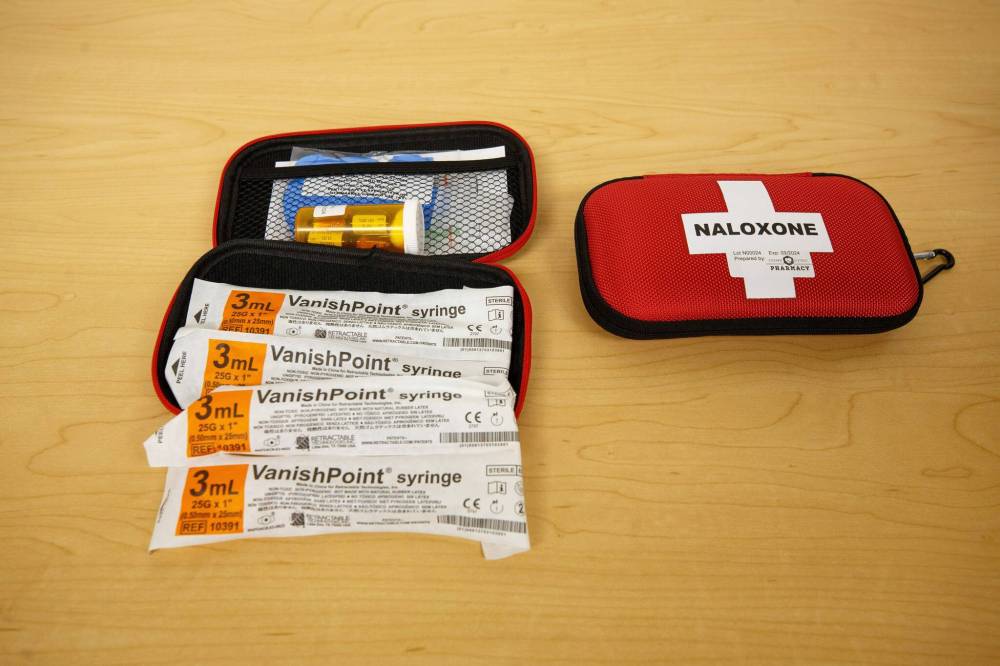
MIKE DEAL / FREE PRESS FILES
Members of the University of Winnipeg’s security team will be trained to use naloxone, which temporarily reverses opioid overdoses.
Zimmerman indicated the availability of kits and training — especially among those who are often the first to respond when an individual is in crisis — is becoming increasingly important, given opioids are a serious public health concern across the country.
Faculty members and other employees can already request naloxone kits and training from U of W’s campus safety office. Students can make similar requests.
The latest initiative has been in the works since January. The security team will soon have Narcan nasal spray at the ready should they need it to block the effects on a legal or illegal opioid to buy time while waiting for first responders.
“It’s just a fantastic idea. I believe everybody should have a kit; it should be no different than defibrillators and EpiPens,” said Arlene Last-Kolb, co-founder of Overdose Awareness Manitoba.
Last-Kolb, also a regional director for Moms Stop the Harm, urged the university to post naloxone signage and ensure security employees wear their kits to bring about visibility and in turn, reduce the stigma of drug use and addiction.
Tuesday marked her adult son’s “angel day.” There was no naloxone handy when Jessie, who was 24, died of a fentanyl overdose nine years ago.
Since then, his mother has made it her mission to advocate for the proliferation of the medication, both in the form of injections and nasal spray, that can reduce the toxicity of fentanyl, oxycodone, heroin and other opioids.
City police and front-line RCMP officers started carrying naloxone in 2016.
The following year, Manitoba launched its take-home naloxone program to provide free kits to members of the public “who are at risk of opioid overdose” and loved ones who may witness such an event.
“My son was much more than how he died… (but) because of the way he died, because it was preventable, it is my duty to do something about it,” Last-Kolb said. “I don’t want anybody else to go through what I and our family are going through. It’s nine years later and our hearts are still broken.”
There were at least 103 drug-related deaths between January and March of this year, preliminary provincial data shows.
The total number of fatal overdoses surpassed 400 — up from the five-year average of about 230 between 2016-2020 — in 2021 and 2022, respectively.
Fentanyl was the most common substance present among last year’s cases, followed by methamphetamine, cocaine and other opioids.

Last-Kolb has been outspoken in her advocacy for harm reduction, including decriminalization and safe supply, and additional government resources to support survivors of trauma.
U of W’s expansion of naloxone is “so overdue,” she said, adding drug toxicity is worsening and as a result, carriers of the drug should be aware the dose required to save a life continues to increase.
So far this year, the Winnipeg Fire Paramedic Service has administered Narcan 2,243 times.
maggie.macintosh@freepress.mb.ca
Twitter: @macintoshmaggie
Maggie Macintosh
Education reporter
Maggie Macintosh reports on education for the Free Press. Originally from Hamilton, Ont., she first reported for the Free Press in 2017. Read more about Maggie.
Funding for the Free Press education reporter comes from the Government of Canada through the Local Journalism Initiative.
Every piece of reporting Maggie produces is reviewed by an editing team before it is posted online or published in print — part of the Free Press‘s tradition, since 1872, of producing reliable independent journalism. Read more about Free Press’s history and mandate, and learn how our newsroom operates.
Our newsroom depends on a growing audience of readers to power our journalism. If you are not a paid reader, please consider becoming a subscriber.
Our newsroom depends on its audience of readers to power our journalism. Thank you for your support.
Maggie Macintosh
Education reporter
Maggie Macintosh reports on education for the Free Press. Originally from Hamilton, Ont., she first reported for the Free Press in 2017. Read more about Maggie.
Funding for the Free Press education reporter comes from the Government of Canada through the Local Journalism Initiative.
Every piece of reporting Maggie produces is reviewed by an editing team before it is posted online or published in print — part of the Free Press‘s tradition, since 1872, of producing reliable independent journalism. Read more about Free Press’s history and mandate, and learn how our newsroom operates.
Our newsroom depends on a growing audience of readers to power our journalism. If you are not a paid reader, please consider becoming a subscriber.
Our newsroom depends on its audience of readers to power our journalism. Thank you for your support.
Advertisement Advertise With Us
Advertisement Advertise With Us