

Frost brings end to extended gardening season

Advertisement
Read this article for free:
or
Already have an account? Log in here »
To continue reading, please subscribe:
Digital Subscription
One year of digital access for only $1.44 a week*
- Enjoy unlimited reading on winnipegfreepress.com
- Read the E-Edition, our digital replica newspaper
- Access News Break, our award-winning app
- Play interactive puzzles
*Billed as $5.77 plus GST every four weeks. After 52 weeks, price increases to the regular rate of $19.95 plus GST every four weeks. Offer available to new and qualified returning subscribers only. Cancel any time.
To continue reading, please subscribe:
Add Free Press access to your Brandon Sun subscription for only an additional
$1 for the first 4 weeks*
- Enjoy unlimited reading on winnipegfreepress.com
- Read the E-Edition, our digital replica newspaper
- Access News Break, our award-winning app
- Play interactive puzzles
*Your next Brandon Sun subscription payment will increase by $1.00 and you will be charged $17.95 plus GST for four weeks. After four weeks, your payment will increase to $24.95 plus GST every four weeks.
Read unlimited articles for free today:
or
Already have an account? Log in here »
Hey there, time traveller!
This article was published 10/10/2023 (1105 days ago), so information in it may no longer be current.
Falling temperatures throughout the weekend marked the beginning of the end for an abnormally long gardening season, and while local horticulturalists are thrilled about the late frost, environmental experts suggest it could be an indicator of climate change.
On Sunday, overnight lows dipped below 0 C for the first time since May 4. The 157-day span of warm weather breezed past Manitoba’s annual average growing period of 121 days, according to data from Environment Canada’s weather station at Winnipeg’s Richardson International Airport.
Further review showed the airport weather station has not recorded more days above zero since at least 1998, the earliest data available. The closest year was 2021, when it recorded 155 days.
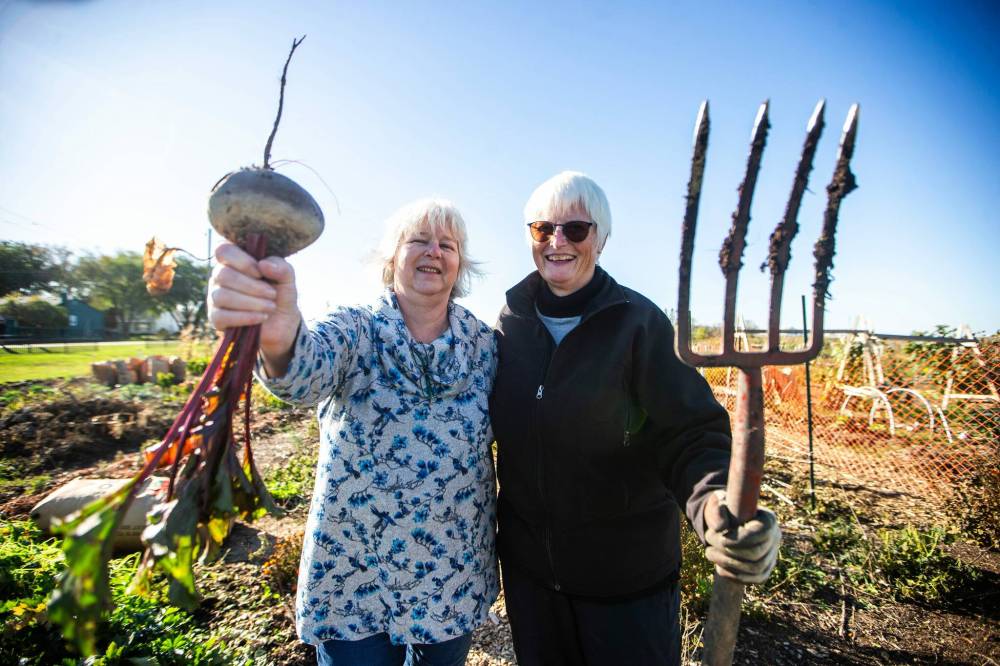
MIKAELA MACKENZIE / WINNIPEG FREE PRESS
Linda Wall (left) and Gayle Leverton at the St. James Community Garden on Tuesday. “Gardening is not for the faint of heart,” said Wall.
“Gardening is not for the faint of heart,” said Linda Wall, president of the Manitoba Horticultural Association. “We gamble that mother nature isn’t going to freeze in September, and this September, we won.”
Wall, whose organization represents 17 horticultural clubs throughout the province, noted every garden varies in its layout and crop. So although temperatures dropped to -1 C Monday (and were expected to hit -2 C Tuesday), many plots in the city remained untouched by frost.
The extended season was a pleasant surprise for gardeners, who were able to keep flowers in pots and planters into October. People tending to flowers may now consider bringing their plants inside to save them from the increasing cold, but root vegetables such as carrots will continue to thrive in the coming days, said Wall.
“Apparently, there was frost last night; well, it didn’t come to my garden. I still have mandevilla outside, I still have begonias outside that look absolutely beautiful and perennials — every gardener is talking about it,” said Colleen Zacharias, another avid gardener and Winnipeg Free Press columnist.
“This is the first year in several years that we could leave everything outside.”
Zacharias said she plans to pack in her garden this week, while Wall suggested planting garlic, which can remain bedded throughout the winter.
Environment Canada meteorologist Sara Hoffman said frost can vary significantly between locations, so the federal body does not track the annual beginning and end of growing seasons. Instead, it develops averages across multiple years.
As a general rule, the first frost falls on Winnipeg around Sept. 22, Hoffman said.
“We are certainly beyond that,” she said. “It’s such a strong El Niño this year that we are seeing quite high temperature anomalies above normal across the Prairies and western Canada. And, of course, climate change is compounding that.”
El Niño describes a climate pattern which typically brings warmer and drier weather conditions.

Climate change is already affecting the frequency, duration and intensity of extreme weather- and climate-related events — as seen in the numerous Canadian communities which were significantly impacted by forest fires this year, Environment Canada said.
Overall, the summer weather created average growing conditions for plants, with some species likely needing supplemental water owing to the dryness, Hoffman said.
“I would say definitely this is a trend we expect to continue. I would expect longer and longer growing seasons for sure,” she said.
The current weather forecast does not predict another temperature below 0 C from Wednesday until at least Sunday.
tyler.searle@freepress.mb.ca
Tyler Searle is a multimedia producer who writes for the Free Press’s city desk. A graduate of Red River College Polytechnic’s creative communications program, he wrote for the Stonewall Teulon Tribune, Selkirk Record and Express Weekly News before joining the paper in 2022. Read more about Tyler.
Every piece of reporting Tyler produces is reviewed by an editing team before it is posted online or published in print — part of the Free Press‘s tradition, since 1872, of producing reliable independent journalism. Read more about Free Press’s history and mandate, and learn how our newsroom operates.
Our newsroom depends on a growing audience of readers to power our journalism. If you are not a paid reader, please consider becoming a subscriber.
Our newsroom depends on its audience of readers to power our journalism. Thank you for your support.
Tyler Searle is a multimedia producer who writes for the Free Press’s city desk. A graduate of Red River College Polytechnic’s creative communications program, he wrote for the Stonewall Teulon Tribune, Selkirk Record and Express Weekly News before joining the paper in 2022. Read more about Tyler.
Every piece of reporting Tyler produces is reviewed by an editing team before it is posted online or published in print — part of the Free Press‘s tradition, since 1872, of producing reliable independent journalism. Read more about Free Press’s history and mandate, and learn how our newsroom operates.
Our newsroom depends on a growing audience of readers to power our journalism. If you are not a paid reader, please consider becoming a subscriber.
Our newsroom depends on its audience of readers to power our journalism. Thank you for your support.
Advertisement Advertise With Us
Advertisement Advertise With Us