

‘This is the best field trip ever’
Lord Selkirk School Division outdoor classroom revived, renewed after two-decade absence

Advertisement
Read this article for free:
or
Already have an account? Log in here »
To continue reading, please subscribe:
Digital Subscription
One year of digital access for only $1.44 a week*
- Enjoy unlimited reading on winnipegfreepress.com
- Read the E-Edition, our digital replica newspaper
- Access News Break, our award-winning app
- Play interactive puzzles
*Billed as $5.77 plus GST every four weeks. After 52 weeks, price increases to the regular rate of $19.95 plus GST every four weeks. Offer available to new and qualified returning subscribers only. Cancel any time.
To continue reading, please subscribe:
Add Free Press access to your Brandon Sun subscription for only an additional
$1 for the first 4 weeks*
- Enjoy unlimited reading on winnipegfreepress.com
- Read the E-Edition, our digital replica newspaper
- Access News Break, our award-winning app
- Play interactive puzzles
*Your next Brandon Sun subscription payment will increase by $1.00 and you will be charged $17.95 plus GST for four weeks. After four weeks, your payment will increase to $24.95 plus GST every four weeks.
Read unlimited articles for free today:
or
Already have an account? Log in here »
Hey there, time traveller!
This article was published 30/10/2023 (1085 days ago), so information in it may no longer be current.
A forgotten field trip site near Albert Beach is being revitalized to host land-based lessons in the Lord Selkirk School Division — the unlikely owners of the 51-acre lot — and student visitors from all over Manitoba.
Albert Beach Trail encompasses a 1.1-kilometre pathway that winds through a mature boreal forest and an open activity area located beside its cottage community namesake. The boggy woodlands are home to one of the largest standing birch tree populations in the province.
“No other school division owns a piece of property like this,” said retiree Ken Avery, who sat on the school board for 30 years. “It’s a jewel within their division.”
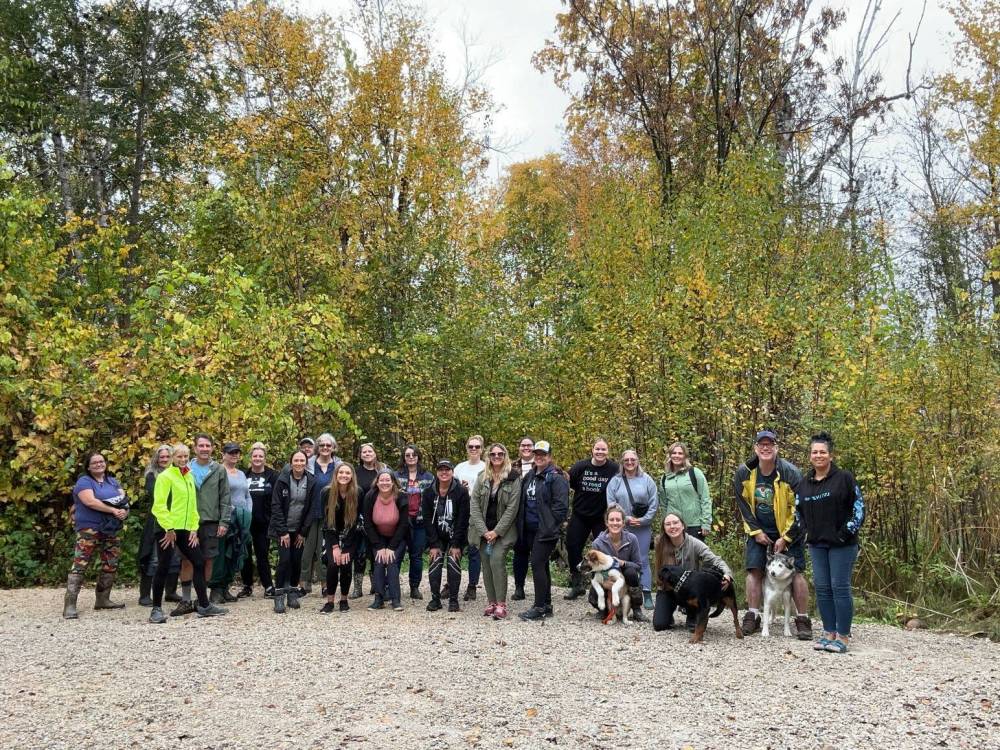
Staff members from the Lord Selkirk School Division visited the Albert Beach Trail site as part of a professional learning day on Oct. 3. (Supplied)
The longtime trustee, who left his post last year, advocated for the site’s renewal while it sat empty and unpruned for years as its upkeep was overlooked, and funds and resources were directed elsewhere.
Developers expressed interest in purchasing the vacant lot, but he said the board never seriously entertained selling it. As far as Avery’s concerned, the destination has always had the potential to become the FortWhyte Alive of Manitoba’s East Beaches.
Earlier this month, after roughly two decades of the space sitting dormant, Jodi Forfar organized the first student hike and scavenger hunt on the newly groomed grounds.
Twenty-eight middle schoolers were sent out with whiteboards and tablets, and tasked with taking notes, snapping photos and using plant-identification apps to record their findings. They left with a newfound understanding of moss, ferns and Labrador tea, among other species.
“I heard kids saying, ‘This is awesome, this is the best field trip ever’ — and to me, that justified all the hard work that we’ve been doing over the last several years,” said Forfar, a science teacher at Lockport School.
Forfar has been involved in the revitalization project since it got underway in 2015.
The self-described outdoor education enthusiast was tapped to oversee the committee in charge of its comeback, which was sparked by then-superintendent Scott Kwasnitza, because of her hand in building an open-air classroom at her junior high. The COVID-19 pandemic disrupted and delayed reopening of the site.
As of this year, the new trail and a picnic shelter are accessible via 55 Christopher Rd., located about 100 km north of the Perimeter Highway. The area is free for community use.
The lot was originally transferred to the Selkirk-based district when it was created in 1967, as a result of an amalgamation of independent and public schools in the region.
In 1981, a teacher-led outdoor education association received approval to create a camp in the forested area. The following year, volunteers built a main lodge and the first of a series of cabins that were frequented by staff and students until they were deemed unsafe in 2005.
“The architects decided that the buildings weren’t safe because it wasn’t certified lumber. The lumber used was rough lumber,” recalled Bob Jesson, a retired principal who serves on the school board. “I was disappointed that we had to shut it down.”
Jesson used to take staff and students up to the area for overnight trips. The groups played games, completed a “fitness trail” and in the winter, built quinzees, he said, adding the outings were a school-year highlight for students and staff alike.
For Forfar, the Oct. 13 “maiden voyage” was yet another reminder of how valuable spending time in nature is for students’ physical and mental health.

A group of students from Lockport School took a trial field trip to Albert Beach Trail on Oct. 13, after nearly two decades of the grounds sitting dormant. (Supplied)
“There’s ‘nature deprivation’ for some students that don’t get opportunities to be out in outdoor settings like this, so providing those opportunities and having it accessible for everyone is important,” Forfar said.
Members of the school division’s maintenance crew cleaned up the trail and marked it as part of the first phase of the renewal project. The second stage involved levelling a large activity area, bringing in gravel and setting up infrastructure, including a wheelchair-accessible picnic table, to facilitate day trips.
A grand opening is anticipated in the spring, after which Forfar said she wants to invite colleagues to start taking field trips year-round and facilitating land-based lessons with support from Indigenous teachers and local elders.
“We are so lucky that we have an abundance of birch trees, so we have quite a bit of (what we call) ‘the king of medicines,’” said Jacqueline Bercier, a Métis-Anishinaabe educator who oversees the division’s cultural perspectives and languages programs.

Not only will visitors be able to go on medicine walks and harvest plants, but they will also be able to participate in teachings about species ranging from wild mint to sweetgrass, Bercier said.
“We want (both Indigenous and non-Indigenous students) to be more in connection with the land,” she said. “The trail is broken up enough so you have to slow down.”
Bercier added she hopes they will eventually be able to construct a teepee and sweat lodge on the grounds.
The long-term plan also involves rebuilding overnight cabins around the trail and hosting local children and students from neighbouring districts for overnight trips.
maggie.macintosh@freepress.mb.ca
Maggie Macintosh
Education reporter
Maggie Macintosh reports on education for the Free Press. Originally from Hamilton, Ont., she first reported for the Free Press in 2017. Read more about Maggie.
Funding for the Free Press education reporter comes from the Government of Canada through the Local Journalism Initiative.
Every piece of reporting Maggie produces is reviewed by an editing team before it is posted online or published in print — part of the Free Press‘s tradition, since 1872, of producing reliable independent journalism. Read more about Free Press’s history and mandate, and learn how our newsroom operates.
Our newsroom depends on a growing audience of readers to power our journalism. If you are not a paid reader, please consider becoming a subscriber.
Our newsroom depends on its audience of readers to power our journalism. Thank you for your support.
Maggie Macintosh
Education reporter
Maggie Macintosh reports on education for the Free Press. Originally from Hamilton, Ont., she first reported for the Free Press in 2017. Read more about Maggie.
Funding for the Free Press education reporter comes from the Government of Canada through the Local Journalism Initiative.
Every piece of reporting Maggie produces is reviewed by an editing team before it is posted online or published in print — part of the Free Press‘s tradition, since 1872, of producing reliable independent journalism. Read more about Free Press’s history and mandate, and learn how our newsroom operates.
Our newsroom depends on a growing audience of readers to power our journalism. If you are not a paid reader, please consider becoming a subscriber.
Our newsroom depends on its audience of readers to power our journalism. Thank you for your support.
Related Articles
Gaming their way into urban planning


Advertisement Advertise With Us
Advertisement Advertise With Us