

Confusion, frustration and hope at Gaza’s border with Egypt as first foreign passport-holders depart
Advertisement
Read this article for free:
or
Already have an account? Log in here »
To continue reading, please subscribe:

Digital Subscription
One year of digital access for only $205*
- Enjoy unlimited reading on winnipegfreepress.com
- Read the E-Edition, our digital replica newspaper
- Access News Break, our award-winning app
- Play interactive puzzles
*First annual payment billed as $205.00 + GST for one year. This annual subscription will automatically renew at $233.00 + GST every 52 weeks (10% off the regular annual price of $259.35). Offer available to new and qualified returning subscribers only. Cancel any time.
To continue reading, please subscribe:
Add Free Press access to your Brandon Sun subscription for only an additional
$1 for the first 4 weeks*
- Enjoy unlimited reading on winnipegfreepress.com
- Read the E-Edition, our digital replica newspaper
- Access News Break, our award-winning app
- Play interactive puzzles
*Your next Brandon Sun subscription payment will increase by $1.00 and you will be charged $17.95 plus GST for four weeks. After four weeks, your payment will increase to $24.95 plus GST every four weeks.
Read unlimited articles for free today:
or
Already have an account? Log in here »
Hey there, time traveller!
This article was published 01/11/2023 (1053 days ago), so information in it may no longer be current.
RAFAH, Gaza Strip (AP) — Hundreds of foreign passport-holders and dozens of other seriously wounded Palestinians desperate to escape Israel’s bombardment of Gaza crowded around the black metal gate on the Egyptian border Wednesday, hoping to pass through the enclave’s only portal to the outside world for the first time since the war began.
Restless children pressed their faces against the wire mesh as families with backpacks and carry-on suitcases pushed and jostled. The air was thick with apprehension.
Everyone was waiting for the Hamas authorities to call their names over the scratchy loudspeaker. Each name represented another individual with a chance to escape the punishing war that has killed over 8,800 Palestinians, according to the Health Ministry in Hamas-ruled Gaza, and forever altered the enclave they had called home.

“We are relying on God and hoping that we get out,” said Rania Hussein, a Jordanian resident of Gaza, as she breathlessly described the horrors she had fled — entire Palestinian neighborhoods razed and families crushed to death since Oct. 7, when Hamas mounted its unprecedented attack on Israel.
“If it wasn’t for what had happened, we wouldn’t leave Gaza,” she said.
After three weeks of repeatedly dashed hopes and torturous negotiations between Egypt, Israel and Gaza’s Hamas rulers, the first group of Palestinians left the besieged strip through the Rafah crossing, swarmed by TV cameras.
Squeezing through the border gates were 335 foreign passport-holders, mostly Palestinian dual nationals but also some foreigners, 76 critically wounded patients bound for Egyptian hospitals and some staffers from aid organizations, including Doctors Without Borders, the International Committee of the Red Cross and the United Nations agency for Palestinian refugees.
The breakthrough for the hundreds of Palestinians traveling by foot and in ambulances into the Sinai peninsula left many others holding their breath. Confusion reigned as hundreds of people who had braved Israeli air raids to flock to the Egyptian border found themselves stranded after the roll-call ended.
There are thousands of foreign passport holders stuck in the Gaza Strip, including an estimated 400 Americans who want out. A widely shared Google spreadsheet outlining just a few hundred names of those cleared for departure Wednesday raised even more questions.
The list included citizens from a handful of European countries as well as Australia, Japan and Indonesia. There were no Americans or Canadians, but the U.S. State Department later confirmed that a few U.S. citizens had managed to cross.
“No one understands how you get on this list or why you’re not on this list,” said Hammam al-Yazji, a Palestinian businessman trying to get out of Gaza with his 4-year-old American son.
Phone and internet connections were down early Wednesday across the strip, adding to the frustration.
“We came here today to the Egyptian borders hoping to leave Gaza, but our Canadian Embassy didn’t contact due to the bad network,” said Asil Shurab, a Canadian citizen.
Dr. Hamdan Abu Speitan, a 76-year-old Palestinian American physician from Syracuse, said he had no idea what to expect.
“All I can do is wait and pray,” he said.
The terms of the deal between Israel, Egypt and Hamas — reached with the help of Qatar and the United States — remained shrouded in secrecy as diplomats promised more foreign passport-holders would be able to cross Rafah in the coming days.
“We expect exits of U.S. citizens and foreign nationals to continue over the next several days,” State Department spokesperson Matthew Miller told reporters on Wednesday.
It still was not clear how long the departures of foreign nationals would go on, which countries’ citizens would depart when and how that order would be decided.

None of the roughly 240 hostages believed to be held by Hamas were released. Most are Israeli citizens, but roughly half hold foreign passports, according to Israel’s Foreign Ministry.
For some, the past weeks of false starts and thwarted plans did not instill much confidence.
“We have little hope,” Shurab said, “to leave and save our lives.”
___
DeBre reported from Jerusalem. Associated Press writer Sam Magdy in Cairo contributed to this report.
Related Articles
More chances to leave Gaza soon: Global Affairs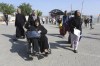



Advertisement Advertise With Us
Advertisement Advertise With Us