

Colour of Courage conference to support BIPOC teachers

Advertisement
Read this article for free:
or
Already have an account? Log in here »
To continue reading, please subscribe:

Digital Subscription
One year of digital access for only $205*
- Enjoy unlimited reading on winnipegfreepress.com
- Read the E-Edition, our digital replica newspaper
- Access News Break, our award-winning app
- Play interactive puzzles
*First annual payment billed as $205.00 + GST for one year. This annual subscription will automatically renew at $233.00 + GST every 52 weeks (10% off the regular annual price of $259.35). Offer available to new and qualified returning subscribers only. Cancel any time.
To continue reading, please subscribe:
Add Free Press access to your Brandon Sun subscription for only an additional
$1 for the first 4 weeks*
- Enjoy unlimited reading on winnipegfreepress.com
- Read the E-Edition, our digital replica newspaper
- Access News Break, our award-winning app
- Play interactive puzzles
*Your next Brandon Sun subscription payment will increase by $1.00 and you will be charged $17.95 plus GST for four weeks. After four weeks, your payment will increase to $24.95 plus GST every four weeks.
Read unlimited articles for free today:
or
Already have an account? Log in here »
Hey there, time traveller!
This article was published 16/01/2024 (932 days ago), so information in it may no longer be current.
A new conference is urging racialized teachers — a group that is underrepresented across the public school system — to consider applying for leadership roles in their buildings and divisions at-large.
The Manitoba Teachers’ Society, one of the largest public-sector unions in the province with upwards of 16,600 members, is hosting its inaugural “Colour of Courage” event this week.
The society has organized symposiums for women in the workforce and LGBTTQ+ educators in recent years in a bid to provide professional development through an equity, diversity and inclusion lens.
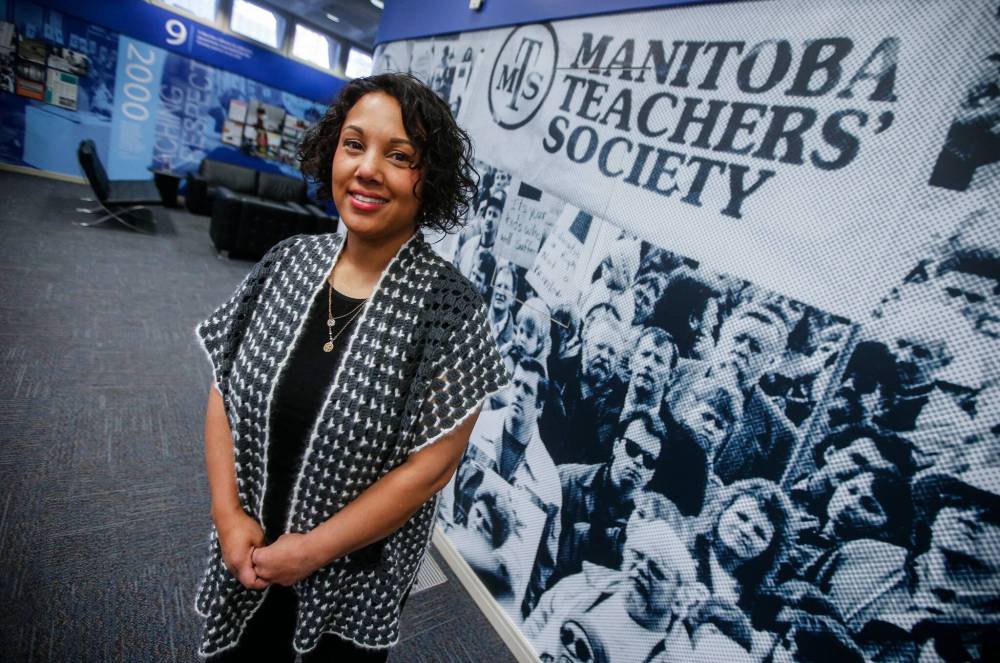
JOHN WOODS / WINNIPEG FREE PRESS
Cynthia Taylor, vice-president of the Manitoba Teachers’ Society: “It’s about being in a safe space to be able to talk about the joys and challenges of leadership.”
Its upcoming conference, scheduled for Friday and Saturday at MTS headquarters on Portage Avenue in Winnipeg, invites members who are BIPOC (Black, Indigenous and people of colour) to network, listen to keynote speeches and participate in workshops.
“It’s about being in a safe space to be able to talk about the joys and challenges of leadership (and related aspirations),” said Cynthia Taylor, vice-president of the union.
Taylor said participants will come away from the conference with the understanding there is a space for them in a principal’s office, as the head of a high school department or otherwise.
The latest state of equity in education reports, completed by the Winnipeg Indigenous Executive Circle and Newcomer Education Coalition, show most Winnipeg divisions have not historically collected race-based data from managers.
Responses from the Winnipeg School Division — an outlier in the 2021 reports — show 20 per cent (two out of 10) senior administrators self-identified as Indigenous in 2018-19. That figure was 11 per cent among principals and 10 per cent among vice-principals.
A single division leader disclosed they were racialized and teachers from visible minorities made up about eight per cent and 11 per cent of principals and vice-principals, respectively.
At the time, a quarter of the student population was Indigenous, while 34 per cent of kindergarten-to-Grade 12 pupils were racialized.
“When you see somebody that looks like you in the school system, that matters,” Taylor said.
While noting this week’s conference is run by racialized teachers for racialized teachers, she said there will be room for discussions about issues that “bring discomfort,” such as microaggressions and other examples of racism BIPOC members experience on the job.
The union leader added she hopes participants will meet mentors and begin to build a support system, especially if they are the only racialized teacher at their school.
Michelle Jean-Paul did not enter teaching to become an administrator, but she ended up accepting a vice-principal position when she was only 27.
Jean-Paul credits mentors and colleagues — many of whom were involved with the Black Educators Association of Manitoba, then an active advocacy collective — who urged her to submit her resumé for jobs she thought not within her reach.
“It’s very easy to underestimate yourself, particularly when you don’t see examples like you leading the way,” she said, noting a growing body of research shows women, BIPOC and other historically oppressed educators are far less likely to apply for advancement in the workforce.
Now, Jean-Paul is the assistant superintendent of staff services at the Louis Riel School Division.

Her advice to up-and-coming leaders is to kick imposter syndrome — to this day, Jean-Paul said she occasionally gets mistaken for clerical support staff — by networking and in turn, building confidence and resilience.
“It may not be within the division you’re working in or even in the city you’re working in, but there are a lot of really dynamic racialized leaders across the country,” added Jean-Paul, who co-founded the Educators of Colour Network.
Laurelle Harris, principal of Equitable Solutions Consulting, and Jim Agapito, host of CBC Manitoba’s Recovering Filipino podcast, are headlining MTS’ two-day symposium in Winnipeg.
Just under 50 people were registered to attend, as of Monday.
maggie.macintosh@freepress.mb.ca
Maggie Macintosh
Education reporter
Maggie Macintosh reports on education for the Free Press. Originally from Hamilton, Ont., she first reported for the Free Press in 2017. Read more about Maggie.
Funding for the Free Press education reporter comes from the Government of Canada through the Local Journalism Initiative.
Every piece of reporting Maggie produces is reviewed by an editing team before it is posted online or published in print — part of the Free Press‘s tradition, since 1872, of producing reliable independent journalism. Read more about Free Press’s history and mandate, and learn how our newsroom operates.
Our newsroom depends on a growing audience of readers to power our journalism. If you are not a paid reader, please consider becoming a subscriber.
Our newsroom depends on its audience of readers to power our journalism. Thank you for your support.
Maggie Macintosh
Education reporter
Maggie Macintosh reports on education for the Free Press. Originally from Hamilton, Ont., she first reported for the Free Press in 2017. Read more about Maggie.
Funding for the Free Press education reporter comes from the Government of Canada through the Local Journalism Initiative.
Every piece of reporting Maggie produces is reviewed by an editing team before it is posted online or published in print — part of the Free Press‘s tradition, since 1872, of producing reliable independent journalism. Read more about Free Press’s history and mandate, and learn how our newsroom operates.
Our newsroom depends on a growing audience of readers to power our journalism. If you are not a paid reader, please consider becoming a subscriber.
Our newsroom depends on its audience of readers to power our journalism. Thank you for your support.
Advertisement Advertise With Us
Advertisement Advertise With Us