

Argentina’s president faces 1-day general strike as foes seek to derail his austerity agenda
Advertisement
Read this article for free:
or
Already have an account? Log in here »
To continue reading, please subscribe:

Digital Subscription
One year of digital access for only $205*
- Enjoy unlimited reading on winnipegfreepress.com
- Read the E-Edition, our digital replica newspaper
- Access News Break, our award-winning app
- Play interactive puzzles
*First annual payment billed as $205.00 + GST for one year. This annual subscription will automatically renew at $233.00 + GST every 52 weeks (10% off the regular annual price of $259.35). Offer available to new and qualified returning subscribers only. Cancel any time.
To continue reading, please subscribe:
Add Free Press access to your Brandon Sun subscription for only an additional
$1 for the first 4 weeks*
- Enjoy unlimited reading on winnipegfreepress.com
- Read the E-Edition, our digital replica newspaper
- Access News Break, our award-winning app
- Play interactive puzzles
*Your next Brandon Sun subscription payment will increase by $1.00 and you will be charged $17.95 plus GST for four weeks. After four weeks, your payment will increase to $24.95 plus GST every four weeks.
Read unlimited articles for free today:
or
Already have an account? Log in here »
Hey there, time traveller!
This article was published 24/01/2024 (942 days ago), so information in it may no longer be current.
BUENOS AIRES, Argentina (AP) — Argentina’s President Javier Milei faced a one-day general strike Wednesday protesting his decree targeting unions as well as his proposals for economic and labor law changes, showing that his opponents are wasting no time in trying to derail his austerity agenda.
The biggest union, known by its acronym CGT, organized the strike and was joined by other unions. Strikers took to the streets in the capital, Buenos Aires, and other cities across the country, joined by social groups and political opponents, including the Peronist party that dominated national politics for decades.
Until his presidential run, Milei, a libertarian economist, was known mostly for his televised screeds against the political caste, and he secured victory last year by a wide margin before taking office just over a month ago. A self-declared “anarcho-capitalist,” he pledged a drastic reduction in state spending aimed at shoring up a government budget deficit that he says is fueling red-hot inflation, which finished 2023 at 211%.
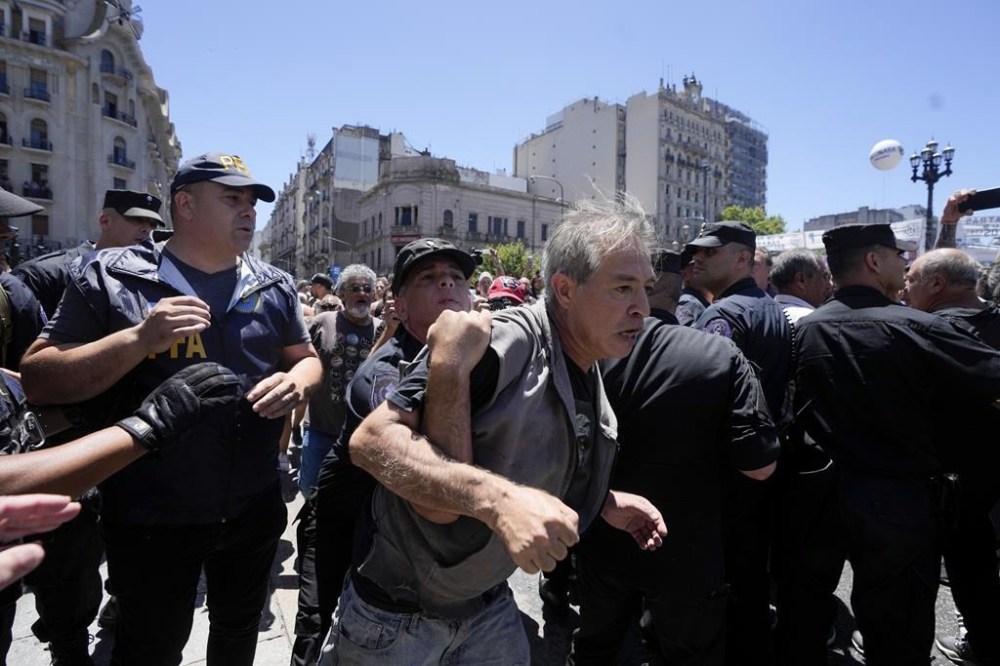
On Dec. 20, Milei issued a decree that would revoke or modify hundreds of existing laws so as to limit the power of unions and deregulate an economy featuring notoriously heavy state intervention. A court ruling has put the labor changes on hold. He also sent an omnibus bill to Congress that would enact sweeping reforms in the political, social, fiscal, legal, administrative and security fields.
It remained unclear if the strike, scheduled to end at midnight, would amount to a speedbump to his agenda or no obstacle at all.
While people have legitimate grievances — triple-digit inflation and a steep devaluation of Argentina’s peso — behind the scenes the main impetus for the strike was the president’s drive to weaken union power, Buenos Aires-based political analyst Sergio Berensztein said.
“For union leaders what is at stake is really a lot. If they don’t complain, their bargaining capacity is going to drop dramatically and their influence in politics is going to dwindle,” Berensztein told The Associated Press in a phone interview. “Milei feels quite comfortable confronting these leaders. He’s still very popular; union leaders are unpopular.”
The walkout was Argentina’s first general strike in more than four years, and it was also the quickest ever to be organized in a president’s term since the return of democracy in 1983, according to a review by local media outlet Infobae. Milei’s predecessor, center-left Alberto Fernández, did not face any general strikes.
“We’re going to lose more rights that we worked for,” teacher Karina Villagra told AP in a plaza in front of Congress. “The militancy should be stronger than ever.”
Milei won the runoff election with 56% of the votes, and in his inaugural address told Argentina that things would get worse before improving. Two separate polls this month show he retains support of more than half of respondents despite accelerating inflation and mass layoffs announced at state-owned firms.
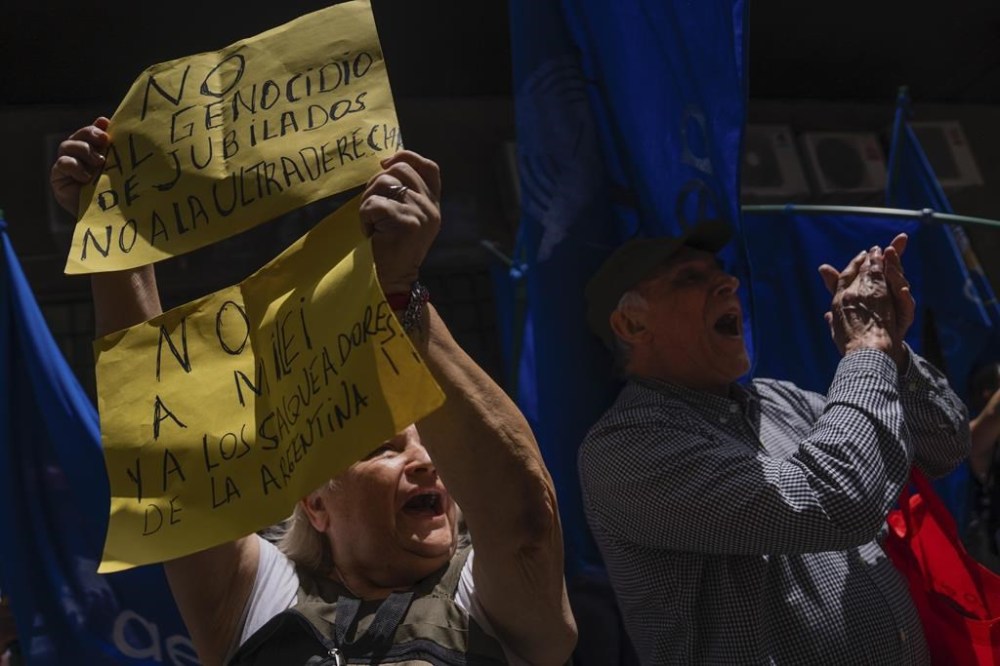
Security Minister Patricia Bullrich on Wednesday accused strike organizers of being “mafiosos” bent on preventing the change Argentine voters chose, saying on the X platform that the action would not halt the administration’s progress. Milei’s spokesperson, Manuel Adorni, said at a news conference, “One cannot dialogue with people who try to stop the country and show a rather antidemocratic side.”
His labor decree would restrict the right to strike by essential workers in hospital services, education and transport, and create new mechanisms of compensation to make it easier to fire employees. It also would enable workers to pay private healthcare providers directly, rather than channeling those resources through unions, and so dry up a significant source of their revenue.
His administration warned in recent days that, as with a demonstration held in December, protesters would be prevented from engaging in the traditional practice of blocking roads and would be subject to arrest.
The stoppage began at midday, and banks, gas stations, public administration, public health officials and trash collection were operating on a limited basis. Airports remained open, although state-owned airline Aerolineas Argentinas canceled 267 flights and rescheduled others, disrupting travel plans for more than 17,000 passengers.
Public transportation workers went on strike at 7 p.m. in Buenos Aires and surrounding areas, but had operated normally during the daytime to facilitate protesters’ access to and from the plaza in front of Congress.
By Wednesday afternoon, tens of thousands of protesters had flooded in. Héctor Daer, CGT’s secretary general, told the crowd from atop a stage that Milei’s decree “destroys individual rights of workers, collective rights and seeks to eliminate the possibility of union action at a time in which we have great inequality in society.”
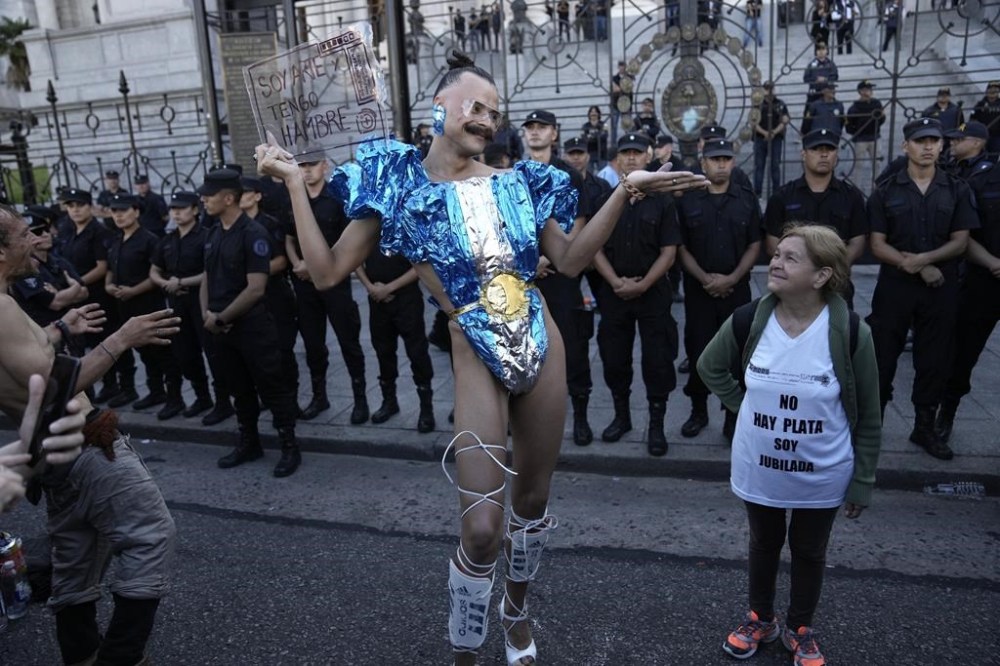
Pablo Moyano, of the teamsters’ union, told them that “if they pass these measures of adjustment, of hunger, then the workers, retirees and the most humble people will put him (Economy Minister Luis Caputo) on their shoulders and throw him in the river.”
Milei responded to Moyano’s comment Thursday evening on X: “Never was the choice so clear. We make the changes or we remain prisoners to these extortionists.”
Milei has said passage of his proposed omnibus bill would create the basis for economic stability and growth, reining in inflation and reducing poverty, which is punishing four in 10 Argentines. The bill’s content is being discussed in Congress’ lower house, with a vote expected in coming days.
Berensztein, the analyst, said he expects the bill to be watered down significantly before clearing the house, then move on to the Senate for another round of negotiations.
Benjamin Gedan, director of the Latin America program at the Wilson Center in Washington said that while Milei is acting as though he has a clear mandate, many of his voters were rejecting Peronism rather than throwing full support behind his proposal for austerity.
Argentines have already been hit with a 30% increase in food costs in a single month, plus a surge in energy bills and transport fares.
“His capacity to keep the Argentine public on board will be tested and is being tested already, and that’s what you’re seeing right now,” Gedan said, adding the president has “given opponents a lot of weapons because he has moved so quickly and dramatically” to address Argentina’s problems.
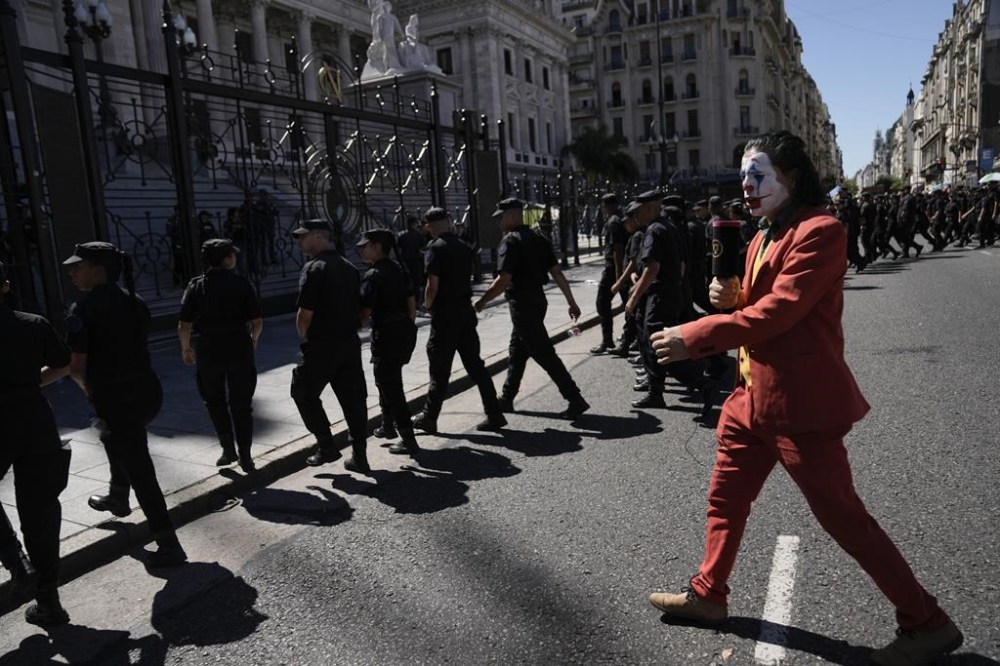
Gedan said a one-day strike is “not an existential threat” for the Milei presidency. “Really the question is if this is a sign of what’s to come.”
___
Biller reported from Rio de Janeiro. Associated Press writer Natacha Pisarenko in Buenos Aires contributed to this report.