

Island Lake chiefs declare emergency as mild weather has made vital winter link unsafe

Advertisement
Read this article for free:
or
Already have an account? Log in here »
To continue reading, please subscribe:

Digital Subscription
One year of digital access for only $205*
- Enjoy unlimited reading on winnipegfreepress.com
- Read the E-Edition, our digital replica newspaper
- Access News Break, our award-winning app
- Play interactive puzzles
*First annual payment billed as $205.00 + GST for one year. This annual subscription will automatically renew at $233.00 + GST every 52 weeks (10% off the regular annual price of $259.35). Offer available to new and qualified returning subscribers only. Cancel any time.
To continue reading, please subscribe:
Add Free Press access to your Brandon Sun subscription for only an additional
$1 for the first 4 weeks*
- Enjoy unlimited reading on winnipegfreepress.com
- Read the E-Edition, our digital replica newspaper
- Access News Break, our award-winning app
- Play interactive puzzles
*Your next Brandon Sun subscription payment will increase by $1.00 and you will be charged $17.95 plus GST for four weeks. After four weeks, your payment will increase to $24.95 plus GST every four weeks.
Read unlimited articles for free today:
or
Already have an account? Log in here »
Hey there, time traveller!
This article was published 06/02/2024 (976 days ago), so information in it may no longer be current.
The rapid deterioration of temporary winter roads due to unseasonably warm weather is threatening the delivery of essential goods, four remote northern Manitoba communities warn.
Chiefs from the First Nations in the Island Lake area — Garden Hill, Red Sucker Lake, St. Theresa Point and Wasagamack — declared a state of emergency Tuesday, saying they collectively have only weeks of such supplies remaining for residents.
The northeast Manitoba fly-in communities have no permanent roads, and rely on the short-lived winter arteries each year.
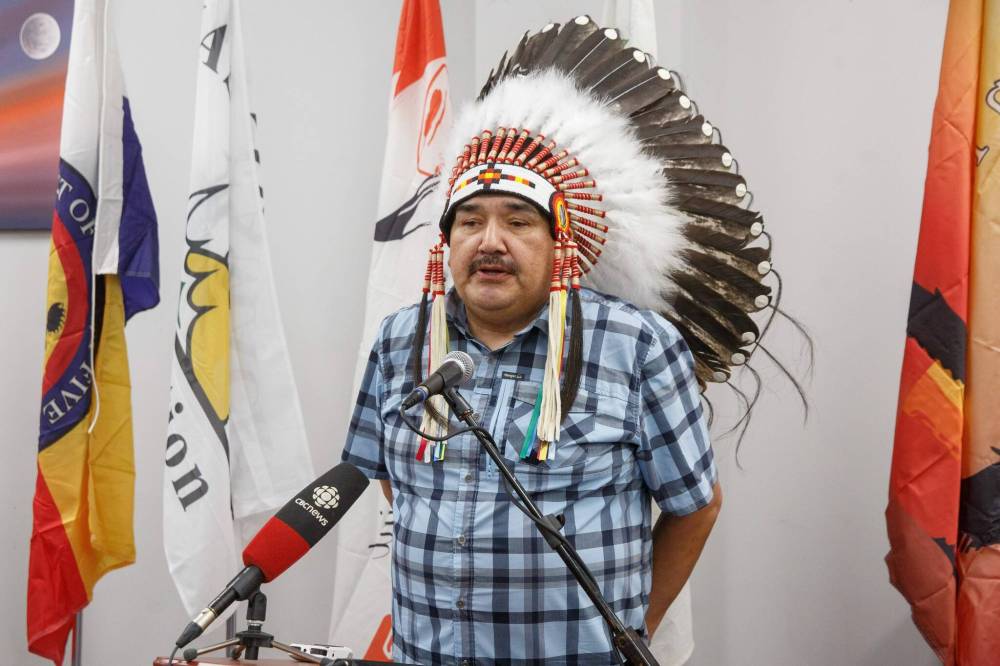
MIKE DEAL / WINNIPEG FREE PRESS FILES
Garden Hill First Nation Chief Charles Knott says his community has yet to receive any deliveries this winter.
“We only have about a week left of our fuel,” Garden Hill Chief Charles Knott said, adding the community has yet to receive any deliveries this winter. “I don’t know what we’re gonna do once we run out.”
The leaders estimate they need close to 1,000 truck loads of fuel, medical supplies, food, water and building materials for the remainder of the year.
Approximately 18,000 people live in the region, Knott said.
Keewatin Tribal Council Grand Chief Walter Wastescicoot (York Factory) compared the winter roads to driving on sponge.
“The governments of Canada and Manitoba cannot sit idly by and ignore climate change,” he said.
The average seasonal high in the Island Lake region is -14 C, according to Environment Canada. On Feb. 5, the area reached a daytime high of 2 C.
Nearly 300 kilometres of winter roads connecting Berens River to St. Theresa Point remain closed as of Tuesday, according to a daily report from Manitoba Transportation and Infrastructure. The anticipated opening date is between Feb. 9 and 12, the report said.
A 62-km ice road connecting Garden Hill and Red Sucker Lake also remains closed.
St. Theresa Point Chief Raymond Flett called on the provincial and federal governments to address the increasing threat of climate change.
Flett said the community is expecting 300 loads of supplies, and it, too, is running out of fuel.
On Jan. 31, the Island Lake chiefs called for the construction of an all-season road providing access to the communities.
St. Theresa Point submitted a $512-million proposal to the provincial and federal governments to build a 252-km link from Berens River First Nation, which is already connected to Winnipeg by an all-season road.
Assembly of Manitoba Chiefs Grand Chief Cathy Merrick said the absence of reliable road access poses a significant risk to citizens’ health, safety and well-being.
Municipal and Northern Relations Minister Ian Bushie said the province is looking for cooler weather to mitigate any immediate threats, but will be discussing solutions for the Island Lake communities “as quickly as possible.”
“Our hopes is that the weather co-operates, we can open the network fully and the community can get service with the necessary goods and services that they need,” Bushie said, adding he’s looked at the proposal for an all-season road and discussions are ongoing.
Vincent Simms, who has worked as foreman for the Red Sucker Lake winter road construction crew for 15 years, said it has become harder to build ice roads over the past decade, due to climate change.

“We need snow to construct our roads, which we do not have up north,” he said. “We’re battling with open water that does not want to freeze… These winter roads are our lifeline.”
Late Tuesday, the communities of Pauingassi, Little Grand Rapids and Poplar River, on the east side of Lake Winnipeg, declared a state of emergency due to the absence of winter road access. The Southeast Resource Development Council Corp. issued a media statement advising of the dire situation.
The corporation said it is concerned about a shorter winter road season. In 2023, it says, all roads were open by February 6 and closed by April 14.
“Winter roads connect us to essential supplies,” says Chief Roddy Owens of Pauingassi First Nation.
The corporation called on the federal and Manitoba governments to develop a contingency plan should the mild temperatures persist.
nicole.buffie@freepress.mb.ca
Nicole Buffie
Multimedia producer
Nicole Buffie is a reporter for the Free Press city desk. Born and bred in Winnipeg, Nicole graduated from Red River College’s Creative Communications program in 2020 and worked as a reporter throughout Manitoba before joining the Free Press newsroom as a multimedia producer in 2023. Read more about Nicole.
Every piece of reporting Nicole produces is reviewed by an editing team before it is posted online or published in print — part of the Free Press‘s tradition, since 1872, of producing reliable independent journalism. Read more about Free Press’s history and mandate, and learn how our newsroom operates.
Our newsroom depends on a growing audience of readers to power our journalism. If you are not a paid reader, please consider becoming a subscriber.
Our newsroom depends on its audience of readers to power our journalism. Thank you for your support.
Nicole Buffie
Multimedia producer
Nicole Buffie is a reporter for the Free Press city desk. Born and bred in Winnipeg, Nicole graduated from Red River College’s Creative Communications program in 2020 and worked as a reporter throughout Manitoba before joining the Free Press newsroom as a multimedia producer in 2023. Read more about Nicole.
Every piece of reporting Nicole produces is reviewed by an editing team before it is posted online or published in print — part of the Free Press‘s tradition, since 1872, of producing reliable independent journalism. Read more about Free Press’s history and mandate, and learn how our newsroom operates.
Our newsroom depends on a growing audience of readers to power our journalism. If you are not a paid reader, please consider becoming a subscriber.
Our newsroom depends on its audience of readers to power our journalism. Thank you for your support.
Related Articles
Northern reserves demand $512-M all-season road




Advertisement Advertise With Us
Advertisement Advertise With Us
History
Updated on Tuesday, February 6, 2024 6:38 PM CST: Article rewritten with latest information.
Updated on Tuesday, February 6, 2024 8:18 PM CST: Adds quote, media statement