

Haiti’s future is being planned on two tracks: traditional political power and gang power
Advertisement
Read this article for free:
or
Already have an account? Log in here »
To continue reading, please subscribe:

Digital Subscription
One year of digital access for only $205*
- Enjoy unlimited reading on winnipegfreepress.com
- Read the E-Edition, our digital replica newspaper
- Access News Break, our award-winning app
- Play interactive puzzles
*First annual payment billed as $205.00 + GST for one year. This annual subscription will automatically renew at $233.00 + GST every 52 weeks (10% off the regular annual price of $259.35). Offer available to new and qualified returning subscribers only. Cancel any time.
To continue reading, please subscribe:
Add Free Press access to your Brandon Sun subscription for only an additional
$1 for the first 4 weeks*
- Enjoy unlimited reading on winnipegfreepress.com
- Read the E-Edition, our digital replica newspaper
- Access News Break, our award-winning app
- Play interactive puzzles
*Your next Brandon Sun subscription payment will increase by $1.00 and you will be charged $17.95 plus GST for four weeks. After four weeks, your payment will increase to $24.95 plus GST every four weeks.
Read unlimited articles for free today:
or
Already have an account? Log in here »
Hey there, time traveller!
This article was published 12/03/2024 (932 days ago), so information in it may no longer be current.
Haiti’s future is being planned on two tracks — one involving traditional political power, the other focused on the power of gangs.
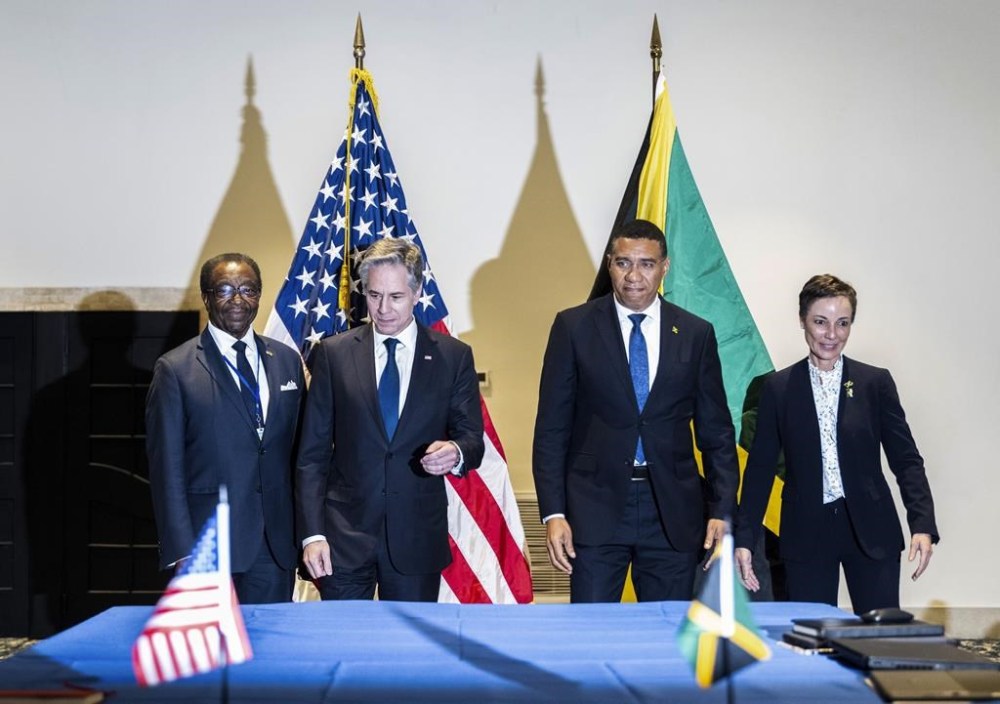
After an intense session of international diplomacy in Jamaica, a group of Caribbean nations and the United States announced Tuesday that Haiti’s best hope for calming violence rests with a council of influential figures who would elected an interim leader and could steer the country toward fresh presidential elections.
As they spoke to the media, a heavily armed gang leader held an impromptu news conference in Port-au-Prince and rejected any solution led and supported by the international community.
“Haitian people will choose who will govern them,” Jimmy “Barbecue” Chérizier said Monday.
Haitian politics have lived in these two worlds for decades, experts told The Associated Press this week. Politicians and business interests have maintained on-the-books legal interests while employing gangs to enforce their will on the chaotic streets.
WHO DECIDES HAITI’S FUTURE?
Prime Minister Ariel Henry announced Tuesday that he would resign once the transitional presidential council was created. Guyana President Irfaan Ali said the transitional council would have seven voting members and two nonvoting ones.
The seven voting members include three traditional political parties, a civil-society group known as the Montana Accord and members of the country’s powerful private sector.
The transitional council includes a role for civil society alongside the Montana one, but some observers say that is far from enough.
”The fact that Haiti’s civil society and religious sector will only have ‘observer status’ on a transitional council dominated by members of the country’s disgraced political class and its allies should tell you a lot,” said Michael Deibert, author of “Notes From the Last Testament: The Struggle for Haiti” and “Haiti Will Not Perish: A Recent History.”
WHO ARE THE MEMBERS OF THE COUNCIL DECIDING THE FUTURE OF HAITIAN POLITICS?
One of the parties is the Pitit Desalin party, which is run by former senator and presidential candidate Moïse Jean-Charles. He is now an ally of Guy Philippe, a former rebel leader who led a successful 2004 coup and was recently released from a United States prison after pleading guilty to money laundering.
Philippe was a charismatic leader who was instrumental in the 2004 rebellion against former President Jean-Bertrand Aristide and had powerful ties to police, politicians and the business elite.
Former Prime Minister Charles Joseph has a party called EDE/RDE, which also has a vote.
Also on the council is the Fanmi Lavalas party backed by Aristide and another coalition led by Henry.
Robert Fatton, a Haitian politics expert at the University of Virginia, said that membership in the group announced Monday appeared to overlap with at least one other group that was founded in recent weeks to calm Haitian civil unrest in the same general way.
WHAT ARE THE BIGGEST OBSTACLES TO SUCCESS?
Solutions to past crises have overly emphasized foreign nations’ ability to resolve problems in Haiti, said Francois Pierre-Louis, a professor of political science at Queens College at the City University of New York.
“The U.S. government and the international community have not allowed Haitians to decide on their own what needs to be done, and that is done two ways,” Pierre-Louis said.
Specifically, outside actors have undermined civil society and failed to punish bad elements, he said, making the work of constructing a functional society infinitely more difficult.
But Haiti’s domestic instability may have gone so far that only an armed force from overseas can impose order, said Eric Farnsworth, vice president of the Council of the Americas and the Americas Society.
People must be ready to welcome that force. “It’s a no-win situation,” he said.