

‘Be an Upstander’ initiative fosters belief kids can help solve problems in their lives, those of others

Advertisement
Read this article for free:
or
Already have an account? Log in here »
To continue reading, please subscribe:

Digital Subscription
One year of digital access for only $205*
- Enjoy unlimited reading on winnipegfreepress.com
- Read the E-Edition, our digital replica newspaper
- Access News Break, our award-winning app
- Play interactive puzzles
*First annual payment billed as $205.00 + GST for one year. This annual subscription will automatically renew at $233.00 + GST every 52 weeks (10% off the regular annual price of $259.35). Offer available to new and qualified returning subscribers only. Cancel any time.
To continue reading, please subscribe:
Add Free Press access to your Brandon Sun subscription for only an additional
$1 for the first 4 weeks*
- Enjoy unlimited reading on winnipegfreepress.com
- Read the E-Edition, our digital replica newspaper
- Access News Break, our award-winning app
- Play interactive puzzles
*Your next Brandon Sun subscription payment will increase by $1.00 and you will be charged $17.95 plus GST for four weeks. After four weeks, your payment will increase to $24.95 plus GST every four weeks.
Read unlimited articles for free today:
or
Already have an account? Log in here »
Hey there, time traveller!
This article was published 20/03/2024 (938 days ago), so information in it may no longer be current.
Manitoba classrooms have transformed into miniature versions of the Canadian Museum for Human Rights in recent weeks as part of a growing initiative to empower students to stand up against injustice.
“My students were overwhelmed at the end of it and saying, ‘Wow, the world sucks.’ They felt hopeless,” said Graham Lowes, recalling the sentiment among his Grade 7 students after wrapping up a unit on human rights issues a decade ago.
The situation sparked conversations in the staff room at H.S. Paul School and a subsequent shift in teaching social studies in Winnipeg’s South Glen neighbourhood and across the Louis Riel School Division.
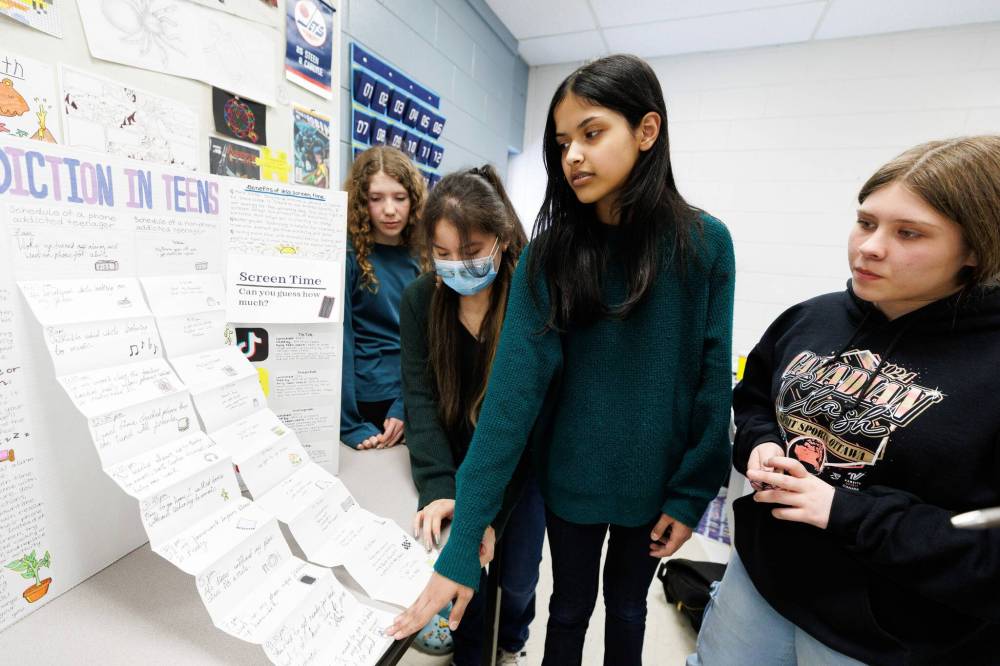
General Byng School grade 8 students (from left): Jamie Plett, 13, Talena Perch, 14, Divisha Sharma, 13, and Lily Crittin, 14, explain their Upstander project called, Phone Addiction in Teens. (Mike Deal / Free Press)
Lowes and his colleagues began tasking their students with researching rights and societal issues they cared about and educating others on them in the pursuit of positive change.
The project-based lessons attracted the attention of the CMHR — where Lowes is now the manager of education and program development — in 2017.
He has turned “Be an Upstander” into a flagship education program at the Winnipeg-based museum and recruited teachers from across the country to participate.
Lowes’ definition of an “upstander” is someone who knows their personal strengths, be it creativity, public speaking or otherwise, and leverages them to act on injustice.
While CMHR recognizes anti-apartheid activist Nelson Mandela and Malala Yousafzai, who has advocated for girls’ rights to education in Pakistan, as upstanders, the Winnipeg teacher said he wants students to know they do not need a Nobel Peace Prize to claim that title.
Last year, more than 600 final upstander projects were selected to be on display at the CMHR’s spring showcase.
The local contenders for the 2024 exhibition include projects out of General Byng School about topics ranging from racism in classrooms to climate change.
The Fort Garry school opened its doors to families on Tuesday evening to scan the student-made exhibits, including dioramas and poster boards that have been in the making for the last three weeks.
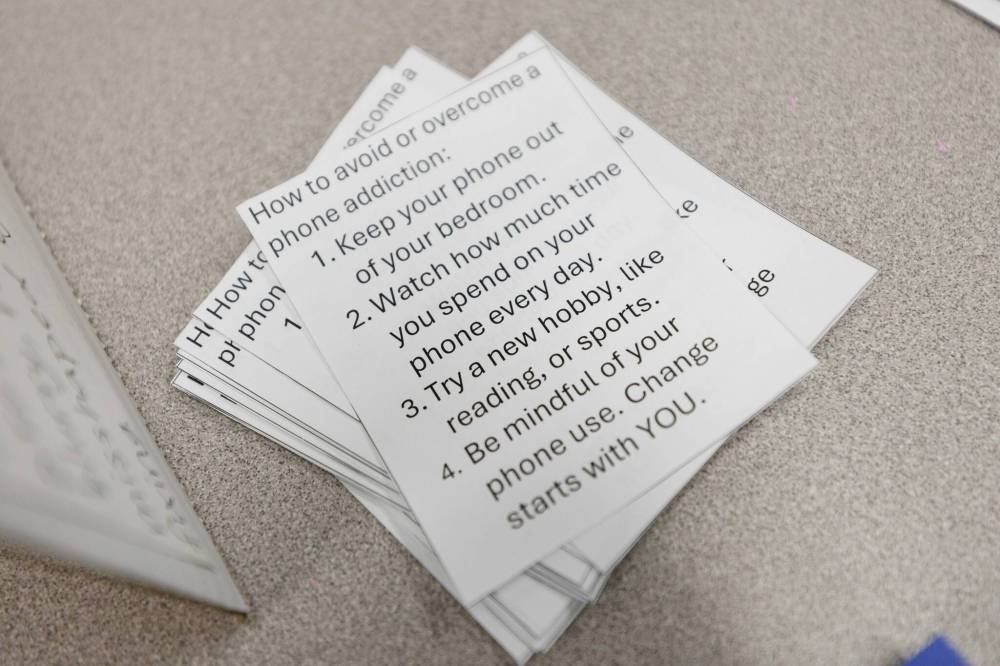
Materials from General Byng School grade 8 students’ Upstander project called Phone Addiction in Teens. (Mike Deal / Free Press)
“It gives kids agency. It provides them with the sense that they can do something about the problems that they see,” said Matt Reimer, a teacher at the kindergarten-to-Grade 9 building in Winnipeg’s Pembina Trails School Division.
“They take pride in that, too, and being able to share their opinions and their beliefs.”
One group of Grade 8 girls chose to study cellphone addiction in teenagers and promote mindfulness to tackle the anxiety that can accompany overuse.
“I can relate to this topic a lot,” said Lily Crittin, who indicated she spends anywhere from five to 10 hours on her cellphone daily.
The 14-year-old said she uses her phone to complete school work, although her most-used apps are TikTok and Snapchat.
Lily and her classmates created flyers to distribute to the public with suggestions on how to reduce screen time. Their list includes keeping a phone outside of the bedroom, monitoring phone use and trying out hobbies unrelated to technology, such as reading and sports.

“Be mindful of your phone use. Change starts with YOU,” the tip sheet states.

Graham Lowes, digital learning specialist at the Canadian Museum for Human Rights, in 2021. (COLIN CORNEAU / CMHR)
“There’s a huge amount of kids who feel anxious or uncomfortable or unable to concentrate without the presence of their phone,” said Divisha Sharma, 13.
Divisha said a balance is needed so teenagers can both live in the moment and access the benefits of instant communication with their parents and other people in their lives. Students need to be wary of the privacy concerns related to using social media, she added.
Members of the group said their research and writing skills have proved useful to spread awareness about the issue of nomophobia — the fear of being detached from one’s phone — and encourage mindful and careful use of their personal devices.
maggie.macintosh@freepress.mb.ca
Maggie Macintosh
Education reporter
Maggie Macintosh reports on education for the Free Press. Originally from Hamilton, Ont., she first reported for the Free Press in 2017. Read more about Maggie.
Funding for the Free Press education reporter comes from the Government of Canada through the Local Journalism Initiative.
Every piece of reporting Maggie produces is reviewed by an editing team before it is posted online or published in print — part of the Free Press‘s tradition, since 1872, of producing reliable independent journalism. Read more about Free Press’s history and mandate, and learn how our newsroom operates.
Our newsroom depends on a growing audience of readers to power our journalism. If you are not a paid reader, please consider becoming a subscriber.
Our newsroom depends on its audience of readers to power our journalism. Thank you for your support.
Maggie Macintosh
Education reporter
Maggie Macintosh reports on education for the Free Press. Originally from Hamilton, Ont., she first reported for the Free Press in 2017. Read more about Maggie.
Funding for the Free Press education reporter comes from the Government of Canada through the Local Journalism Initiative.
Every piece of reporting Maggie produces is reviewed by an editing team before it is posted online or published in print — part of the Free Press‘s tradition, since 1872, of producing reliable independent journalism. Read more about Free Press’s history and mandate, and learn how our newsroom operates.
Our newsroom depends on a growing audience of readers to power our journalism. If you are not a paid reader, please consider becoming a subscriber.
Our newsroom depends on its audience of readers to power our journalism. Thank you for your support.
Advertisement Advertise With Us
Advertisement Advertise With Us