

NATO weighs a plan to provide long-term military help to Ukraine as Russian troops assert control
Advertisement
Read this article for free:
or
Already have an account? Log in here »
To continue reading, please subscribe:

Digital Subscription
One year of digital access for only $205*
- Enjoy unlimited reading on winnipegfreepress.com
- Read the E-Edition, our digital replica newspaper
- Access News Break, our award-winning app
- Play interactive puzzles
*First annual payment billed as $205.00 + GST for one year. This annual subscription will automatically renew at $233.00 + GST every 52 weeks (10% off the regular annual price of $259.35). Offer available to new and qualified returning subscribers only. Cancel any time.
To continue reading, please subscribe:
Add Free Press access to your Brandon Sun subscription for only an additional
$1 for the first 4 weeks*
- Enjoy unlimited reading on winnipegfreepress.com
- Read the E-Edition, our digital replica newspaper
- Access News Break, our award-winning app
- Play interactive puzzles
*Your next Brandon Sun subscription payment will increase by $1.00 and you will be charged $17.95 plus GST for four weeks. After four weeks, your payment will increase to $24.95 plus GST every four weeks.
Read unlimited articles for free today:
or
Already have an account? Log in here »
Hey there, time traveller!
This article was published 03/04/2024 (914 days ago), so information in it may no longer be current.
BRUSSELS (AP) — NATO is debating a plan to provide more predictable military support to Ukraine in coming years as better armed Russian troops assert control on the battlefield, the organization’s top civilian official said Wednesday.
“We strongly believe that support to Ukraine should be less dependent on short-term, voluntary offers and more dependent on long-term NATO commitments,” NATO Secretary-General Jens Stoltenberg said before chairing a meeting of the alliance’s foreign ministers in Brussels.
Earlier on Wednesday, Ukraine lowered the military conscription age from 27 to 25 to help replenish its depleted ranks after more than two years of war. A shortage of infantry combined with a severe ammunition shortfall has helped hand Russian troops the initiative.
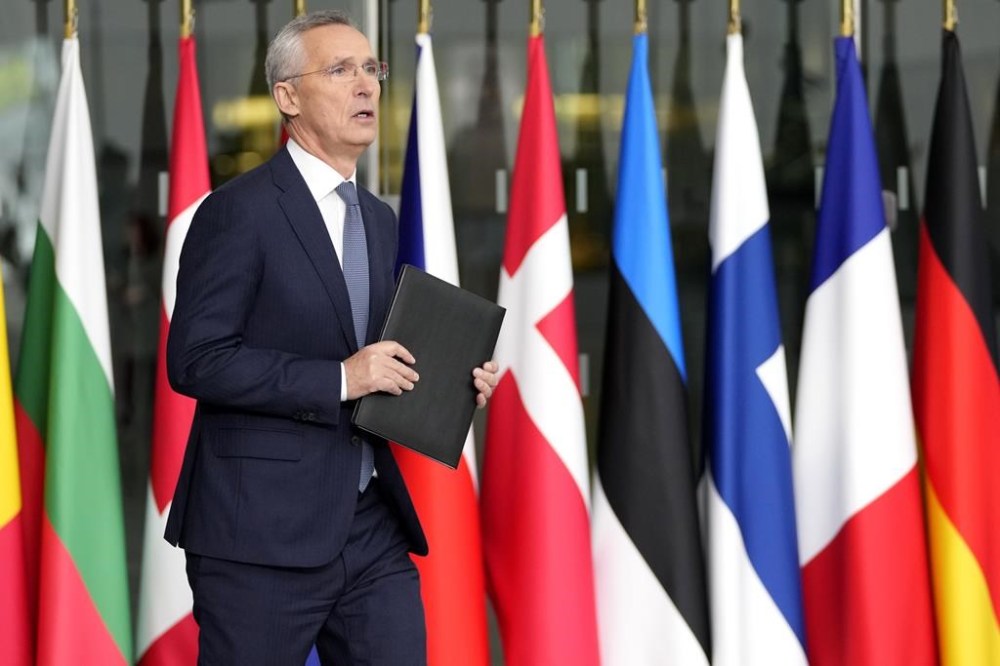
“The reason why we do this is the situation on the battlefield in Ukraine. It is serious,” Stoltenberg told reporters. “We see how Russia is pushing, and we see how they try to win this war by just waiting us out.”
The plan is to have NATO coordinate the work of the Ukraine Defense Contact Group — a forum of around 50 countries that has regularly gathered during the war to drum up weapons and ammunition for Ukraine — rather than the U.S. European Command.
U.S. Gen. Christopher Cavoli is NATO’s top military commander as well as the head of U.S. European Command, so the person in charge would not change. But Stoltenberg said a formal “institutional framework” is needed as the war drags on and that NATO can provide it.
While the move would not see NATO directly providing weapons to Ukraine — as an organization with 32 members that functions by consensus, the allies only agree to send non-lethal aid like demining equipment, fuel and medical supplies -– it would mark a new phase in its involvement in the war.
NATO is desperate to do more for Ukraine, particularly while Russia holds a military advantage, but its members are not ready to offer the country their ultimate security guarantee: membership. Nor do they want to be dragged into a wider war with a nuclear-armed military power like Russia.
Under the new plan, which is expected to be endorsed by U.S. President Joe Biden and his counterparts at their next summit in Washington in July, NATO would coordinate the military side of Ukraine support efforts by assessing Ukraine’s needs, collecting pledges and running meetings.
The Financial Times newspaper reported that the multi-year plan could involve up to $100 billion, but Stoltenberg declined to provide details.
Western pledges of support to Ukraine have been marred by broken promises. A European vow to provide 1 million rounds of ammunition fell woefully short, and financial aid meant for Ukraine’s war-stricken economy was delayed by political infighting in Europe and is still blocked in the U.S.
“It’s dangerous to make promises that we can’t keep,” Belgian Foreign Minister Hadja Lahbib told reporters when asked how much her country might be willing to contribute to a $100-billion fund. She said the plan requires more discussion.
Stoltenberg again urged Congress to overcome its differences and pass a supplemental spending bill, which includes roughly $60 billion in military aid for Ukraine, saying that the continued delay “has consequences” on the battlefield.
“That’s one of the reasons why the Ukrainians have to ration the number of artillery shells, why they have problems standing up against the Russian force with overwhelming military power,” he said. Russian troops, he added, “are able to outgun them with more ammunition and more artillery.”
___
Associated Press Diplomatic Writer Matthew Lee contributed to this report.
___
Follow AP’s coverage of the war in Ukraine at https://apnews.com/hub/russia-ukraine
History
Updated on Wednesday, April 3, 2024 9:21 AM CDT: Adds video